Greetings fellow investors!
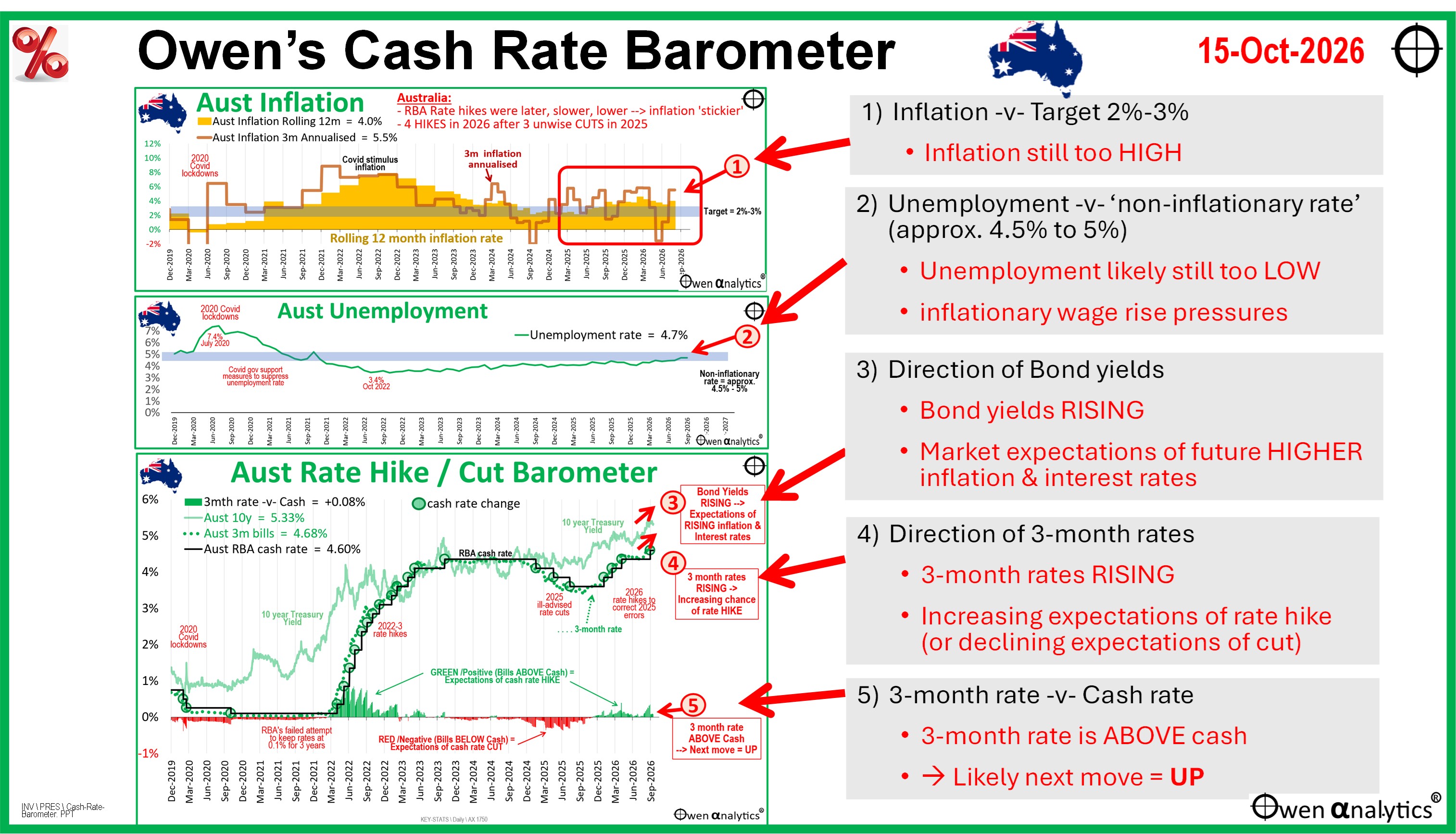
This is a model I have developed and used for the past 20 years managing portfolios. It is not always perfect, as it does not anticipate sudden events like the Covid lockdown, but I like it because it is fact-based, and reflects what the weight of money is saying, rather than ‘economists’ and so-called market ‘experts’.
The first 2 steps (inflation & unemployment) are the obvious starting points, but what they mean for interest rates is a matter of judgement and opinion, given problems with assumptions, data, lags, etc.
But the power is in steps 3, 4, & 5, which are NOT judgements or opinions, but factual indicators of what the WEIGHT OF MONEY is saying - ie where institutions are putting their money. I place more faith in the weight of money than opinions.
Here’s what the 5-step barometer is pointing to now:
STEP 1) INFLATION relative to the RBA’s target 2% - 3% range --> likely rate HIKES
On numerous measures, inflation is still running well above the RBA’s 2-3% target range. The RBA’s post-Covid rate hikes were later, slower, and lower than the rest of the world, and our inflation remains higher and ‘stickier’.
The RBA hiked rates 4 times in 2026 (but the first three were reversals of the three unjustified cuts in 2025), and inflation is still too high (fiscal policy has also been far too loose, as in other countries).
STEP 2) UNEMPLOYMENT relative to the ‘non-inflationary rate’ --> likely rate HIKES
Estimates of the theoretical ‘non-accelerating inflation rate of unemployment’ (‘NAIRU’) in Australia have varied widely over time, and is hotly debated. The Treasurer, Treasury, and RBA have different views, as do the usual gaggle of economists.
Currently NAIRU is probably around 4.5% to 5% Ie jobless rates below this tends to be inflationary. The RBA has said that it needs higher jobless rates to curb inflation, so the current rate of 4.7% is probably still too low.
STEP 3) DIRECTION of 10-year Treasury yields à likely HIKES
After going sideways during 2024 and most of 2025, yields on 10-year Commonwealth bonds have been rising since late 2025, telling us the weight of money fears higher inflation and interest rates ahead.
STEP 4) DIRECTION of 3-month rates --> likely HIKES
Rising short-term interest rates mean the weight of money is reflecting increasing expectations of an imminent rate hike (or decreasing expectations of a cut).
STEP 5) Current LEVEL of 3-month rate versus Cash rate --> likely next move UP
The green/red bars in the lower section of the bottom chart show that 3-month rates have been ABOVE the prevailing cash rate since late January 2026. They remained above the cash rate throughout the four rate hikes this year. Even after the 4th rate hike (29 Sep), the weight of money is still pointing to next move UP.
This tool has worked almost like clockwork for the past 20 years running portfolios. It is not always perfect, as it does not anticipate sudden events like the Covid lockdown, but I like it because it is fact-based, and reflects what the weight of money is saying, rather than ‘economists’ and so-called market ‘experts’.
Personally, I like rate hikes!
Professionally, I favour rate hikes in the currently environment because they will help tame the inflation beast, which is one of the largest and most pernicious threats to economic prosperity and investment returns.
Personally, I like higher cash rates because I have no debt, and higher rates mean more income for me! Higher interest rates hurt borrowers but they benefit depositors.
Despite what you might think from the continual flood of shrill media hysteria over rate hikes, there actually are a lot more depositors than borrowers in Australia!
Every bank deposit is actually a loan to the bank, which it on-lends to businesses which employ people, produce products and services we use every day, and generate the foreign exchange revenues we need to buy all of the foreign stuff we need to support our lifestyles.
We need more depositors, not borrowers!
For more on inflation and interest rates –
· How the RBA scores on its inflation goal? Somewhere between 3 and 10 out of 10. Overall I give it 8 out of 10. Why so high? (6-Jan-2026)
· Why are Australian cash rates HIGHEST in the world? Five simple reasons (20-Apr-2026)
· Australia’s highest cash rate in the world just got even higher – and the job’s not done yet! (5-May-2026)
· I wrote a year ago that the RBA should not cut rates. It did, but now has to correct its mistake – again! (29-Jan-2026)
‘Till next time – safe investing and stay healthy!