Sunday, September 20, 2026

linkedIn

Australia’s highest cash rate in the world just got even higher – and the job’s not done yet!

5 May 2026 4 month(s) ago 2 Comments

Last month I outlined five simple reasons why Australia has the highest cash rate among its peers, and I warned that further rate hikes were needed to tackle inflation -

Today (5 May 2026), the RBA hiked rates for a third time this year, and of course government blamed the war in Iran, but the fact is that inflation was already well above target BEFORE the war. See –

Following the RBA’s third rate hike today, here is my updated story on why Australian cash rates are highest in the world, and will probably need to go even higher to tackle inflation.  


The question of why cash rates are higher here than in peer ‘rich-world’ countries (chart A), and why further action is needed, are among the most common investor questions I receive from advisers.

The answer is fairly simple. It is because Australia has:

      • The highest inflation (chart B),
      • The highest medium-long-term inflation expectations ie highest treasury yields (C),
      • The highest central bank inflation target (D) – for no good reason at all,
      • The strongest jobs market eg lowest unemployment rate (E) (apart from Japan which has a declining population and workforce), and
      • The loosest / most undisciplined monetary and fiscal policies during and since Covid.
      • Bottom line: locked-in structurally higher inflation

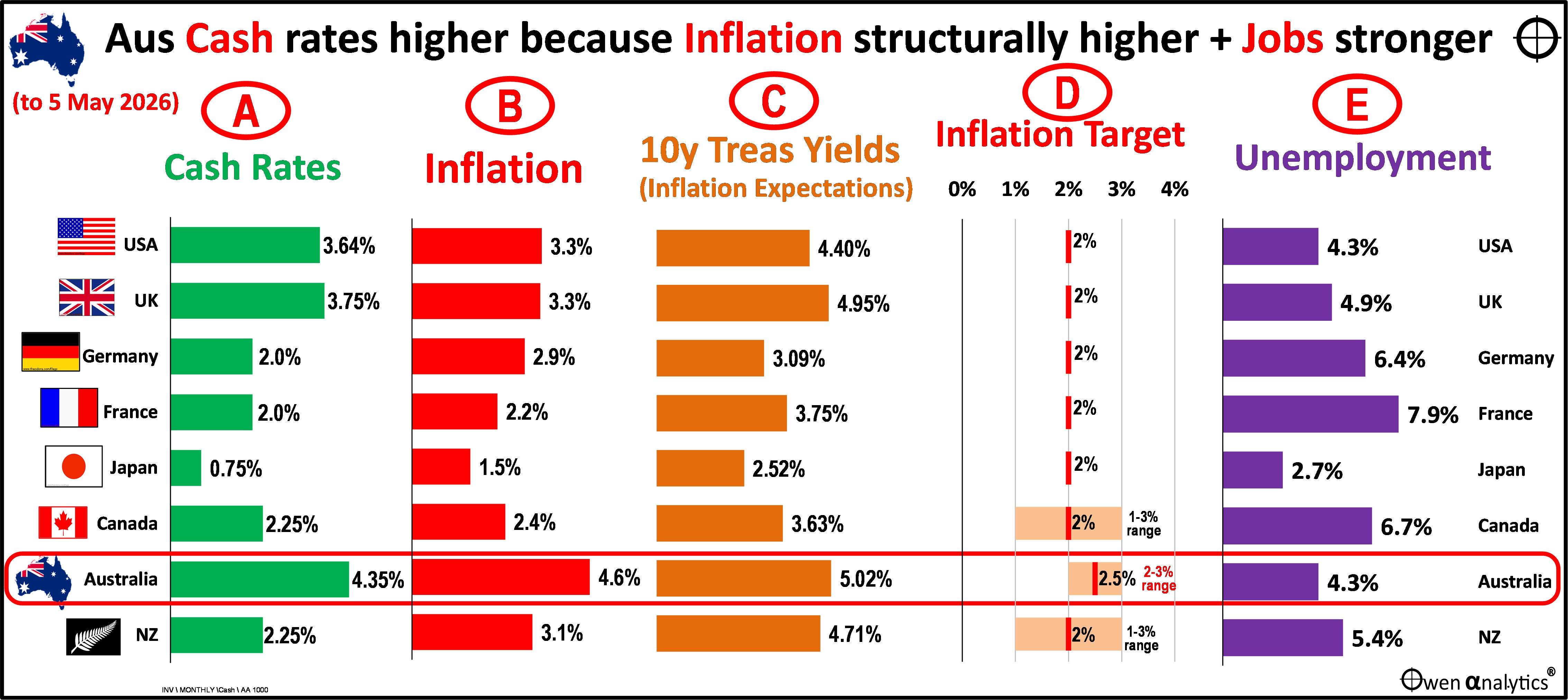
Here is the updated chart (to 5 May 2026):
 

Cash Rates (A)

Australia’s 4.35% cash rate (up from 4.1%) is much higher than in peer ‘rich world’ countries. (There are plenty of other countries with higher interest rates of course – including Venezuela with 58%, Turkey 37%, Zimbabwe 35%, Argentina 29%, Nigeria 26%, Brazil 14.75% and others, but they are not our ‘rich country’ peers.)

High cash rates are more important in Australia than in any other country because we have the highest proportion of variable/floating rate mortgages in the world. The rest of the world relies much more on fixed rate mortgages, which are far less sensitive to changes in short-term cash rates.

Accentuating the problem is the fact that we have most indebted household sector.

Australia is the only country to have had to switch from rate CUTS to rate HIKES this year, after the RBA’s three unnecessary rate cuts in 2025 (February, May, August). Those 2025 rate cuts were unnecessary because inflation was running above target, the economy was running above capacity, and unemployment was low, fuelling inflationary wage claims that were supported by profligate state and federal governments.

At the start of this year I warned of the need for the RBA to reverse its 2025 rate cuts -

Inflation (B)

Australia’s CPI inflation was already running at a rather high 3.7% to February (BEFORE the Iran war), well above its peers. This shot up to 4.6% in March as higher fuel prices flowed directly and indirectly through to several categories of spending, not just fuel.

This remains well above peer countries, which also posted inflation increases in March.

Inflation expectations – bond yields (C)

Australia also has the highest medium to long-term inflation expectations, expressed in yields on 10-year government bonds (and for all other maturities / terms for that matter).

This means current and future taxpayers pay more interest on government debt, as federal and state governments have to borrow to finance their wild spending deficits, and also refinance the existing piles of debt.

Central Bank inflation target (D)

A much deeper problem is that the Reserve Bank of Australia has always had the loosest / highest /laziest inflation target in the world. Why? There is no good reason or excuse for this (apart from historically higher inflation).

There is no philosophical or ethical justification for a government to deliberately set ANY positive target for inflation – ie to deliberately engineer CONTINUALLY rising prices, and continually debasing the value of its mandated monopoly currency in the hands of its citizens. Deliberate price inflation / currency debasement (even 1% per year) is nothing more than officially sanctioned theft of citizens’ wealth.

Governments love high inflation because it means high interest rates, so they can lure in lenders (bond holders) to finance their debts, and then repay them in the distant future with debased currency worth a faction of its current purchasing power.

High structural inflation

The reason or excuse for Australia having the highest inflation target in the world – ie the most aggressive money debasement and theft of citizens’ wealth, probably has its roots in our Federation pact.

The formation of Australia at Federation in 1901 was based on three central features for the newly formed nation: (1) high protection barriers to keep out cheaper foreign goods, (2) restricted ‘White Australia’ immigration policy to keep out inferior, low-wage, non-white labour, and (3) centralised wage fixing/indexation to redistribute the windfall profits from protected industries to the protected workforce.

Today both the White Australia immigration policy, and the industry protection barriers are (mostly) long gone, but for some unknown reason we still have the heavy-handed, centralised wage fixing and indexation system, which is a relic from the distant protected past, and now unique in the world.

An additional inflationary feature of Australia’s industry structure is that just about every domestic industry (eg banks, retailers, telcos, utilities, toll roads, airlines, ASX, ports, etc) is a monopoly/oligopoly where the dominant incumbents can simply pass on rising input costs to consumers in the form of higher prices, rather than being borne by shareholders.

In addition, Australia has had the highest population growth rate in the world (outside of Africa) since Federation, and still has. It also has one of the best (youngest) demographics of any ‘rich’ country.  See –

These factors combine to result in Australia’s higher structural inflation, which is reflected and perpetuated in our higher central bank inflation target.    

Low unemployment (E)

We also have the lowest unemployment rate in the rich world, aside from Japan which has a declining population and declining workforce.

An additional problem for Australia is the fact that the vast majority of hiring is for the government sector or ‘non-market’ (private sector but revenues/prices are set by government – eg all those private suppliers to government services like NDIS, Home Care packages, construction contracts on public works, etc).

Currently the US also has a 4.3% unemployment rate like Australia, but Australia has a higher workforce participation rate of 64%, compared to 61.9% in the US, so our jobs market is tighter.

Making matters even worse is our much larger proportion of government and government-related employment, which is driven by black-cheque hand-outs and universal (non-means-tested) welfare programs.

Poor monetary and fiscal policies

The RBA and federal/state governments share the blame for the post-Covid inflation we are still suffering. However, true to form, both sides now conveniently divert the blame for rising energy prices to Russia’s 2022 invasion of Ukraine, and now the 2026 US/Iran war.

The fact is that the RBA woke up to the Covid stimulus inflation later than the rest of the world, then it hiked interest rates to attack inflation LATER, SLOWER, and LOWER than other central banks.

Then, for some unknown reason, the RBA CUT rates unnecessarily in 2025 when inflation was still running above target, when the economy was running at or above full capacity (inflationary), the unemployment rate was still low (also inflationary), and the government was backing double-digit wage claims.

Meanwhile, federal and state governments have squandered windfall revenue gains from raw material export booms, run war-time-like deficits on mad un-costed spending sprees, run up war-time-like debt piles, supported inflationary wage claims, and wound back four decades of productivity-enhancing industrial relations reforms.

The next time you (or your clients) wonder why Australians suffer the highest interest rates in the ‘rich’ world, and why the RBA is hiking rates well ahead of the world - you have some answers!

‘Till next time – safe investing and stay healthy!


See also –

(this includes a history of how the RBA’s inflation target came to be)


For my latest monthly report on global markets for Aussie investors –


Related Articles

2 Comments

Existing Comments

Sharp and to the point.

In 2025 the headline inflation rate was reduced by temporary energy "handouts"

The Reserve Bank decided to look though this and reduced rates prior to the election. The RBA having a new governor and Board would have also assisted in acceptance of the "politically" driven timing as a reality. Econmonic commentators (not necessarily the most skilled macroeconomists) in the media subscribed!

In 2026 it is already apparent Jim Chalmer's approach will use intergenerational equity as the smokescreen for lack of progress on icreasing housing supply which is the other big factor (in addition to energy) driving inflation.

There are many factors significant in the housing debate - level of migration (demand); lack of labour supply (also impacted by the government spend on large infrastructure projects - often off budget) which drive labour cost inflation; lack of productivity improvement .... etc; but predicatably the failure by goverment to address these factors will be smokesceened by a debate on taxes and equity. And again the economic commentators in mass media will buy in!

Paul Keating understood the habits of chooks but did get reforms made. Jim Chalmers unfortunately just knows how to feed them.

Michael
May 06, 2026

Hey Michael - thanks for the comments! Hard reforms that hit voters are near impossible because voters have to (a) accept the medicine and suffer some pain, and (b) believe in some sort of coherent plan and trust government the pain now will be worth it later.
This requires (c) government to truly believe that there is NO CHOICE, and (d) voters TRUST governments and ACCEPT the vision and strategy.
For the radical and far-reaching reforms from 1983 to early 2000s, Hawke/Keating/Kelty actually did believe there was no choice/ They had a fairly clear vision and strategy - although it was very VERY scary - remove industry protection, wind back union dominance, allow work place flexibility, give up automatic wage indexation for productivity gains + compulsory super, sell off government sacred cows like CommBank, Telstra, Qantas, etc.
The ONLY reason they made these decisions and were able to sell it to voters was the fact that the 1970s double-digit inflation, double-digit unemployment, daily strikes across numerous industries, negative real interest rates, and falling real asset prices were in VERY recent memory - they had all just lived through a decade of economic and social disruption.

Problem is that the 1970s decade of double-digit inflation, double-digit unemployment, daily strikes across numerous industries, negative real interest rates, and falling real asset prices are now either very distant memories (for boomers and older), or not even contemplated or understood at all (today's gen-X/Y/Z).

Bottom line - there is no urgent need or desire for action. And there is no coherent vision or strategy of a better future after some short-term pain. There is virtually no tolerance of any pain - voters have got used to massive increases in government interference and hand-outs to just about everybody (Hawke/Costello's middle-class welfare, and now Labor's universal welfare).

All funded by 25 years of windfall resources booms since the early 2000s. And looks like continuing for many years yet.
No urgent need to change anything while the money keeps rolling in!

cheers
ao

ashley owen
May 06, 2026

Leave a Reply

Ashley Owen


Please subscribe to my Newsletter, connect on LinkedIn, or follow me on Twitter X 


Experiences


Director/Principal, Owen Analytics Pty Ltd (current)

Investment Markets Research & Analytics, Portfolio Construction & Management, Corporate Finance, Venture Capital, M&A, and IPOs. Investment Committee membership, consulting to advice firms and financial institutions.

Co-founder & Regular Contributor, Firstlinks (current)

Co-founder of Australia's leading investment and superannuation newsletter and website for industry professionals and investors.

Non-exec Director, Third Link Investment Managers (current)

Leading Australian equities fund-of-funds that donates all management fees to Australian charities. The fund has donated in excess of $21m to a range of Australian chartities since inception in 2008. 

Chief Investment Officer, Stanford Brown (past)

Responsible for managing over $2 billion AUM in multi-asset class portfolios and discretionary accounts at a privately-owned advice practice.

Director & Joint CEO at Philo Capital Advisers Pty Ltd (past)

Specialises in investment portfolio construction & management, multi-asset class asset allocation, and global macro strategies.

Check out my full bio here

“Ashley has the rare ability to ground insightful analysis in solid data and to present it in readily understandable ways. His wry, detached style and focus on the long term is rare and willingness to share a lifetime of learning and thinking appreciated by all who come to know him.”

Toby Potter - Chair, Institute of Managed Account Professionals (‘IMAP’), the peak industry body for the discretionary managed accounts industry in Australia, representing investment managers,  advisers, Managed Account providers, and technology companies. It is the primary thought-leader for the industry in Australia, and provides training and industry events and conferences.

“Ashley is one of the best writers and thinkers on financial markets in Australia. His unique analysis and research is always fact-based and insightful, not the usual uninformed market noise and waffle that infects the mainstream financial media.”

Graham Hand - Editorial Director of Morningstar Australia, including Founder/Managing Editor of FirstLinks, Australia’s leading newsletter and publishing service on wealth management, superannuation, and personal finance.

“Over the past 20 years, Ashley has been an invaluable assistance to me, as a reliable source of unbelievably strong and interesting data, and many good investment ideas.” 

"The depth and quality of Ashley’s research and analysis of investment markets is the best in the business.”

Dr Don Stammer - Australia’s most respected economic writer, commentator, and speaker for the past 40 years, with a distinguished career including the Reserve Bank of Australia, Chief Economist at Deutsche Bank Australia for 21 years, chair of nine ASX companies, plus numerous non-listed and not-for-profit boards.

‘For many years, Ashley has been my go-to source of information and analysis on what’s going on in financial markets and why.’

“Ashley has an encyclopaedic knowledge of the markets – I call him Mr Google!”

Noel Whittaker, AM – Australia’s best-known personal finance writer, columnist, and media commentator for the past three decades. He has written more than 20 books on personal finance, his regular columns on personal finance are published in almost every major Australian newspaper, and he appears regularly on radio and TV as an expert on finance and investing.

“Ashley’s unique fact-based analyses and insights into Australian and global markets are always worth reading. He has an incredibly deep and comprehensive store of financial markets data.”

Chris Cuffe, AO – One of Australia’s best known and most experienced investment managers – former CEO of industry giants Colonial First State, then Challenger Financial; founder and Chair of Australian Philanthropic Services, and Third Link Growth Fund; current/former chair, director and/or investment committee member of numerous funds including UniSuper, Argo Investments, Hearts and Minds Investments, Paul Ramsay Foundation, and many others.

“What sets Ashley Owen’s analysis apart from investment banks and the financial press is his deep fact-based understanding of long-term financial data, rather than getting caught up on the daily noise over issues that may generate trades or sell newspapers today, but will be irrelevant and misleading two years from now.” 

Hugh Dive, CFA. Chief Investment Officer, Atlas Funds Management, and frequent expert commentator quoted in the AFR.

"I read all of Ashley's research on financial and economic issues. His data resources, deep knowledge, and original analysis put him in a class of his own."

Ian Macfarlane AC - Former Governor, Reserve Bank of Australia (Australia's central bank), 1996-2006. Former Director, Woolworths, Leighton Holdings, and ANZ Bank. Also on the International Advisory Boards of Goldman Sachs (2007-2016),  the China Banking Regulatory Commission (2011-2014), and director of the Lowy Institute for International Policy (2004-2017).

Copyright © 2026 Owen Analytics

About Ashley Owen | Terms and Conditions | Privacy Policy | Archive | Disclaimer

The information contained in this document relates to historical, factual events and returns, and contains general commentary and observations about financial markets, asset classes, and asset allocation. This document, or any part thereof, does not, and is not intended to, constitute investment advice, or financial advice, or financial product advice, in any jurisdiction in which it is published, re-published or read. It does not recommend, encourage, or influence readers to buy, hold, sell, or deal in any financial product or security. Where securities of financial products are mentioned, it is purely for the purposes of illustration, context, and/or education, and not intended to influence anyone to buy, hold, sell, or deal in it. The information is current when written. All reasonable measures are taken to ensure its accuracy at the time of publication, but the author accepts no responsibility or liability for any errors or omissions. This document is only provided to, and intended for, holders of Australian Financial Services Licences. It should not be used or relied upon by any person or entity other than a duly licenced AFSL holder, or authorised representative thereof. The author receives no benefit, financial or otherwise, from any product provider, or product issuer, or any other firm involved directly or indirectly in the provision or services in or to financial markets or industries, whether mentioned in the report or not. Any opinions expressed by the author are his alone, and are intended for the purposes of education.