This is a quick report on my colorectal cancer surgery on 8 January 2026 and first week of post-op. Recapping the lead-up:
I had a very busy December. A day after returning from a big family wedding in Malaysia, I received a positive result from my recent test as part of the Australian government’s National Bowel Screening Program. Further tests, scans, colonoscopy, and biopsies prior to Christmas revealed that I had a cancerous tumor in my right/ascending large intestine, plus some nearby related indications.
This was literally while I was doing my usual year-end review and goal-setting -
- My Life in Weeks: 83% done, but there’s a nasty new twist this year. “Life’s like a box of chocolates. . .” (4-Jan-2026)
Surgery booked in for 8 January at North Shore Private (which fortunately is a 10-minute walk from home). ‘Hemicolectomy’ procedure to remove about 25cm (the right side) of my large intestine, plus appendix, junction with small intestine, surrounding tissues and lymph nodes. ‘Da Vinci’ robotic surgery operated by surgeon via six cuts through the abs across the belly area.
My surgery goals:
After discussions with GP, surgeon, anesthetist, and a bit of digging around to read up on what to expect, I set five main goals for the surgery and post-op.
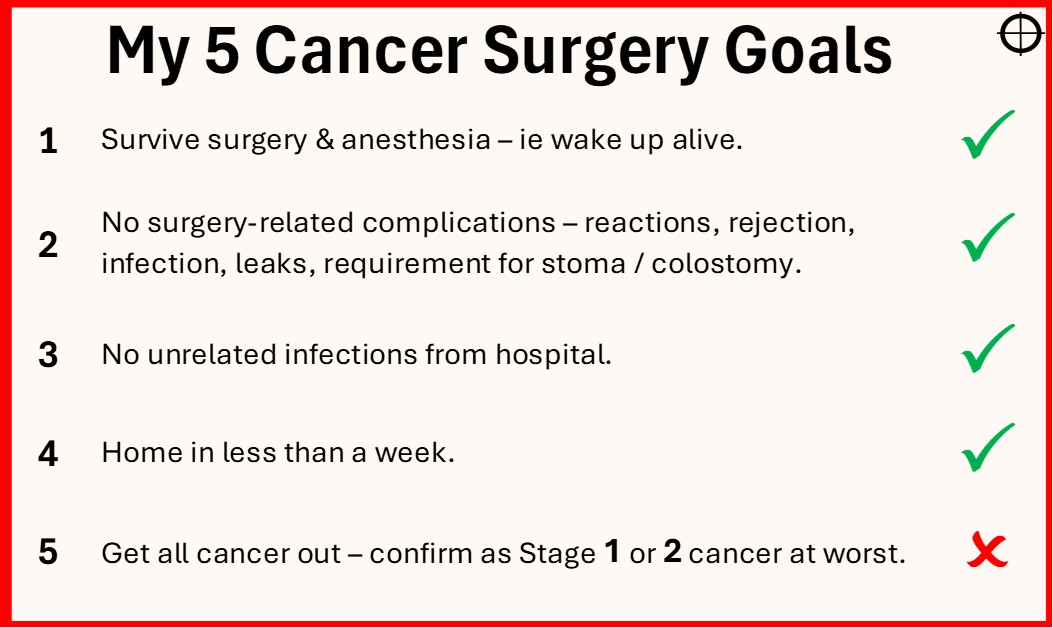
It seems I got 4 out of 5. Could have been a lot worse but could have been better!
Brief comments on each goal:
1. Survive surgery & anesthesia – ie wake up alive
With any surgery and general anesthetics, there is always a very small chance of not making it through. This may be a low-bar goal, but it’s not a bad place to start, especially given my medical allergies (known and possible as yet unknown).
I had an uncle who had a ‘routine’ minor back surgery many years ago, went into a coma while under, and died a year later without ever waking up. True, there have been enormous medical advances since then, but still a remote risk.
2. No surgery-related complications
Ideally there would be no surgery-related complications – eg reactions, rejection, infection, leak or failure in the new small/large intestine junction, or requirement for stoma / colostomy.
Biggest factor here is the skill of the surgeon, anesthetist and medical team.
3. No unrelated infections from hospital
From numerous experiences of family and friends over many years in many different hospitals in Australia and other countries, I have learned that avoiding/surviving hospital-based infections is actually an achievement in itself.
4. Home in less than a week
This depends of course on a host of different factors in each individual case, but my aim was to be well enough to be out and home within a week. In my case it was under five days.
Here’s a brief summary of my post-op time in hospital:
Night after surgery: mostly vomiting, severe pain, tangle of tubes.
Day 1 post-op: severe pain/discomfort, trying to find effective nausea drug combos. Less vomiting.
Day 2 post-op: still very groggy, pain levels lower, some soft foods, mostly resting, sleeping.
Day 3 post-op: pain levels lower, mentally back with it, bit of physio, mostly out of bed.
Day 4 post-op: pain levels lower, more food, getting bladder & bowel working. Weaning off drugs.
At home: main issue is managing base-level pain across mid-section, trying to minimize sharp stabbing pains, getting around without abs, managing food intake, getting digestive functions back to normal, increasing activity.
5. Get all cancer out – confirm as Stage 1 or 2 cancer at worst
This is the BIG one. I was hoping that the cancer would be contained to Stages 1 or 2, meaning ‘early stage’ and confined to the initial primary site, so high probability that it was removed by the surgery.
However, in my case, following the operation and post-op tests and biopsies, it has been diagnosed as ‘Stage 3‘ (‘Advanced Localised’). Cancer has spread from the primary site and taken root at ’advanced’ levels in some other nearby areas – including some of the lymph nodes they took out, and there is a good chance it has gone further and/or there are microscopic bits left behind.
Bugger.
At least ‘Stage 3’ is better than ‘Stage 4’, which is ‘advanced’ in a wider area and other parts of body.
What it is likely to mean
For me the next steps are recovery from the surgery over the next month or so, further tests/scans, and discussions with surgeon and oncologist about further treatment options, eg chemo, etc.
Bottom line – with Stage 3 cancer, the initial surgery was not the end of the problem, just the beginning.
Statistically, this reduces my median life expectancy by around 30% (based on Australian data), so I will update my ‘Survival Probability Curve’ in due course. (That is just the ‘median’ of course – half will die earlier, the other half will live longer.)
It will mean some changes to diet and lifestyle, although I have very few of the ‘risk factors’, but certainly big changes to how I prioritise my time, energy, focus.
Rich world problem
NB this is very much a ‘rich world problem’ of course. I am extremely lucky to live in Australia with its excellent public and private health and hospital systems, ‘free’ government cancer screening programs, availability of highly skilled professionals, and comprehensive private health insurance system.
I will write soon on colorectal cancer – What is it? What causes it? How prevalent/deadly is it? Survival rates?
‘Till next time – safe investing, stay well, and best wishes for 2026!
A note on terminology
Different terms are used in different countries, but it seems the terms ‘bowel’ cancer, ‘colon’ cancer, and ‘colorectal’ cancer are used interchangeably in most contexts, as they all refer to cancer in the digestive system beyond the small intestine stage – ie in large intestine (colon), and/or rectum. Technically, ‘colorectal’ and ‘bowel’ refer to the large intestine (colon) plus rectum, whereas ‘colon’ refers to just the large intestine, but all three terms seem to be used interchangeably in reporting and statistics.
I received my cancer diagnosis literally while I was doing my usual year-end review and goal-setting -
- My Life in Weeks: 83% done, but there’s a nasty new twist this year. “Life’s like a box of chocolates. . .” (4-Jan-2026)
On life expectancy and how do construct your own ‘Survival Probability Curve’, see -
For my 2025 year-end wrap-up of local & global markets for Aussie investors: