Key Points:
- As SpaceX is priced at crazy multiples of profits, dividends, cash flows and assets, and is based on outlandish growth assumptions, it is not an ‘investment’ but rather a pure speculative bet that I might consider if is a potential ‘10-bagger’ or ‘100-bagger’ (and bought with ‘play money’, not money I or my family will be relying on in future).
- So, how does SpaceX stack up as a speculative bet?
- I been lucky enough to have had the odd ‘10-bagger’ over the years (ie gained 10-fold or 1,000%) but I have only ever found one ‘100-bagger’’ (10,000% gain), and it turned out to be a ‘1,000-bagger’ (100,000% gain).
- I bought into Fortescue Metals Group (FMG) in 2003 at 27 cents per share (or 2.7 cents after the 10:1 split in 2007). It turned into a ‘100-bagger’ in late 2024 when the share price reached $27. It has been the only 1,000-bagger I have ever found, and I don’t expect to find another one in my lifetime.
- (Note that it was certainly not ‘investing’, but a pure speculative bet that paid off, big time).
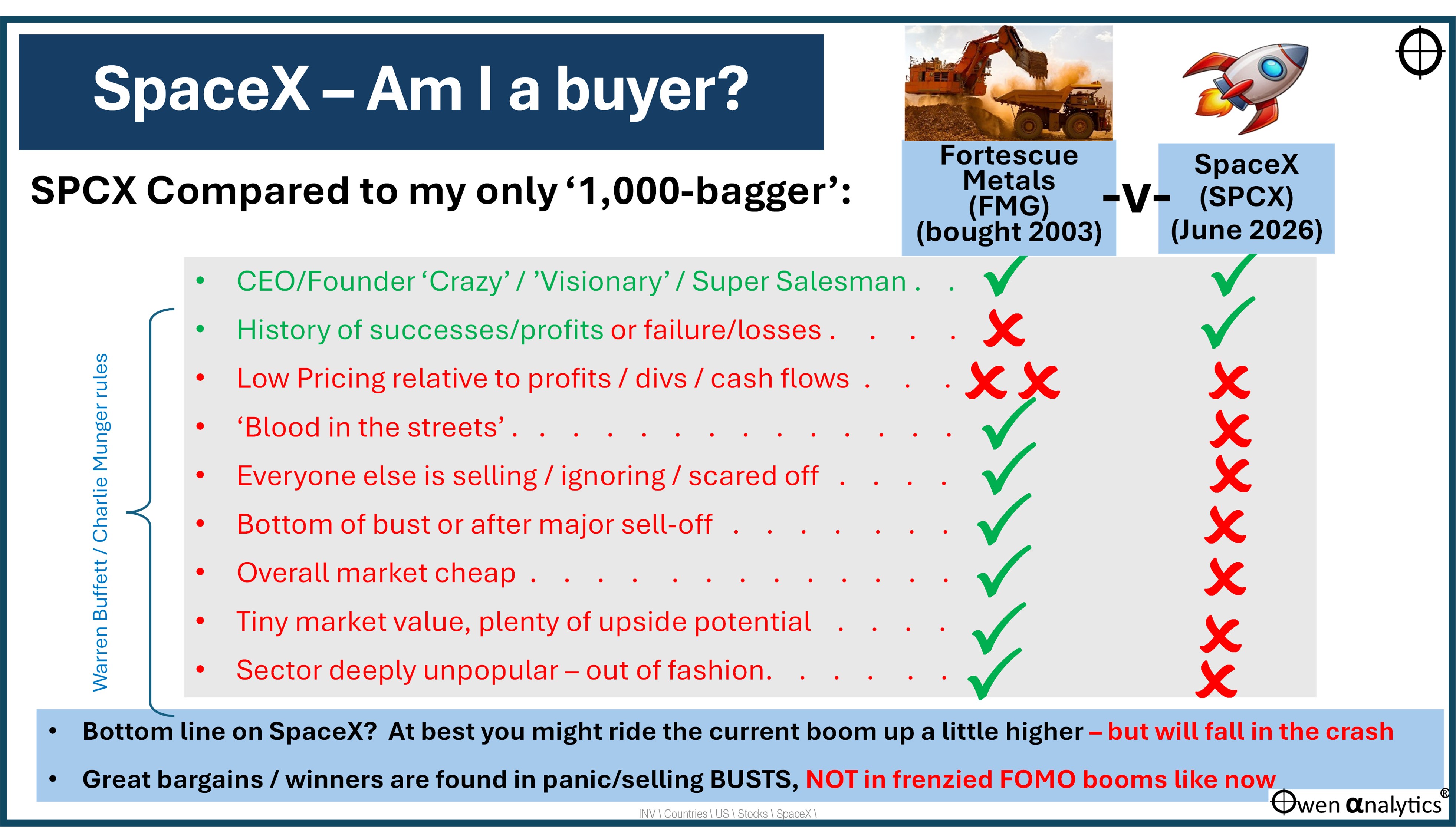
- So here is my quick summary of how SpaceX stacks up against my one and only 1,000-bagger, FMG.
- They get very different scores on 7 out of my 9 tests.
- Apart from both having crazy pricing and growth assumptions (test 3), the only other common factor is the fact that both are majority owned and run by crazy/visionaries (Elon Musk and Andrew Forest) who are also superb salesmen who could sell pretty much anything to anyone (test 1).
- Seasoned investors would know that eight out of the nine tests (all bar test 1) are straight out of the Warren Buffett / Charlie Munger playbook on how to pick winning companies.
- The problem is that SpaceX fails 7 out of the 9 tests (3 to 9).
- Great companies can be bought at great prices, but is is generally:
-
-
- when pricing is low relative to fundamentals like profits, dividends, cash flows, assets
- when there is ‘blood in the streets’ – ie general investor fear and panic-selling
- when everyone else is selling or ignoring the company or scared off
- at the bottom of a bust or after a major sell-off
- when the overall market environment is cheap
- when the company is small relative to the market – has plenty of room to grow
- when the sector is deeply unpopular and out of fashion.
- FMG in 2003 had the benefit of each of these tests, but for SpaceX, each is the exact OPPOSITE.
- We are currently in the late-ish stage of a crazy speculative boom driven by a FOMO frenzy, on pricing multiples not seen since the top of the late 1990s ‘dot-com’ craze right before the 2000-2 ‘tech-wreck’ and deep US/global recession, and also the late 1920s, right before the 1929 crash and 1930s Great Depression. In big market corrections/crashes, everything is sold off in the general panic, regardless of merit or fundamentals.
- Bottom Line? - if I were to buy into SpaceX in the current environment, I may ride the current FOMO boom a little higher, but it will most likely fall heavily when (not if) the current boom ends. Unless Musk can grow profits to at least $1 trillion or so per year. Anything is possible I guess!
- TIMING is just as important as PRICING – and both are lousy in the case of SpaceX.
- If you are patient, you may be lucky and find your 100-bagger (bought with play money of course, not serious money you or your family will be relying on in future), but you’re unlikely to find it in the middle of an over-priced boom when people are literally throwing money at everything.
- Look for the opposite – always go against the crowd.
- I could be wrong of course – let’s check in 10 years’ time.
Greetings fellow investors.
Elon Musk’s SpaceX hits NASDAQ this week after raising a whopping US$75B in cash, bringing its total theoretical IPO market value to US$1.8 Trillion. It is by far the largest IPO in the history of the world (in nominal terms and probably also adjusted for inflation and GDP).
Essentially SpaceX has three businesses: the profitable and growing Starlink satellite internet business, plus two giant money pits – rockets and ai. Much has been written and said about the company and the IPO pricing, so I won’t attempt to summarise it here. Suffice to say that it is also probably the most expensive IPO – relative to profits, dividends, free cash flows, and hard assets.
Would I buy it?
Given the speculative ‘blue sky’ nature of the businesses, their growth assumptions, skinny asset backing, and astronomical pricing, I would only buy it as a highly speculative punt if I thought it could realistically be a 100-bagger or even better (ie share price rises at least 100-fold or 10,000%).
That would require the market value to rise from US$1.7Trillion to $170Trillion – ie worth more than twice the current market value of the entire US share market.
My only ever ‘1,000-bagger’
Fortunately I been lucky enough to have had the odd 10-bagger over the years (ie gained 10-fold or 1,000%) but I have only found one 100-bagger, and that turned out to be a ‘1,000-bagger’(gained 100,000%).
I bought 100,000 shares in Fortescue Metals Group (FMG) in September 2003 for 27 cents per share. The shares split 10 for 1 in December 2007, so I effectively owned 1 million shares at 2.7 cents per share. It became a 100-bagger in December 2024 when the share price rose above $27. Today it is back to around $20 per share.
Why I bought FMG shares is another story for another day. It was tiny speculative mining stock with virtually no operations, no hard assets, no income and certainly no profits or dividends. It was run by a fast-talking spruiker (Andrew Forest) who had just caused massive losses for shareholders and bondholders when ran Anaconda Nickel into the ground only a couple of years earlier (which I viewed from a safe distance!), and he had no experience in iron ore, nor in building or running anything profitable.
In terms of timing - 2003 was the aftermath of a major market crash (the ‘tech-wreck’ that ended the late 1990s crazy ‘dot-com’ boom). Commodities prices including iron ore had been falling for two decades, and you literally could not give away speculative mining shares because mining and commodities were deeply out of favour in the new ‘wired’ world of internet and ‘dot-coms’.
Let me be very clear on one thing – buying into FMC (and a bunch of other miners at that time) was not ‘investing’ it was pure speculation, but it paid off.
2003 turned out to be great timing because it was the start of the great China/Commodities boom, when commodities prices soared and iron ore became Australia’s largest export commodity. It was mainly BHP and RIO, but FMG did manage to build a small operation mining and selling iron ore to China – at lower volumes, at lower grades, and with higher costs than the majors.
Anyway, given my buying price was just 2.7 cents per share, I had sold out by 2013. So FMG was only a ‘200-bagger’ for me.
(FMG’s share price rose 200-fold in the first 10 years after I bought in 2003, but then rose another 5-fold in the subsequent 11 years to late 2024 (making it a ‘1,000 bagger’), so I got the lion’s share of the total percentage gains in those first 10 years as a shareholder.)
SpaceX -v- FMG
As SpaceX is a pure speculative bet, priced at crazy multiples of profits, dividends, and cash flows, and based on outlandish growth assumptions, I would only buy it as a potential ‘100-bagger’ or ‘1,000-bagger’.
So the table is my quick summary of how SpaceX stacks up against my only 1,000-bagger, FMG, in the form of nine factors.
Apart from both having crazy pricing and growth assumptions (test 3), the only other common factor is the fact that both are run by crazy visionaries who are superb salesmen who could sell anything to anyone (test 1).
Seasoned investors would know that 8 of the 9 tests are straight out of the Buffett / Munger playbook on finding winners.
The problem is that SpaceX fails 7 out of the 9 tests (3 to 9).
Great companies can be bought at great prices, but generally only:
-
- when pricing is low relative to profits, dividends, cash flows, assets
- when there is ‘blood in the streets’ – ie fear and panic-selling
- when everyone else is selling or scared off
- at the bottom of a bust or after a major sell-off
- when the overall market is cheap
- when the company is small relative to the market – has plenty of room to grow
- when the sector is deeply unpopular and out of fashion.
FMG in 2003 passed each of these tests, but it is the OPPOSITE for SpaceX.
We’re currently in the late stages of a speculative boom driven by FOMO frenzy, on pricing multiples not seen since the top of the late-1990s ‘dot-com’ craze before the 2000-2 ‘tech-wreck’ and deep US/global recession, and the late-1920s boom before the 1929 crash and 1930s Depression.
Bottom Line
If I were to buy SpaceX, I may ride the current FOMO boom a little higher, but it will fall heavily when (not if) the current boom ends. Unless Musk can quickly grow profits to $1 trillion or so per year. Anything is possible, I guess!
TIMING is just as important as PRICING – and both are lousy for SpaceX.
Kerry Packer once said 'You only get one Alan Bond in your life!' (Packer sold his publishing & broadcasting empire to Bond for $1billion at the top of the market in 1987 before the 1987 crash, then he bought it back for just $230m after the crash.) I have found one 1,000 bagger in my life (and I rode it for a 200-bagger) so don't expect to find another.
If you are patient, you may find your 100-bagger, but you won’t find it in the middle of an over-priced boom when people are literally throwing money at anything and everything.
Look for the opposite – always go against the crowd.
I could be wrong of course about SpaceX – let’s check in 10 years’ time.
‘Till next time – happy investing and stay healthy!
Visit my web site for hundreds of original articles on a wide range of topics for advisers, portfolio managers, and serious long-term investors.
https://www.owenanalytics.com.au/
- All completely free of charge. Free of conflicts. Free of ‘ai’.
- All original research and analysis.
- No ads, No marketing material, No sponsored material at all.
- Not ‘monetised’ in any way. No ‘revenue model’.
- Guaranteed No ‘hot stocks’, No ‘hot tips’.
- Guaranteed No ‘ai’. All human.
Enjoy!