The term ‘alternatives’ covers a wide range of ‘non-traditional’ types of investment, including hedge funds, private equity, venture capital, currencies, commodities, and the current ‘hot’ sectors: ‘private credit’ and ‘crypto’.
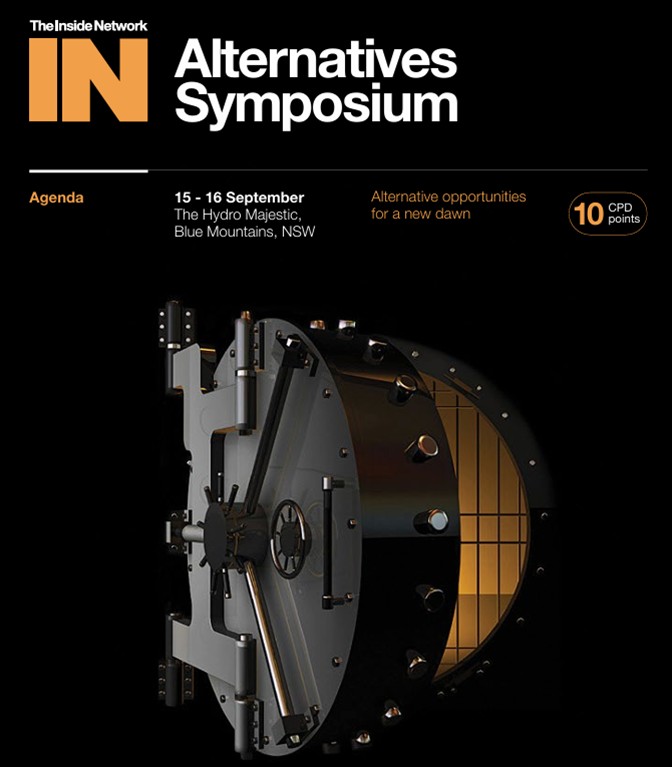
Here are my top 10 take-aways from The Inside Network’s symposium on Alternative Investments this week.
1.
For readers who are now asking ‘What does Alternatives mean?’ – that was precisely the subject of the first session – because there is no agreed definition. There is a general idea that ‘alternative’ means ‘not in the mainstream asset classes’, but that hardly helps because it raises the question – what is a regular or mainstream asset class?
Without clear definitions, it is hard to have meaningful discussions about different portfolios and strategies. Eg - Is real estate an alternative or a mainstream asset class? What about an ‘ever-green’ private equity fund? Or ‘private credit’? What about an ETF that holds listed private equity funds? etc.
This is vitally important because different client funds and portfolios containing exactly the same assets in the exactly same proportions might be classified as, say, a ‘60/40’ growth/defensive portfolio, or it might be ‘40/60’, or anything in between, depending on how each asset is classified. It is hard to compare funds – like the Future Fund or Aussie Super’s ‘Balanced’ fund because they use quite different definitions.
Or a client may think they are in a ‘Balanced’ fund on the brochure cover, but actually have a more aggressive asset mix if the assets were classified differently/correctly. Within the industry there is quite a bit of definition stretching (or straight out fudging) to get their funds into a different risk/return classification.
Personally, my starting point is the CFA Institute’s definition of ‘alternatives’ being anything other than listed shares, traded bonds, or cash (each un-levered, and held either directly or indirectly via pooled fund structure). However, that is probably a minority view among delegates.
The symposium sessions covered several different types of ‘alternatives’ including – private equity, venture capital, secondaries, private credit, non-bank lending, hedge funds, commodities, currencies, gold, infrastructure, real estate, long-short funds, asset-backed finance. There was even some discussion on some of the more esoteric types of alternatives – like water rights and music royalties.
2.
I was pleasantly surprised that there was not a single mention of bitcoin, crypto, de-fi, or stable-coins. This was a great relief and time-saver. These things certainly are not mainstream asset classes, so it was good to see that nobody (that I heard anyway) considered them as ‘alternatives’ either – ie not investible assets for serious long-term investment portfolios.
3.
Nor were there any mentions of ‘ai’ in the context of taking jobs, or affecting company profitability, or transforming society, etc. However, ‘ai’ was discussed as the driver of enormous growth in data centres. But are data centre builders/operators ‘real estate’, or ‘infrastructure’, or ‘equities’?
4.
Thankfully, there were no presentations by economists! I have attended and spoken at dozens of investment conferences in Australia and Asia, and they all seemed to start and/or end with an economist’s blizzard of indecipherable charts and chatter. Not this time!
5.
Best explanation – ‘Secondaries’. In our world of increasingly complex and convoluted investment markets, segments, and products, it is often very difficult to explain concepts to clients and advisers.
The best explanation of a market segment at the conference was by Eric Foran (Coller Capital, US) explaining the ‘Secondaries’ market. He said: ‘Imagine if you were betting on a ball-game, would you rather place your bet before the start of the game, or half way through?’ (Obviously half way through when you can see how things are going.)
In his analogy: Private Equity and Venture Capital funds have to place their bets before the game starts (high risk), but Secondaries funds can place their bets during the game (lower risk) – you know much more about what you’re buying. Neat description!
(A long explanation - Private equity funds and venture capital funds invest in companies on the ‘primary market’ (‘primary’ because the money goes from the fund to the company). P/E and V/C funds generally have fixed terms, eg 10 years, so they need to sell their stakes in companies, via ‘trade sales’ or IPOs, before they have to close the fund and give the money back to their investors at the end of the fixed term. Often, they are unable to find buyers in time - which has been very common in the past few years – and they are forced to sell their stakes on the ‘secondary market’ – often at big discounts - to specialist funds who are lurking in the shadows. These scavengers are called ‘secondaries’ funds (a nicer name than ‘vultures’ or ‘bottom feeders’!)
6.
I found the best sessions in the conference were those focused on practical implementation, execution of strategies in actual portfolios, within advice firms and/or institutional funds. Understanding how, when, and where a product or strategies might work or not work is one thing, but understanding how it might interact alongside other types of assets in a diversified portfolio in the real world is a whole other ball-game. Some very valuable insights from battle-weary practitioners building and running client portfolios.
7.
Product pitches were kept to a minimum. There were fund spruikers present of course (after all, they pay for the whole shindig in the ‘pay-to-speak’ conference model) but, fortunately most of the fund folk were on panels and not allowed to give their usual straight product pitch.
On panels, they had to answer some awkward questions without the benefit of their slick slide decks. Most of the value was from their discussions with other panellists and delegates.
During the few sessions that were straight product pitches, which inevitably trumpeted tremendous returns (of course!), on several occasions I heard fellow delegates turn to each other and make comments along the lines of: ‘We have had them in portfolios for x years, and the returns have been very poor!’
8.
As usual, most of the insights and learnings came from discussions (either on the panels, and especially around the delegate tables and on meal breaks) between practitioners. These are the advice practice principals, asset consultants, ratings houses, rather than the fund spruikers. The practitioners are the ones who are accountable to clients for selecting the funds and building portfolios, and accountable to the clients for portfolio returns. I found them much more humble, introspective, and happy to talk about mistakes and lessons.
Among the fund managers & marketers, the stand-out exception was Greg Miles, who had some fascinating insights from his long and varied career in the retail property fund world. I don’t think he even mentioned his actual fund at any point.
9.
Overall – I was struck by how different the general tone of the conference turned out to be, compared to what I had expected at the outset. Given the current media and client frenzy about ‘alternatives’ – in particular current hot sectors - private credit and crypto/de-fi, and the constant client and advisor pressure to find the latest ‘shiny new toy’, I was pleasantly surprised by the general level of scepticism and wariness from the practitioners.
My impression was that discussions involving issues like illiquidity, opaqueness, fudged valuations, high fees, hidden leverage, derivatives, and counterparty risks out-weighed the time spent talking about returns and finding the next hot fund, by a good margin.
10.
A couple of final thoughts coming down the mountain. First - the Blue Mountains and Hydro Majestic Hotel make a wonderful venue and backdrop for a conference. Second - is that my days of drinking into the wee (and not so wee) hours are well and truly behind me! Had I partaken (or partook), I may have picked up some pearls of wisdom, but I would not have remembered them anyway!
Many thanks again to The Inside Network for putting on an excellent event, and inviting me to take part!
Some notes on ‘Alternative’ investments in portfolios
ETFs and ‘managed discretionary accounts’ generally require daily pricing and daily liquidity for each holding, so this rules out most types of ‘alternative’ investments because of their illiquidity. Therefore my ETF portfolios (including my own published long-term ETF portfolio) holds no ‘Alternatives’. I am happy with that situation.
At the moment my advised portfolios (and my own) holds the GOLD ETF (un-hedged AUD Gold), and it has been the best investment in the portfolio over the past couple of years. Gold is considered an ‘alternative’ asset, but it is available via listed ETFs, which makes them more accessible (but with a fee of course).
However, I have included a variety of ‘Alternatives’ – including private equity, venture capital, etc - in various diversified portfolios I have run and advised on for advice firms, institutions, and large investors over the past 20 years.
I have found that finding good, value-adding funds in the Alternative space usually involves very lengthy and often expensive independent hands-on research (always be wary of fund research houses, especially when they are paid by the funds they rate, which is almost all of them).
There is a time and place for many things in portfolios, but it takes a lot of work to understand what, where, and when to use them.
I receive no direct or indirect financial or non-financial benefit from any provider of products or services mentioned in this article or at the conference, other than attending the conference itself, which was sponsored by the providers of products and services named in the conference materials.
'Till next time . . . save investing!