Key Points:
-
-
- I do not own (and have never owned) Bitcoin or any other crypto, but I do like the underlying utopian ideals of citizen-controlled digital currencies out of the reach of governments, banks, central banks, taxes, regulation, intermediaries, scrutiny, hackers, etc, and I have been following developments closely since the early 1980s.
- The idea of Bitcoin offers many potential benefits touted by its spruikers - a means of exchange, a store of value, and a hedge against inflation, political turmoil, US default.
- But in practice it has turned out to be the OPPOSITE.
- As a means of exchange? - So far bitcoin is used mainly for speculation, and is only a currency of choice for drug dealers, arms traders, scammers, hackers and blackmailers.
- As a hedge against inflation? – it has been the opposite: rising when inflation fell, then falling when inflation rose.
- As a hedge against political turmoil? – it has been the opposite: falling on the outbreak of recent wars and civil unrest, then rising when each crisis faded.
- As a hedge against US debt default? – it has been the opposite: falling heavily when the US credit rating was downgraded by S&P on 5 August 2011, and then falling during every US government shutdown crisis since then.
- As a post-apocalyptic currency? – Bitcoin would be useless in a world with no power, internet or phone networks.
- As a stable store of value? – it has been the opposite: with extreme price volatility several times more volatile than shares.
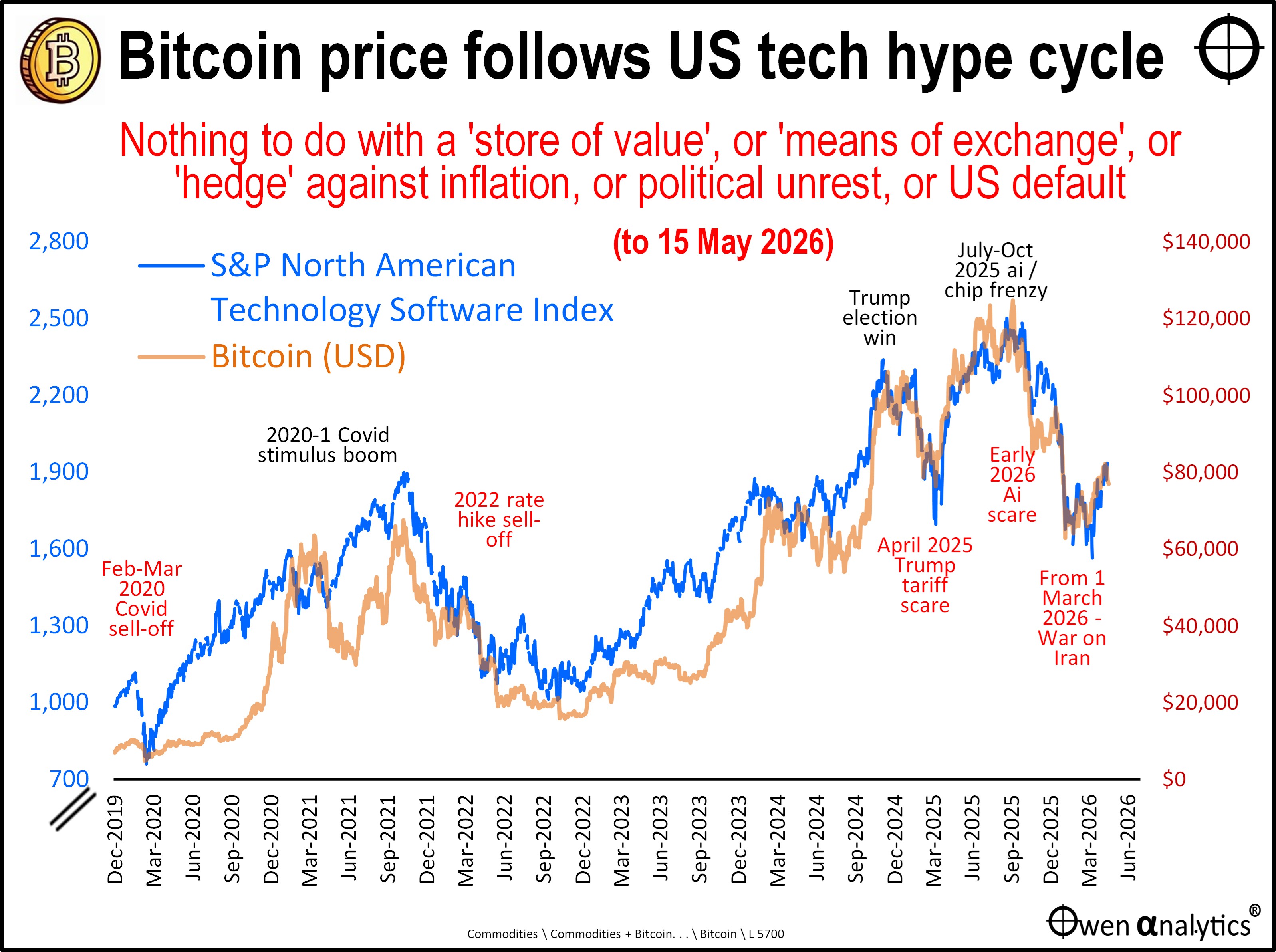
- So what DOES drive Bitcoin’s wild price volatility? Despite the lofty ideas behind it, Bitcoin’s price actually just follows the US tech hype cycle: S&P’s ‘North American Technology Software Index’ (except BTC is seven times more volatile!)
- Nothing to do with its theoretical value as an alternate currency, or store of value, or so-called hedge against inflation, or political unrest, or US debt default.
- So, when (not if) the current boom/bubble bursts, like every prior over-hyped, over-capitalised, over-bought new technology boom in the past, will Bitcoin’s price fall in the general sell-off (as it has in every tech sell-off to date)?
- Or will it magically stop being a tech hype cycle proxy and start reflecting its true fundamental value (whatever that is)?
- We’ll find out soon enough – stay tuned!
Greetings all!
I do not own (and have never owned) any Bitcoin, or any other cryptos, or NFTs, or interests in bitcoin miners, or traders, or exchanges, or anything else related to the industry.
Why? Because I am a long-term investor who tries to understand the underlying fundamentals (old-fashioned things like assets, cashflows) of what I am investing in, rather than just looking at price action.
I like the ideas behind Bitcoin
However, I do like the underlying utopian ideas behind bitcoin: an alternative to the worthless paper ‘money’ that is deliberately and systematically debased by governments. Anonymous holdings and transactions, completely free from governments, taxes, controls, regulations, surveillance, central banks, commercial banks, public visibility, intermediaries, ticket-clippers, marketers, scammers, hackers, and transaction costs.
Who wouldn’t want that?
I started following the development of bankless digital peer-to-peer currencies since Dave Chaum in the early 1980s (when I started out in banking); then in the 1990s the development of ‘digi-cash’ and ‘b-money’, in the 2000s Nakamoto’s ground-breaking paper, Bitcoin and blockchain: in the 2010s Laszlo Hanyecz’s famous Pizza order, Silk Road, the dark-web, and Mt Gox; in the 2020s the flood of crypto tokens, exchanges, ‘stable-coins’, NFTs, and FTX.
Along the way we have also seen a seemingly endless stream of collapses, scams, frauds, thefts, and losses.
I like the original lofty ideals and motivations behind citizen-controlled digital currencies like Bitcoin, but they have been horribly corrupted. So far bitcoin is used mainly for speculation, and has only been adopted as the currency of choice by drug dealers, arms traders, scammers, hackers and blackmailers.
Supposed benefits
The internet and my email inboxes are flooded with countless spruikers and hucksters promoting Bitcoin. It is being touted as:
- A store of value
- A means of exchange
- A hedge against inflation
- A hedge against government debt default
- A hedge against political turmoil, civil war, nuclear winter
- A practical, universally accepted currency in a post-apocalyptic world
The problem is – Bitcoin’s price does not reflect any of these themes, however attractive the ideas behind it may be.
A means of exchange?
So far bitcoin has been the currency of choice for drug dealers, arms traders, scammers, hackers and blackmailers (aside from Hanyecz who paid 10,000BTC for two pizzas in 2010! Wise purchase?)
(On 22 May 2010 Florida bitcoin miner Laszlo Hanyecz paid fellow bitcoin miner Jeremy Sturdivant 10,000 BTC, worth a total of $42 at the time, for two Papa John’s pizzas. Thankfully they were Large pizzas! It was the first real-world use of Bitcoin as a means of payment. It was also possibly the worst trade in the history of the world!)
A hedge against inflation?
When inflation surged in 2021-2 Bitcoin’s price halved.
But when inflation declined in 2022-5, Bitcoin rebounded.
Then when inflation surged again in 2026, Bitcoin halved again.
This price behaviour is the OPPOSITE of an inflation hedge.
A hedge against political turmoil?
When the US started another war in the Middle East in in March 2026, Bitcoin’s price fell sharply, but it started to recover on signs of a peace deal.
When Russia invaded Ukraine in February 2022 to start the biggest war in Europe since WW2, Bitcoin’s price fell and kept falling for the rest of the year as the war deepened.
When governments everywhere triggered social unrest by locking whole nations of citizens in their homes during the Covid crisis in early 2020, Bitcoin’s price fell.
These price actions from Bitcoin are the OPPOSITE of a hedge against political / social / military turmoil.
A hedge against US debt crises?
Once again, Bitcoin has been the OPPOSITE of a safe haven in US debt crises. In every US debt crisis since Bitcoin has been in existence, the Bitcoin price fell when it should have risen as a safe haven:
- When rating agency S&P downgraded US debt for the first time in history on 4 Aug 2011: BTC FELL by -9%, then FELL another -33% the following day.
- In the 1-16 October 2013 US government shutdown: BTC FELL -1% during the shutdown (including -21% at the start), but then rallied again from 16 October after the shutdown ended.
- In the 20-23 January 2018 shutdown: BTC FELL -11% during the shutdown (including falling -16% in the first two days, then rallied after the shutdown ended.
- In the 22 Dec 2018 to 25 Jan 2019 shutdown: BTC FELL -10% during the shutdown (including falling -5% in the first three days, then rallied after the shutdown ended.
- In the 1 Oct to 12 Nov 2025 shutdown: BTC FELL -14% during the shutdown, but then kept falling in the general tech sell-off after the shutdown ended.
- In the 31 Jan to 3 Feb 2026 shutdown: BTC FELL -4%, then kept falling in the general tech sell-off after the shutdown ended.
In every case, BTC behaved like an tech stock – the OPPOSITE of a hedge or safe haven.
A post-apocalyptic currency?
I have a full-prepared and ready-to-go ‘INCH bag’ (INCH = I’m Not Coming Home) that is full of the things I will need in a in a post-apocalyptic world, for example caused by a nuclear winter after a global nuclear war. We need to assume a world with no power, no internet, no phone networks, no satellites, no water, no gas, no ATMs, no banks, no shops, no fresh food, no industrial production of food or energy or anything else, and possibly no direct sunlight for many months.
We have all seen this scenario in movies, but will it happen in my lifetime? Probably not, but best to be prepared it if does. Sh*t happens.
In my kids’ lifetimes? Much greater probability. Get prepared!
My INCH bag contains useful everyday items of value that are easy to carry, easy to measure, hard to forge, and easy to trade – USD notes, AUD notes, matches, butane lighters, gold coins, practical tools, knife sharpeners, water purifiers, solar panels, etc. (Having a ready-to-go INCH bag is another story for another day!)
Problem is that in a world with no power or internet or phone networks, what good is Bitcoin?
Stablecoins?
On a related issue - I also like the idea behind ‘stablecoins ’– to remove the role of banks and central banks by allowing other companies like retailers and credit card issuers to issue their own ‘currencies’ for payment, with transactions recorded on the blockchain instead of bank accounts. The groundwork was laid in the GENIUS Act in July 2025.
The problem is that ‘stablecoins’ are backed by US dollars, which are inherently unstable and being deliberately de-based by the US government as part of its pro-inflation policy.
The US Fed’s 2% inflation target means the US government is deliberately aiming for 2% wealth destruction every year. This compounds into 18% wealth destruction over 10 years, 33% wealth destruction over 20 years, 45% wealth destruction over 30 years, etc. Official government policy is to deliberately and systematically destroy your wealth!
How is a stablecoin ‘stable’ if it is guaranteed to destroy wealth as part of official government policy?
Isn’t the whole idea to get away from government-mandated wealth destruction?
And if the aim of digital currencies is to get away from reliance on the US dollar, stablecoins tied to the USD do the opposite!
A store of value?
Despite its lofty ideals, Bitcoin is the opposite of a stable store of value.
Bitcoin’s price is extremely volatile. Thirteen times more volatile than the US S&P index, and seven times more volatile than the US tech index that the Bitcoin price appears to follow. (Daily price variance over past 10 years: Bitcoin = 0.002258, US Tech index = 0.000284, S&P500 index = 0.000168).
(tip: relative volatility compares relative statistical ‘Variances’, not ‘Standard deviations’ – it’s a math thing.)
What actually drives Bitcoin’s price?
If Bitcoin is supposed to be a stable ‘store of value’ – why is its price to volatile?
What causes the Bitcoin price to jump around so much? (because it is clearly not driven by news or events relating to inflation or wars or political turmoil, etc.)
Turns out Bitcoin’s price just follows the US tech hype cycle! Nothing to do with its value as an alternate currency, or store of value, or so-called hedge against inflation, or political unrest, or US debt default.
Bitcoin price is a bet on US tech hype cycle!
This chart shows Bitcoin price (orange) versus the ‘S&P North American Technology Software Index’ (SPGSTISO) – a good barometer of the US tech hype cycle:
The S&P North American Technology Software Index is available here.
It includes US tech stocks including: Microsoft (MSFT), Oracle (ORCL), Palantir (PLTR), Salesforce (CRM), Palo Alto Networks (PANW), AppLovin (APP), CrowdStrike (CRWD), Adobe (ADBE), Intuit (INTU), Synopsys (SNPS), and around 100 other companies.
Bottom line is that when people feel confident about US tech, they buy up US tech stocks and also Bitcoin. When they get scared or spooked about US tech, they sell US tech stocks and also sell Bitcoin.
Simple as that!
Nothing to do with the grand, idealistic notions of a stable store of value or a hedge against inflation or political turmoil or US debt default or alternative currency.
When the tech bubble bursts?
Since we know that Bitcoin’s price just follows the US tech hype cycle, when (not if) the current boom/bubble bursts, like every prior over-hyped, over-capitalised, over-bought new technology boom in the past throughout history, will Bitcoin’s price collapse in the general sell-off?
Or will it magically stop being a tech hype cycle proxy and start reflecting its true fundamental value (whatever that is)?
We’ll find out soon enough – Stay tuned!
‘Till next time – happy investing and stay healthy!
Visit my web site for hundreds of original articles on a wide range of topics for advisers, portfolio managers, and serious long-term investors.
https://www.owenanalytics.com.au/
-
-
- All completely free of charge.
- Free of conflicts.
- No ads, No marketing, No sponsored material at all.
- Not ‘monetised’ in any way. No ‘revenue model’.
- Not selling or promoting anything.
- All original research and analysis.
- All original charts. No copy/paste of 3rd party materials.
- Guaranteed No ‘hot stocks’, No ‘hot tips’.
- Guaranteed No ‘ai’. All human.
Enjoy!