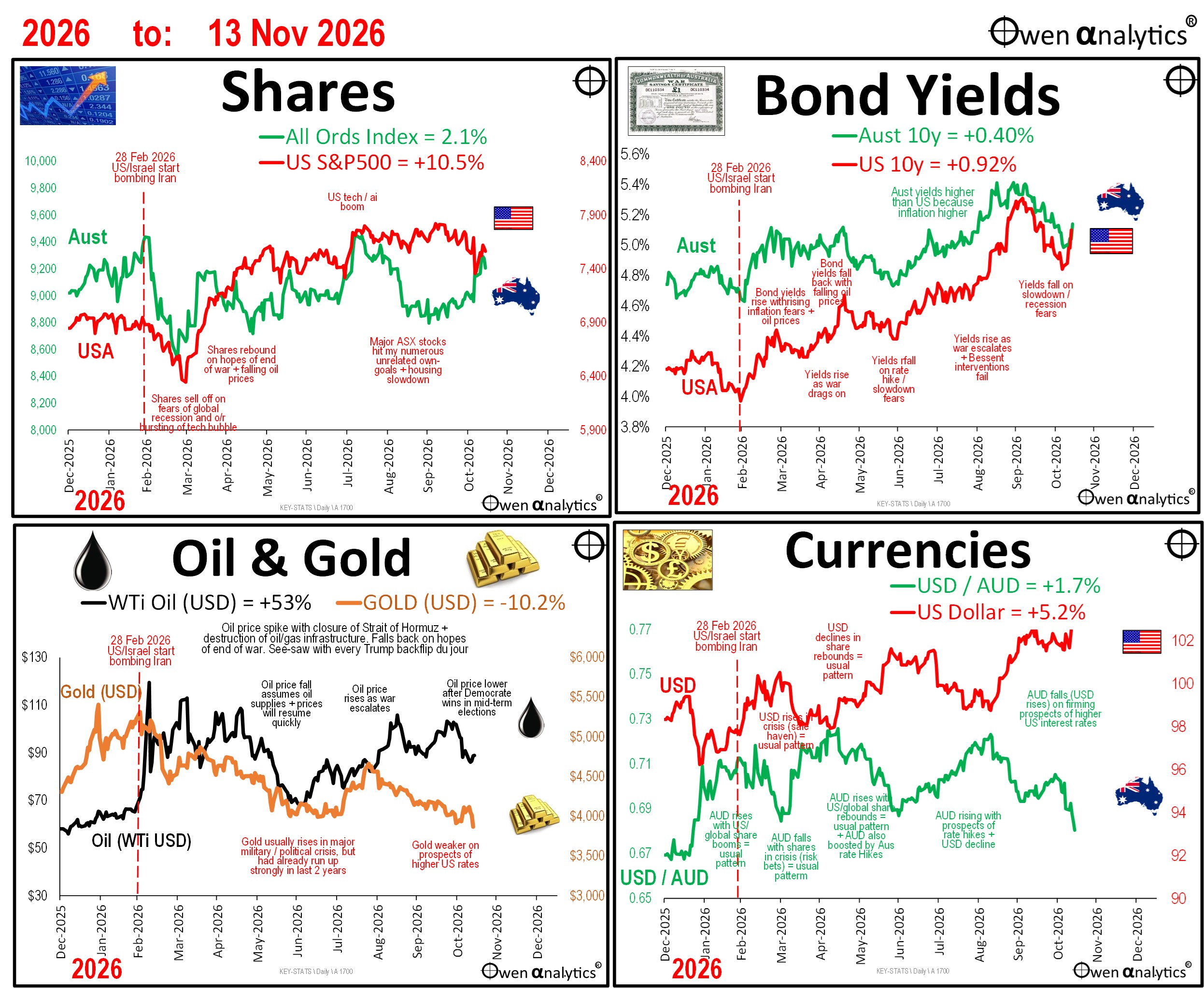
Background - I track and analyse thousands of data points across all markets and asset classes, but the most important barometers and drivers of local and global markets for my day-to-day purposes (answering questions from media & colleagues, and mentoring advisors & portfolio managers in managing their client portfolios and client comms) are the following key items:
- Share markets (Australia & US)
-
- the Aussie market as it still anchors most long-term diversified portfolios
- the US market as it dominates (financial and sentiment) global markets
- Treasury bonds (Aus & US)
-
- because fixed rate bonds still make up a sizeable chunk in most long-term diversified portfolios,
- and because treasury yields reflect expectations of future inflation and interest rates, which directly affect other asset classes including shares, real estate, commodities, currencies.
- Currencies (AUD & USD)
-
- The AUD because it is a ‘risk’ currency, which it ALWAYS falls in general global sell-offs as global (mainly US) investors dump foreign risky assets and retreat to the safety of the US. Conversely, but in general global rebounds and booms, the AUD usually (but not always) rises as foreign investors (mainly US) venture back in.
- The USD as it is the global reserve currency on which everything else is anchored,
- Oil – because fuel prices filter directly or indirectly into just about every inflation category, and inflation expectations drive interest rate decisions and bond yields, which in turn affect the pricing of all other assets.
- Gold – as it is the original ‘hard currency’ and it is still a good proxy measure for how investors, governments, and central banks are felling about future inflation and political / civil / military unrest and disruptions.
This handy set of four charts track changes in these key markets since the start of 2026, and is my quick go-to daily reference point.
Here’s my latest quick take on the week’s activity on local & global markets for Aussie investors:
Owen’s Market Pulse - 14 Nov 2026: Now that was an interesting week!
For seasoned investors most of the time we’re waiting around for what we’re fairly sure is coming - a recession or rate hikes or corporate collapse or election, etc. It’s like watching life in slow motion. But occasionally something hits completely out of the blue. (No, Trump’s endless TACO brain spasms don’t count any more – we’ve learned to ignore them).
This week it was Nvidia founder/CEO Jensen Huang’s sudden implosion. One minute he’s on top of the world running the largest company in the world at the centre of the global ai/tech revolution. Next minute he’s gone, with no successor, and the share price is down by a third. So far.
It’s probably just another factor culminating in the end of the ai bubble (along with persistent inflation, rising cash rates, rising bond yields, failed IPOs, escalating wars, out-of-control deficits/debts, regulatory attacks, worsening ai / cyber hacks). While these negative factors pile up, the final trigger is often some completely unrelated event.
SHARE MARKETS - The Huang/Nvidia implosion was not enough to slow US share markets. The NASDAQ and S&P500 indexes were still up more than 2% each for the week. Nvidia fell a further -14% but just about every other major stock was up, especially rival chip-makers AMD and Micron. The exception was Microsoft (flat) after its global outage on Friday. The S&P500 is down just 3% from its 6 October peak, but is still up more than 10% for the year.
The ASX edged up 0.7% for the week (but has gone nowhere this year). Banks gained overall after good results despite falling property markets, slowing lending and rising loan arrears. Money rotated out of NAB into CBA and WBC. Falling prices for iron ore and gold hit most of the miners (except BHP up 2%).
BONDS - The silent mover for the week was bond markets – yields on 10-year treasuries in US and Australia back above 5% on worsening inflation numbers increasing the prospects of further rate hikes. Yields are still below their October peaks, but we will be back there soon.
OIL - back below $90 in US and below $100 in Europe, but it all depends on Trump’s next TACO brain spasm.
GOLD - fell below $4,000/oz (down -10% for the year) on firming prospects of higher US interest rates.
MY TAKE – We all know the ai boom will end, and that negative factors are piling up one by one. But booms often run much longer and higher than expected until the final trigger for collapse. More money is lost trying to avoid sell-offs than in the actual sell-offs themselves (Peter Lynch).
Meanwhile, Trump is plotting how to use his time left in office. Domestic policy will be hampered by a hostile Congress from January, so he is likely to focus even more on foreign adventures where he still has pretty much unfettered power. Cuba looks like being next, or he may offer support for Xi to invade Taiwan. Who knows?
‘Till next time – happy investing and stay healthy!
Experiences
Director/Principal, Owen Analytics Pty Ltd (current)
Investment Markets Research & Analytics, Portfolio Construction & Management, Corporate Finance, Venture Capital, M&A, and IPOs. Investment Committee membership, consulting to advice firms and financial institutions.
Co-founder & Regular Contributor, Firstlinks (current)
Co-founder of Australia's leading investment and superannuation newsletter and website for industry professionals and investors.
Non-exec Director, Third Link Investment Managers (current)
Leading Australian equities fund-of-funds that donates all management fees to Australian charities. The fund has donated in excess of $21m to a range of Australian chartities since inception in 2008.
Chief Investment Officer, Stanford Brown (past)
Responsible for managing over $2 billion AUM in multi-asset class portfolios and discretionary accounts at a privately-owned advice practice.
Director & Joint CEO at Philo Capital Advisers Pty Ltd (past)
Specialises in investment portfolio construction & management, multi-asset class asset allocation, and global macro strategies.
Check out my full bio here