
This is a follow-up to my main story ‘10 things I learned about dementia & dementia care homes from close range’. In that first story I covered various aspects my experiences dealing with my mother’s dementia and dementia facilities in Sydney over the past three years, including - the pace and pattern of cognitive decline, the decision to ‘go in’, different types of facilities we went through, what it’s like inside, lessons in preparation, key documents, and more.
Today’s story is about the costs, how they were very different to what I expected, and how some of the lessons have shaped my own plans.
The four different ‘permanent’ facilities my mother went through (which I named in the first story), plus several others I investigated, just in case they were required, covered a range of locations (including Sydney eastern suburbs, western suburbs, country NSW near where my sister lived), some were modern and some were old, and there were very different levels of amenities and services offered across the range.
However, as I pointed out in the first story, it wasn’t a case of which one we chose. You don’t choose them; they choose you! The key is finding the facility that is the best fit for the resident’s individual’s conditions and needs.
Understanding the costs was a very new, rather complex, and often confusing journey for me, on top of everything else that was going on.
As with the first story, every case is different of course, so these are just my random anecdotal comments that may be of interest to others facing the prospect of parent(s) or family member(s) with, or developing, dementia.
1. In-home assistance subsidies seemed very generous
Before going into ‘permanent’ facilities, my mother was on a ‘Home Care Package’ (‘Home Care Subsidies & Supplements Scheme’) for several years while living by herself in her unit. This scheme subsidises a very wide range of services – all paid for by tax-payers. https://www.health.gov.au/our-work/hcp/about
The amount of money available under the scheme depends on the assessed level of need. My mother was on Level 4 which I believe is the highest level. It seemed very generous.
The Level 4 subsidy was around $55k per year, but Level 4 now pays $63k per year from 1/7/2025 - .https://www.health.gov.au/sites/default/files/2025-08/schedule-of-subsidies-and-supplements-for-aged-care_0.pdf. On top of that there is an additional $7k per year for dementia services. (My mother was not diagnosed with dementia until after she went into permanent care).
The service providers would send a weekly budget spreadsheet that itemised the services and costs to use up the weekly budget. My mother could never spend the full amount even if she tried, and she had all sorts of different types of carers almost daily.
The service providers were constantly chasing up to ensure the money was spent and ‘didn’t go to waste’ (as if it were free!) It seemed my mother always had credits for unused Home Care money piling up all the time. There always seemed to be a variety of intermediaries involved and their relentless pushing of services left me thinking there must be financial incentives to spend more money.
Their weekly spreadsheets itemised the costs of each of the services. Most basic services that required very little skill or training – like cleaning, shopping, laundry, running errands, etc – were charged (to tax-payers) at rates of $80 to $90 per hour, which seems extraordinary given most of the actual workers probably receive less than half of that. Probably most of it was profit margins to the private companies running the services. No wonder they were so keen for us to spend the ‘free’ money!
On the bottom of each of the weekly spreadsheets, there was an item - ‘Add Weekly Income Tested Amount’ This was always zero for my mother as she had plenty of assets and income and would have failed any means test. But it looks like people below the means test would get an additional money. Therefore my mother’s $53k per year (or $63k today) was AFTER the means test!
(All of these things are on government department websites, but they are extraordinarily difficult to navigate.)
I always thought the whole thing was extraordinarily generous. It did not encourage shopping around or finding best value for money, etc – because everything was picked up by tax-payers.
In recent months I believe there has been some talk of proposals to amend the scheme to require recipients to make ‘co-contributions’ at different levels for different services. Good idea!
2. ‘Permanent’ nursing/aged/dementia home costs
Here is where the costs really started adding up. The initial ‘sticker shock’ can be daunting.
The first thing I noticed was that costs always seem to be quoted in terms of a daily rate, as if it were a short hotel stay. This was probably to minimise the ‘sticker shock’ of the total cost. But when you multiply everything by 365 days per year, each item ends up being tens of thousands of dollars. Hey, ‘$208 per day’ doesn’t sound like a huge amount, but that comes to $76k per year - Ouch!
There are four main regular costs (usually set out as four columns on fee schedule sheets provided by aged care facilities), plus a variety of random extra costs. The four main costs are:
- The Basic aged care fee – this is the same for all people. It is set at 85% of the current government age pension rate, whether the resident is on the government age pension or not. When my mother first went in, it was around $25k per year (and increased each half year along with the government age pension rate).
- Additional aged care facility fees. This varies for each place. From the many facilities I looked into, these can be up to $100 to $150 per day (around $37k to $55k per year) or more, depending on the level of services – eg number of nurses, physios, staffing levels, variety/quality of food, activities, amenities, etc.
- The ‘RAD’/‘DAP’ – this is essentially the cost of the real estate (land & buildings). If taking the regular ‘DAP’ option (more on this below), for the places I looked at it tended to be between around $35k and $100k per year, depending on several factors – see below.
- The ‘Means Tested’ fee. The means test (on assets and income) are set very low levels when I looked at them, so it looks like only government age pensioners with very little in the way of other assets or income would avoid this fee. At the time, this ‘means tested fee’ was capped at 135% of the government age pension, which meant that the fee was around $33k per year. My mother had assets and income well above the test levels, so we paid this. It started at a monthly rate ($125 per day initially) from October each year, then cuts out when the cap is reached. Then starts again next October. There is also a lifetime cap on the means tested fee.
So, the numbers looked like something like this:
$25k per year for the Basic fee (same for all),
+ around $30k to $50k pa for the specific nursing home fee (varied depending on the place),
+ around $50k to $70k pa for the DAP (varied depending on the place),
+ $33k for the means tested fee (same for all who fail the means test).
These came to a total around $120k to $150k per year, depending on which place she chose (or more accurately, which places accepted her).
On top of these regular costs, there are random extras for additional services – like hair dressers, day trips, medications, ambulance trips, operations, tests, etc.
Health insurance?
From my experiences with both my father and mother (each involved numerous surgeries, procedures, and hospital stays on and off over several years), their top level private hospital cover ended up covering almost all of the hospital-related expenses, including specialists, surgeons, anaesthetists, tests, theatre fees, etc.
Of course, different levels of cover from different insurers will cover different things for different people, but the cover my parents had seemed to cover pretty much everything.
In my mother’s last three years, she was in hospital on average about every couple of months – for numerous broken bones from falls, a hip replacement, bowel cancer removal, high blood pressure, mini-strokes, plus several other trips to ED (Emergency Department). I was amazed at how little was not picked up by health insurance.
However, private health insurance did not cover the costs of the permanent nursing/aged/dementia facilities – itemised above.
3. The RADs and DAPs
This is item three in the above list of costs, and it can be the largest single cost of permanent / residential care, particularly for up-market facilities in expensive suburbs. (My mother lived in Bondi Junction and initially wanted a place in the eastern suburbs close to friends and familiar surroundings).
The RAD/DAP is essentially the cost of the real estate (land and buildings) for the room in the aged care facility. You can pay this in one of two ways:
- As a single lump sum Refundable Accommodation Deposit (‘RAD’). This is akin to the capital cost of the room. You pay this up front, and it is refunded when you leave.
- Or you can pay it in the form of a Daily Accommodation Payment (‘DAP’) – paid monthly. This is akin to paying rent for the room instead of paying the lump sum RAD capital cost. The DAP (rent equivalent) is the RAD (capital cost) multiplied by a set interest rate, divided by 365 days.
- Or a combination of the two methods.
RAD -v- DAP formula
If the RAD (capital cost) of a room is say $1 million, instead of paying the $1m RAD in cash up front, you can choose to pay it as a ‘rent’ which is calculated as the $1m RAD multiplied by a set interest rate divided by 365 days per year.
The interest rate for the DAP calculation is set by the government and is a margin above the RBA cash rate. The current rate is here. At the time of writing it is 7.61% but it was above 8% before the interest rate cuts in 2025.
For example, if the RAD for the room is $1m and the set interest rate is 8%, then -
The DAP = $1m RAD x 8% interest rate divided by 365 days = $219 per day. Or $80k per year.
You can generally choose to pay either the RAD or the DAP, or even a combination of the two.
My mother was the sole owner of her unit after my dad died, so there was a choice – pay the RAD or the DAP (see below on the actual decision). However, in the case of a couple where one partner needs to go into permanent care, if they sell their joint family home to pay the RAD, the total monthly cost is lower because there is no monthly DAP cost, but it leaves the other partner with no home to live in. On the other hand, if they retain the family home, they need to come up with the monthly RAD which can be crippling.
Why different RADs?
The one-off RAD cost for typical aged care rooms I looked at ranged from around $500k to $1.5m, depending on the location of the property, size of the room, facilities. It is somewhat similar to how the price of a regular strata title one-bedroom unit would work – ie the price (or capital value) depends on size, location and facilities. (No doubt prices vary city to city and usually lower in country towns.)
For example, I saw some aged care rooms with RADs up to $1.5 million and some were even higher (Sydney eastern suburbs, modern building, large sunny room with pleasant views, ensuite, own sitting area, kitchenette). Probably somewhat similar to the price of a one-bedroom strata unit with similar location, size, and facilities.
At the other end of the scale, I also saw aged care rooms with RADs of $500k (older building, cheaper suburbs further out, small pokey room with not much sun or view, basic en-suite, no living area, no kitchenette). This would also probably be similar to the price of a one-bedroom strata unit in an older building, with similar location, size, and facilities.
As it turns out, the place my mother ended up in (number four), which was perfect for her needs, had a RAD of less than $500k. This was very low compared to the others, but it was a shared room, with shared bathroom, in Parramatta.
On the ‘shared room, shared bathroom’ thing - patients with advanced dementia spent virtually all of their waking hours in the main common rooms doing group activities (refer to my main story). My mother (and probably most other patients I observed) did not know where her room was anyway, and before long she could not recognize any of the pictures of herself and family we put on the walls to remind her (taped down, not hung – for safety). She had no idea who she was or where she was, and she needed staff for basic things like washing, toileting, dressing, changing, etc.
The facility does have single rooms, but they are reserved for patients who needed isolation for the protection of others. So, shared room and shared facilities were fine for her needs.
4. Which is better - RAD or DAP?
Three things I found. First - when the interest rate for the DAP is low, as they were when RBA cash rates were near zero in the year or so after Covid, it would usually make more mathematical sense to pay the DAP because of the very low interest rate. (At the time, one place I look at used a rate of 2.1%, so a $1m RAD at 2.1% meant the DAP would have been $21k per year.)
But if interest rates are higher (eg they were above 8% in 2024) it may make more sense to pay the one-off RAD and avoid the high interest rates on the DAP. (The same $1m RAD room at an 8% interest rate would mean a DAP of more than $80k per year for the same room.)
(Although the DAP can be ‘locked in’, my mother was not! She went through four different facilities and so there were four different formulas, and I had others lined up in case she was moved on again.)
Second – and more importantly in our case – as she was ‘moved on’ three times in the first year, I was just happy to pay the daily DAP for each place, and not have to deal with the truck-loads of additional RAD paperwork each time (getting the RAD refunded each time she had to move to the next one).
Third - advanced dementia is usually a relatively short journey. Our experience was less than three years in ‘permanent’ care. I am told that this is more or less the average duration for advanced dementia (especially since my mother was already 95 when diagnosed with dementia), and it is consistent with the ‘turnover rate’ of dementia patients in the places I experienced. We are not talking many years here. By the time you figure out how the numbers work, the whole thing may be over.
5. Nursing home costs were less than I had expected
Bottom line is that costs of permanent/residential aged/dementia care homes were less than I had expected, especially after the ‘sticker shock’ of adding up the four columns of costs for various places I looked at in the initial months of search.
However, as I highlighted in the first part of this story, the level of services and care my mother received, especially at the fourth place where she spent most of the time, certainly exceeded my expectations.
Total costs turned out to be around 120k-150k per year out of pocket (ie net of insurance, which covered the hospital related costs, not the nursing homes). This was around half of what it would have cost for full-time 24/7 professional care at home, which was the only other practical option, given my mother’s condition and needs.
6. Big gap between theory and practice
The high costs of residential / permanent aged care facilities in the last three years of my mother’s life came as a big surprise out of the blue to us. My father, who had died in 2012, was riddled with a bunch of cancers, and had numerous operations and other procedures. He spent much of his final years in hospitals, and his private health insurance picked up almost all of the costs of the hospital stays, including operations, test, doctors, surgeons, specialists, anaesthetists, theatre fees, medications, ED, ICU, Hi Obs, recovery, respite, etc, leaving very little out of pocket expenses over the entire time.
My mother’s case was very different. Her health insurance also picked up virtually all of hospital-related costs for her numerous trips to hospital for operations and procedures, but the difference was the enormous costs of the four residential / permanent aged care facilities in her final years.
Theory versus practice
In the retirement planning process, in order to help answer critical questions like: ‘How much capital do we need for a desired level of spending?’, and ‘How much can we afford to spend given our level of capital?’, numerous models and tools have been developed by the retirement and financial advice industries.
I have studied dozens of these retirement planning models over several decades. They are based on three main components:
- 1) a desired level of spending (or spending budget or ‘withdrawal rate’) – during retirement,
- 2) this spending budget remains at a constant ‘real’ (inflation-adjusted) level, in order to maintain ‘real’ living standards,
- and 3) ends at a statistically forecast age of death according to actuarial life tables.
These assumptions drive the calculations and estimations of how much investment capital is required to order to generate the desired level of investment income (increasing for inflation), over the expected life span of the retiree or couple, for the duration of the expected lives (or the surviving partner in the case of a couple).
In the chart below, the theoretical spending pattern is shown as the blue line.
This starts out at the left during the final years of working (at 100% of pre-retirement income, which is the black dotted line). Then, at retirement (65 in this case), the annual spending budget reduces to the 70% of pre-retirement income, then remains flat in real terms (ie increases for inflation) for their expected lifetimes, and lasts until expected death.
Most models allow for things like staged retirement/semi-retirement when working income reduces in steps, but in our case my dad (the breadwinner) essentially went straight from full-time work to retirement.
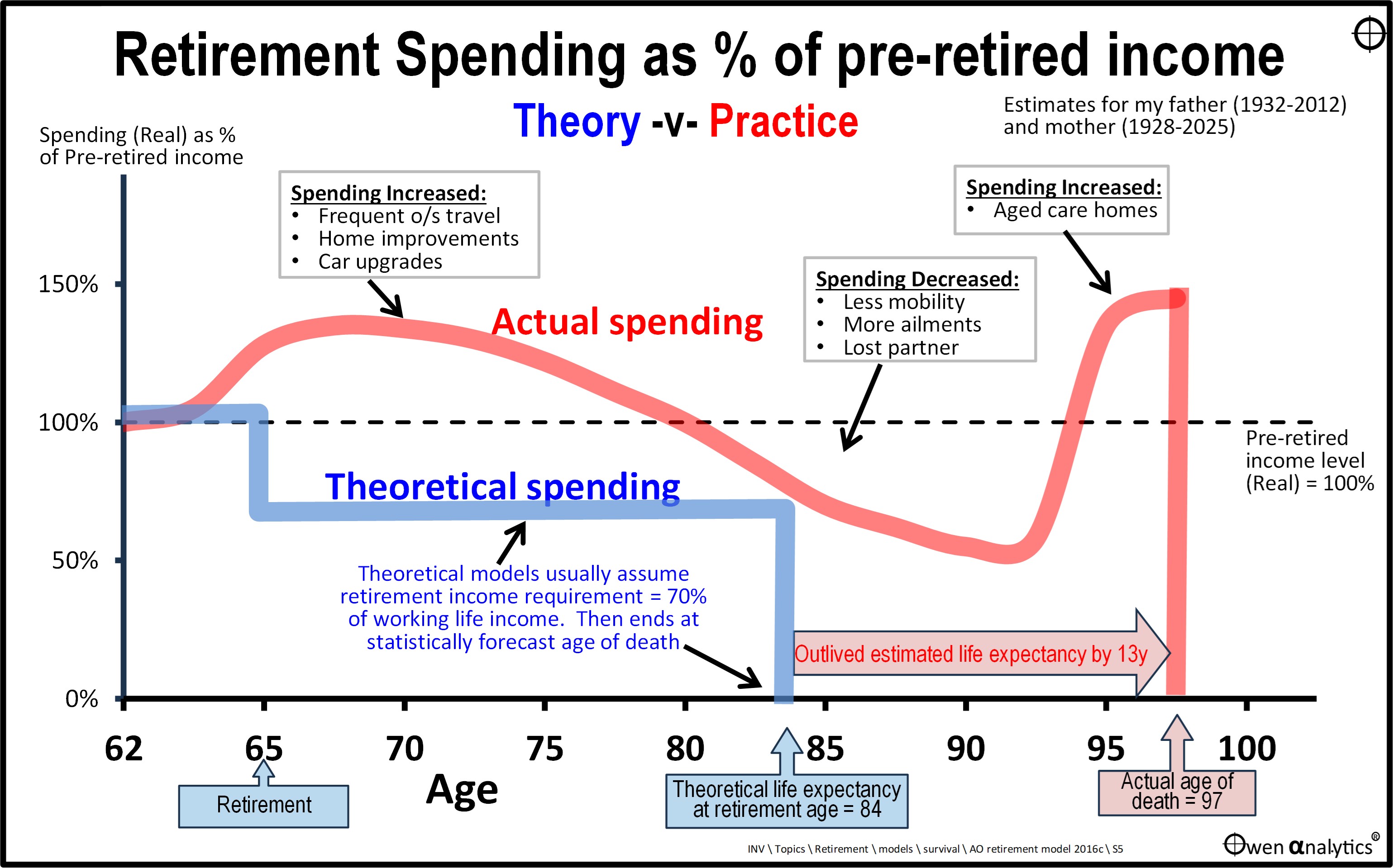
The red line is my estimate of their actual spend (expressed as a percentage of their pre-retirement income).
Obviously, there is a huge difference between their actual spending (red line) and the theoretical models (blue). This is because there are big problems with several aspects of the theoretical retirement planning models.
On the first issue – the desired spending budget in retirement
Most models describe or define this as a specified percentage of pre-retirement (or working) income. This is usually referred to as the ‘replacement rate’ (ie your working income is ‘replaced’ by retirement income). A common ‘replacement rate’ is 70%, used widely in Australia and around the world as a standard base-line.
For example, for a person or couple is earning $100k per year at the end of their working life, a ‘replacement rate’ of 70% would mean a spending budget in retirement of $70k per year, etc. The replacement rate is usually a number below 100% (ie retirement expense budget is usually lower than their working income) because it is assumed that there will be fewer work-related expenses, lower income taxes in retirement, and no more mortgage repayments or school fees, etc.
In the case of my parents, they actually spent more money in the first dozen or so years of retirement, than their pre-retirement income. They went on several overseas trips, a round-the-world cruise, renovated their home, and upgraded cars. (This is a matter of choice and finances, of course)
Second issue – retirement spending level is not constant
The theoretical retirement planning models are always designed on the basis that withdrawals for living expenses keep pace for inflation in order to preserve their inflation-adjusted or ‘real’ living standards. Therefore the blue theoretical line is horizontal ie flat or constant in real terms during retirement.
In my parent’s case, spending was high in the early years and declined from their late 70s as their health and mobility deteriorated. My father died in 2012 at age 80. After that, the red line declined steadily as my mother’s health also deteriorated from her mid-80s.
The big surprise was that the costs of her four permanent aged care places in the final three years shot up to be well above the inflation-adjusted pre-retirement income (ie above the 100% line).
Third issue – life expectancy
This is the biggest issue – longevity risk. ‘What if I outlive the actuarial life expectancy tables?”, ‘Will I run out of money?’ (The other main risk – inflation risk – has presumably been dealt with in the investment strategy for the retirement portfolio – so that withdrawals for spending can remain at its inflation-adjusted level to maintain real living standards).
When my dad retired (he was the breadwinner), my mother was 65, and at that time the actuarial life expectancy for 65 year old females in Australia was 19 years – ie expected to live to age 84.
For Australians, the most widely used source for these life expectancies is the Australian Bureau of Statistics, which publishes tables following each national census it conducts every five years. For my mother’s life expectancy when she was 65, I used ABS Year Book Australia 1995, book 77, page 108 table 5.25 -
https://www.ausstats.abs.gov.au/ausstats/free.nsf/0/6ECEC1450F9AED8FCA257AFA0011B879/$File/13010_1995_Bk77.pdf
(All Australian Year Books going back to 1901 are available online.)
According to the tables, the life expectancy of 65 year old females alive at that time was 84. But this was just the MEDIAN. Far too much importance is given to this ‘median’ number.
The problem is that the probably of a person actually dying at their median expected date of death is almost zero. The median is just the mid-point of a very wide distribution of likely outcomes. 50% of the cohort will live beyond the expected median, and the other 50% will die sooner.
You can make all sorts of guess based on things like diet, health, lifestyle, genetics, etc, - but ultimately never know which half you will be in! Life’s a lottery.
My mother outlived her predicted life expectancy by thirteen years – and those extra years (that were not allowed for in traditional retirement models) were when the biggest expenses hit.
The bottom line is that traditional retirement modelling and advice processes based on them are fundamentally flawed for several serious reasons.
If you base your estimates of ‘How much do we need?’ and ‘How much can we spend?’ on these models, there is a 50% chance of failure (running out of money, or not enjoying your money while you can).
For further reading on this aspect, see an article I wrote last year –
Overall, some of the main lessons for me from the costs aspects of this experience include –
- I will follow my parents example in spending more on myself, family, and others during the earlier years (that’s now!), when I am mentally and physically able to participate, contribute, and appreciate the benefits.
- There is a decent chance I will live a lot longer than the actuarial life tables suggest, meaning I will probably need a fair bit more capital than traditional retirement models suggest. Every year those life table medians (and the whole distribution curve) extends out further.
- Life’s a lottery, but I can’t rely on luck as to whether I have enough money to (a) enjoy life and (b) to not run out.
- Whether or not I live longer than expected, there is a good chance I will deteriorate mentally (like my mother) and/or physically (like my father) – but hopefully not both! Which one it will be is pure luck!
- Either path could lead to much higher costs – when I probably will have lost the ability to manage my finances.
This is not ‘advice’ of course, and it is certainly not intended to be comprehensive or complete. It is just my personal observations and reflections from my experiences with my mother’s four ‘permanent’ facilities in Sydney, plus several others I investigated along the way. Every case is different, and this is certainly an area where I would highly recommend seeking expert advice to understand how it interacts with your family’s overall financial situation and circumstances.
But hopefully this has shed some light on what was for me a very new, rather complex, and often confusing journey.
Thank you for your time!
‘till next time . . . . safe investing . . . . and get prepared!
See also –
- 10 things I learned about dementia & dementia care homes from close range’ 15 Oct 2025)