Greetings fellow investors! - Here’s my monthly snapshot on global markets for Aussie investors.
Key points:
-
-
- Global share markets posted a sixth straight month of gains, despite Trump’s on-going frenzy of tariffs, deals, backflips, side-deals, and yet another US debt ceiling / government shut-down crisis.
- Wrap-up of US, global, and Aussie share markets – what were the winners, losers, and why?
- While the US posted another eight new record highs in September, the ASX took a welcome breather.
- The US Fed’s 4th rate cut confirmed its shift in priorities to jobs and stability rather than inflation.
- Why RBA is not rushing to cut rates here.
- Plus I also cover currencies, commodities, interest rates, inflation, and more.
First - my essential 1-page snapshot chart - covering Australian and US share markets, short and long-term interest rates, inflation, and the AUD/USD exchange rate. As usual, there are two versions – first is the traditional version on a single chart:

Plus the alternate version below, requested by several advisers - showing Australian and US inflation separately in the lower sections:

Share markets
Global share markets rose for a sixth straight month, exceeding the two runs of 5 straight months of gains in the past couple of years. The US market posted another eight all-time record highs in September (even better than the five in August).
Two main reasons for the continued bullishness – the first was the Fed’s 4th rate cut - despite inflation remaining above target and unemployment still at inflationary (low) levels – confirming Fed Chair Powell’s sudden shift in priorities from inflation to jobs growth and financial stability.
The second likely reason for general bullish sentiment was some extraordinary developments on the ai boom front (see below), underpinned by strong US profit results.
Global Industry Sectors
It was another sea of green ink across global share market sectors in September (middle chart), with all global sectors ahead except for consumer staples (where all major global staples stocks were down, possibly over fears of absorbing tariff costs, except Walmart) -
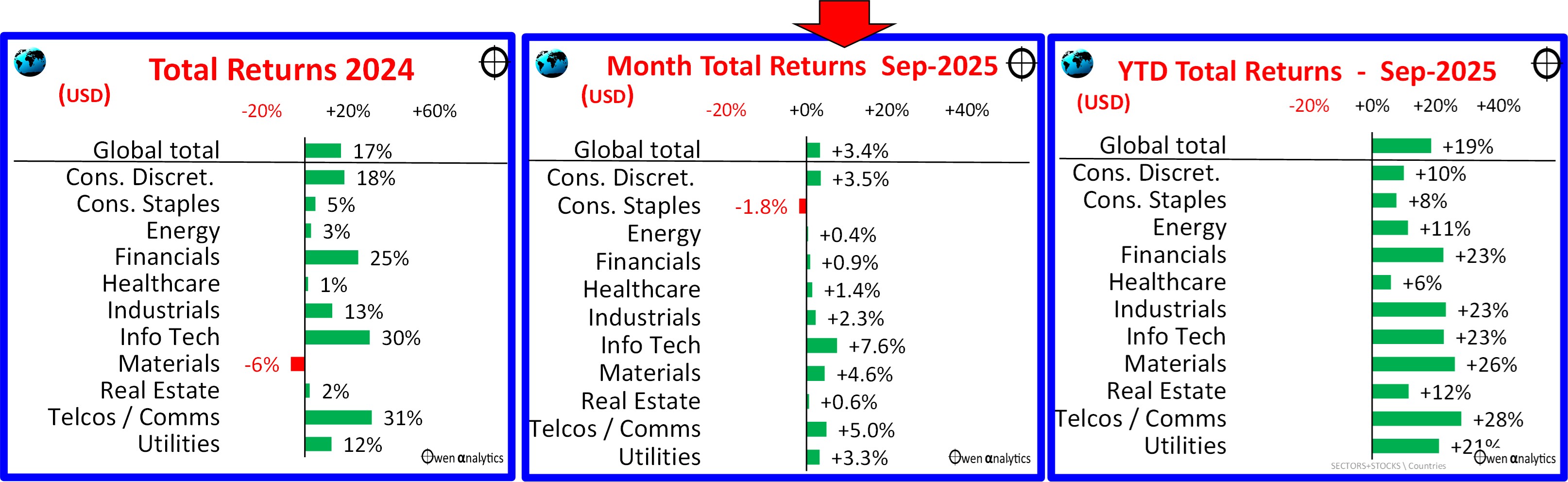
The star sectors for the month were IT, Comms, and Discretionaries (see below). The other star sector for the month was Materials - mainly gold stocks with the surging gold price. Within the health care sector, US stocks did well at the expense of non-US (mainly European) after Trump’s 100% tariff announcement.
For the 2025 year to date (right chart above), most global sectors are heading for another year of above-average returns.
Major global stocks
Here is the picture for the largest global stocks (all of which are US based):

The US big-tech ‘ai’ stars are spread across three industry sectors – ‘Discretionaries’ (Amazon, Tesla), ‘Tech’ (Nvidia, Microsoft, Apple, Broadcom), and ‘Communications’ (Meta/Facebook, Alphabet/Google).
The stand-out development in the past month, which will probably go down in history as a confirmation that the current ‘ai’ boom entered crazy bubble territory was the Nvidia-OpenAI-Oracle money-go-round. Nvidia announced it will provide US$100b to OpenAI (including $10b to take a 2% stake), so OpenAI can spend $300b on cloud computing from Oracle (remember them from the 1990s tech boom?), to enable Oracle to buy chips from Nvidia.
It’s vendor finance on steroids! Nvidia also spent $5b on Intel (another 1990s tech boom star which thus far has been a laggard in the current ‘ai’ race).
Usually, when there is a major investment or commitment from company A into company B, the share prices of A and B go in opposite directions, reflecting who is the perceived winner and loser from the deal. But this time it was different – share prices surged all ‘round, even for companies completely unrelated to the deals - just the general bullish 'vibe' of the thing (apologies to 'The Castle').
It seems everyone’s a winner! Company A pays money to company B, which pays the money to company C, which pays it back to company A. The money just goes in a circle, but this time – BINGO! – hundreds of billions in ‘value’ is created out of thin air!
Oracle jumped 36% on the news and ended the month up +24%. Intel ended up +38%, and Nvidia also jumped but eased to end up +7% for the month. The only player not a public company is Sam Altman’s OpenAI, and its ‘value’ keeps accelerating astronomically higher with each deal.
Tesla was also up strongly with Musk’s apparent rapprochement with Trump, but is lagging the other stars this year.
After the strong gains in September (middle chart), most of the major global stocks are well ahead for the calendar year to date (right chart). Leading the pack are the (current) perceived winners from ‘ai’: Nvidia, Meta/Facebook, Microsoft, and Broadcom (ex-Hewlett Packard).
Mag-7 update
For context, here are the share price charts for the so-called ‘Magnificent Seven’ stocks over the past decade (plus I have added China’s Alibaba and Tencent):

(I have not used any y-axis scale trickery here – the vertical y-axes all start at zero, and have regular, nominal scales, which highlights the explosive share price growth of the US giants from very low levels in the past decade.)
China’s Alibaba and Tencent are up in the Chinese rally this year, but both are still below their 2021 peaks. By comparison, all of the US majors are well above their previous peaks in the 2021 Covid stimulus boom, even Tesla finally.
The US tech giants are still very expensive on a range of metrics. See my recent report on how they stack up individually on revenues, profits, dividends, and pricing -
Profits and Pricing
The July-August reporting season for US companies (for their June quarter results) was relatively strong. 77% of S&P500 companies beat broker consensus expectations (which is around par for the course), and aggregate earnings per share across the S&P500 companies were up +14% over the 12 months to June (up from +8% for the prior 12 months to June 2024).
Consensus forecasts for the next couple of years are pencilling in a further +14% EPS growth again for calendar 2025, and then +17% growth for calendar 2026. These would appear to be very ambitious to say the least as Trump’s tariffs have not really had a chance to eat into US consumer spending nor US company profits yet.
The problem is that S&P500 pricing is at a very bullish 30 times trailing (past 12 months) earnings, and 26 times next year’s ambitious earnings forecasts. These are very optimistic multiples on very optimistic earnings outlooks – a double layer of over-confidence, and highly vulnerable to any negative shocks from left field.
But so far, investors have shrugged off Trump’s tariffs, weak GDP growth, Moody’s US credit downgrade, another US debt ceiling / government shut-down crisis, and ongoing wars in the Middle East and Ukraine. Are US company earnings and investor optimism invincible?
I recently published a six-part series on pricing of global share markets to better understand their implications -
For more on US profits and pricing – see:
Major country share markets
Most of the main global share markets continued their upward march in September (middle chart below), and most are heading for good returns again for the 2025 calendar year (right chart) –

The exceptions are Australia (see below), Switzerland (with declines from major exporters like Nestle, and especially pharmaceuticals like Roche and Novartis, to be hit hardest by Trump’s new pharma tariffs), and also several major French and German companies for similar reasons.
Australian shares
The most obvious feature of the first two charts in this report is the fact that the US market (red line in upper section) is up more than 100% since the start of 2020 (pre-Covid), while the Australian share market (green line) is up by only 35% over the same period. This is a reflection of the relatively much poorer underlying fundamentals (profits, dividends, and returns on equity) from the two markets. I cover this aspect in some detail in my stories on share market pricing and valuations - refer to the links to the 6-part series above.
The local Aussie share market was down in September (middle chart below), defying the global bullish trend. Here are the main ASX stocks:
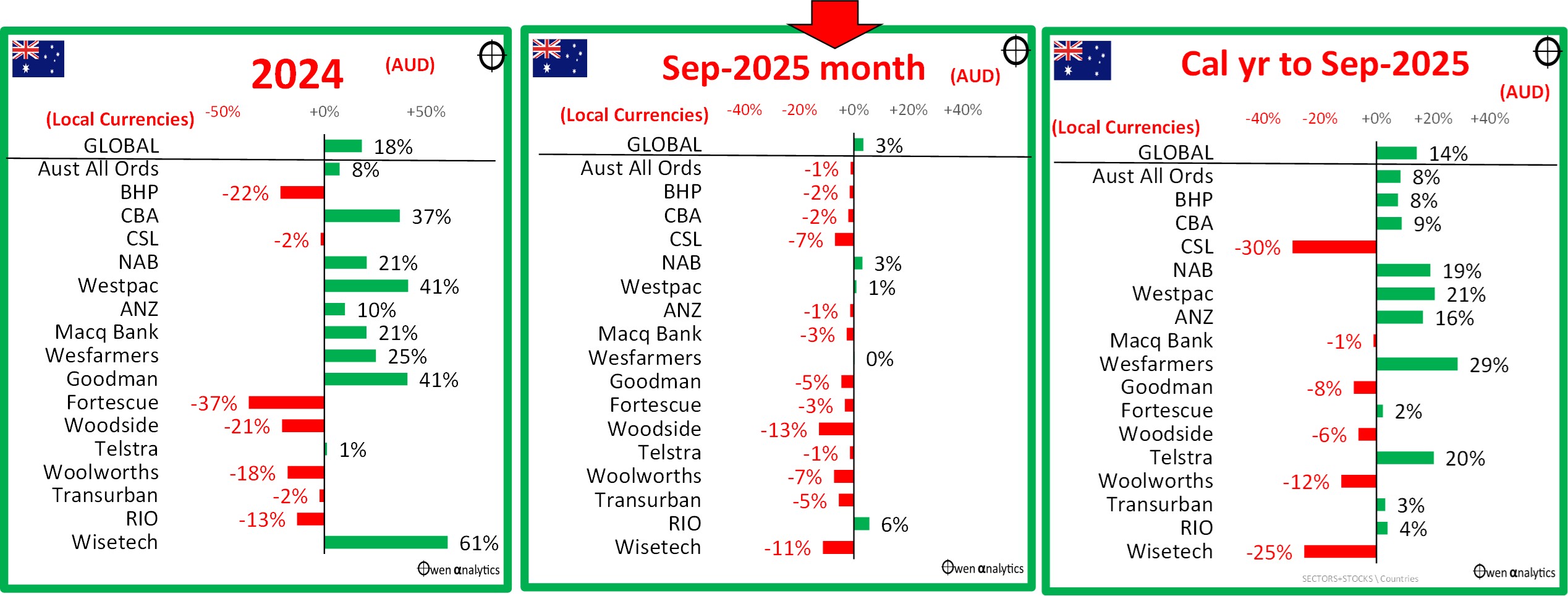
Almost all of the main ASX stocks were down in September. CSL continued its slide (still having problems with its Vifor acquisition, and now has even bigger headaches with Trump’s dramatic tariff hikes on foreign drug companies.)
Iron ore’s price rise of +6% (back up over US$100/tonne after several Chinese stimulus measures), lifted RIO but not BHP or FMC, which are facing higher costs and lower grades, and a rumoured Chinese boycott.
Within the banks, the rotation out of the vastly over-price CBA into slightly less vastly over-priced other banks continued, with NAB benefiting in September (it was Westpac in August).
For my take on CBA see –
(Disclosure – I am personally over-weight Aussie banks and have been since the early 1990s, so I am just sitting here milking it while the crazy boom lasts. I can’t sell because of the embedded CGT, so I am getting insanely high dividend yields (plus franking credit refunds) on my buy-in prices. Enjoying the benefits of apathy!)
For 2025 year to date (right chart above) the overall ASX market looks like it is heading for an average year (possibly better than 2024), but it is still lagging the US and global share indexes. The big drags on the local market continue to be CSL and Wisetech.
Inflation & interest rates
First, to the US market because the US drives all global markets including the ASX. After three rate cuts in September, November and December of 2024, the Fed hit the pause button and said they are in no hurry to cut rates further, despite a barrage of criticisms and personal attacks aimed at Fed Chair Powell from Trump and his stooges.
The big change in August was Powell’s speech at the annual Jackson Hole get-away, when he appeared to shift his attention from sticky inflation, to the weakening jobs market.
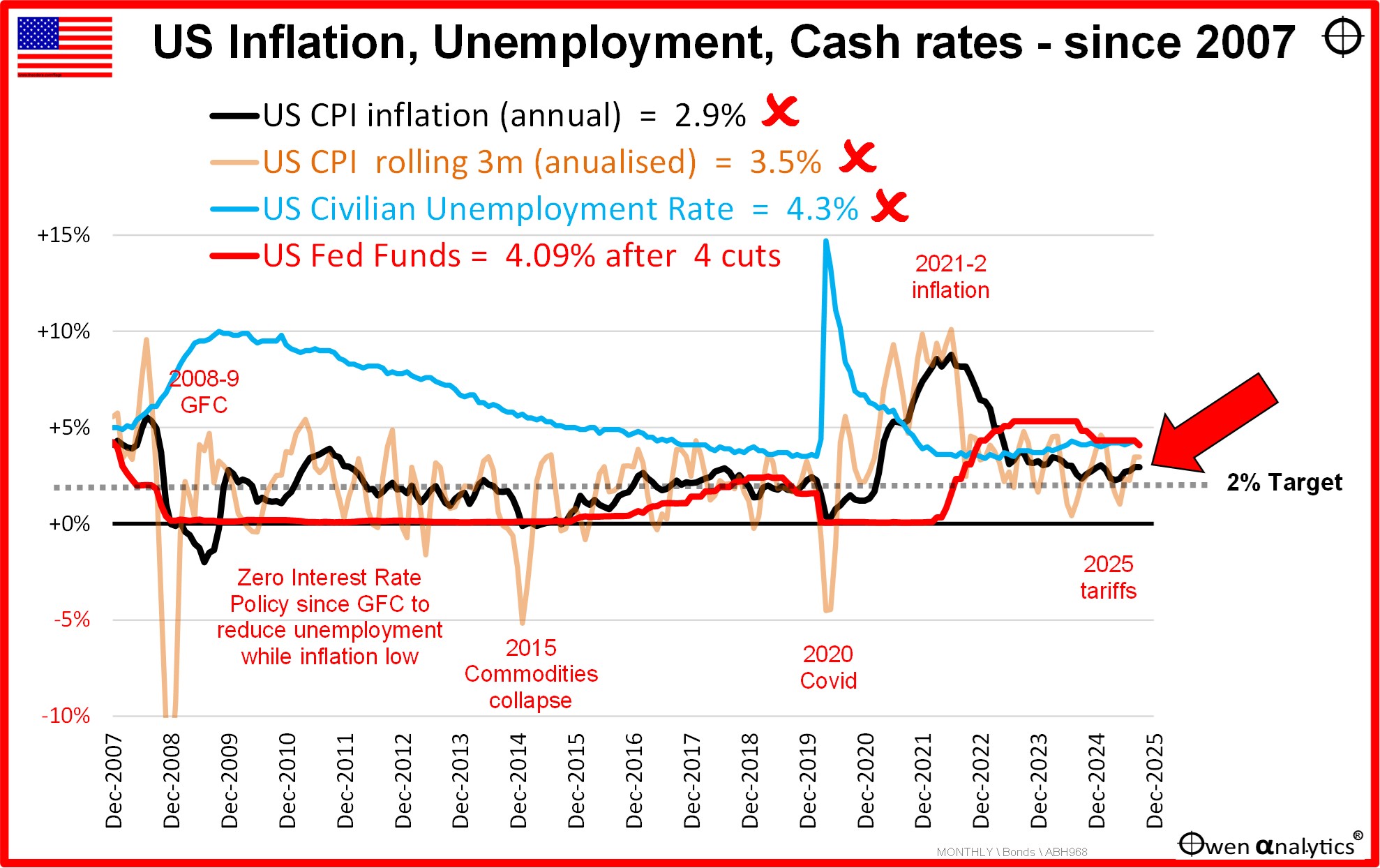
The 12-month inflation rate is still a rather high 2.9% (up from 2.7% prior month), including some elements of tariff impacts, and the annualised 3-month rate is back up to 3.5% (up from 2.3%). The Fed’s preferred measure, Personal Consumption Expenditure (PCE) is back up to 2.7% (from 2.6%), still higher than the 2% target.
The US jobs market remains surprisingly strong. The unemployment rate has risen to 4.3%, which is still relatively tight. Thus far we have seen little impact of Trump’s tariffs on trade, prices, inflation, or jobs. But it is early days yet.
I give it 3 crosses out of 3 for inflation control.
Despite inflation above target and unemployment still at inflationary levels, the Fed made its 4th rate cut on 17 September, reflecting Fed Chair Powell’s recent policy shift from inflation to jobs and stability, flagged at the August Jackson Hole meeting.
Bottom line = no compelling reason to cut rates – with inflation still high and unemployment low. But the hint of further rate cuts (Powell’s term as Fed Chair ends in February 2026) is keeping share markets moving higher.
Australian inflation, interest rates, unemployment
Australia also gets 3 crosses out of 3 for inflation control.
Inflation in Australias also remains problematic, but for different reasons. The RBA has only three rate cuts in this cycle (Feb, May, August 2025), while most other countries have made several more cuts as inflation has edged down. (For example, there have been 8 rate cuts in Europe, 7 in Canada, 7 in NZ, 5 in UK, 4 in the US)
Here is the Australian picture:
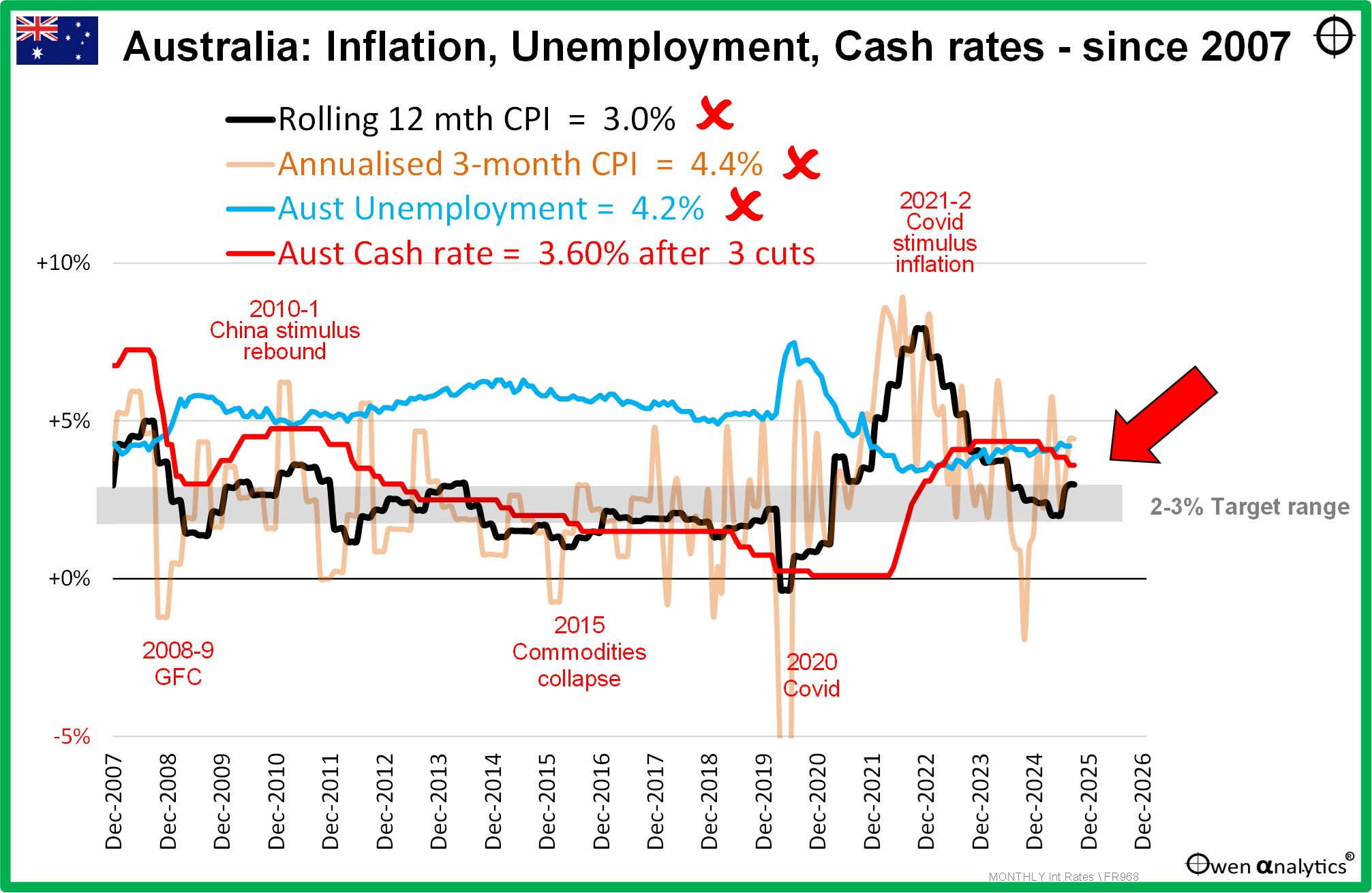
The 12-month CPI inflation rate is still rather high at 3.0% (up from 2.8% last month), and the annualised 3-month rate is back up to 4.4% (up from 3.2%). The main problem areas are housing rents, electricity, gas, healthcare, tobacco, and education costs. The RBA’s preferred ‘trimmed mean’ measure is rather high at 2.7%, but not too bad if it stays there (it rose last month).
As in the case of the US, the most obvious motivation for a further series of rate cuts would be a local recession, which would lift unemployment and probably soften inflation pressures, allowing (or necessitating) rate cuts.
Unemployment in Australia has been rising slowly but steadily over the past year, from a low of 3.4% in late 2022, but is now back down to 4.2%. This is still relatively low rate, and the RBA regards this as inflationary as it is below the RBA’s non-accelerating inflation rate of unemployment (‘NAIRU’) of around 4.5%.
‘Participation rates’ (the number of people in the workforce as a percentage of working age population) are at record highs, but this is almost entirely due to expansionary government-related hiring. The government sector has been expanding, but the real economy is doing it tough, with rate hikes eating into top-line revenues and raising financing costs.
Bottom line = no great pressure or reason to cut rates – with inflation still high and unemployment still too low.
For my assessment of the impact of wages on inflation -
Exchange Rates
The Aussie dollar rose another 1% against the USD in September and it also rose against all major currencies. Two main reasons – 1) rising export commodities prices (iron ore, copper, gold, uranium); and 2) the US rate cut reduced the relative attraction of the USD for hot money flows.
The US dollar index rose a fraction (especially against the weaker Yen) in September, but is still weaker against other currencies for the year to date - down 5.1% against the Yen, -6.6% against the Pound, -11.3% against the strong Euro. But the US dollar down just -2% against the RMB this year, which is where it needs to fall most. Beijing is cunningly depressing the RMB almost tit for tat against the US dollar in order to maintain trade advantages in the wake of Trump’s tariffs.
For the big picture on the strong US dollar and why Trump it trying to talk it down – see:
Commodities markets
Here is my chart of price changes in major commodities markets for the month of September (upper chart) and 2025 year to date (lower chart) -

Most industrial commodities continued to strengthen after some recent Chinese stimulus announcements (Tibet dam, Shanghai housing rule boost), plus rising global military spending, and some more mine closures (lithium) and supply disruptions (copper). Of most importance to ASX returns - iron ore rose +6% in September, back above US$100/tonne. Oil prices were down 2% on talk of OPEC production increases.
Gold was once again the star - up +11% in September and up +47% in 2025 year to date. The rise has been driven by fist-full of festering fears – including inflation, political unrest, military tensions, and general distrust in traditional financial institutions. (Gold is the best performer in my own long-term ’10-4 All-weather ETF portfolio’).
We are probably in the early stages of the next big commodities cycle, but currently most industrial commodities markets are suffering from weak prices due to sluggish global demand and over-production. Hence the very poor performance of Australia’s big miners weighing heavily on ASX returns in recent years.
Bitcoin regained most of the ground lost in August, and is still up strongly this year due to Trump’s progressive shift to embrace the crypto-sphere, including the passage of the ‘Genius Act’.
For my outline of Trump’s grand vision for stable-coins and blockchain – see my recent webinar –
It’s three quarter time for 2025 calendar year – and things are looking reasonably good for double digit returns for diversified portfolios across most public asset markets. (Not so good for ‘private markets’ where trouble has been brewing for a while and now starting to surface – but I have stayed out of those in the past couple of years).
‘Till next time – safe investing!