Key points:
-
-
- The two months since my positive bowel cancer scan result in December has been a wild ride – tests, scans, colonoscopy, surgery, oncology, and now prepping for chemotherapy. All of this over the Christmas-New Year break! I cannot imagine this would have been possible in any other country.
- As I am 95% recovered from surgery I can reflect on the costs. Total cost for first two months was $29,000. Sounds like a lot, but I had no idea what to expect.
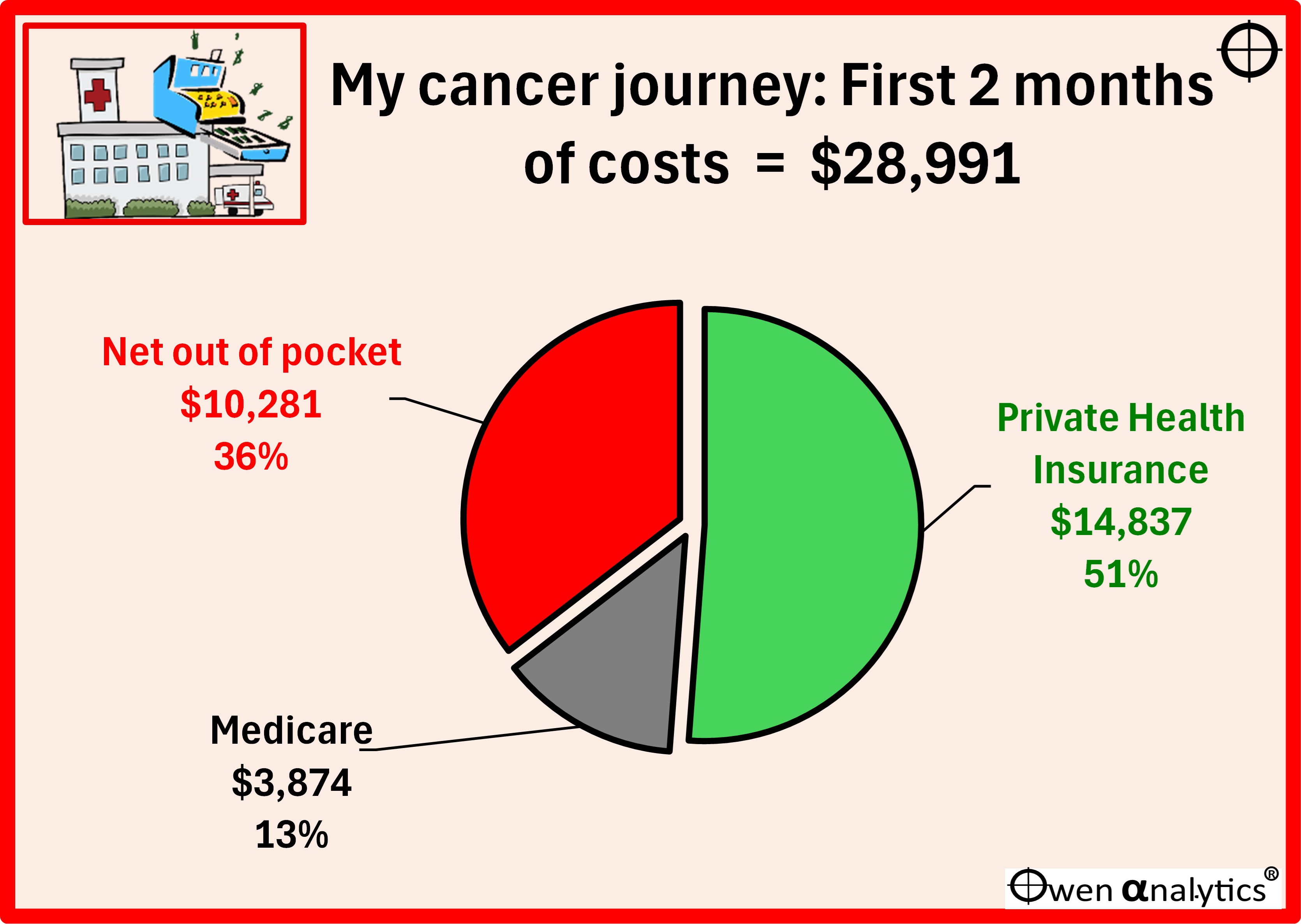
- Private health insurance covered 51% of costs – much less than I had expected. Medicare covered 13%, so I was out of pocket $10k, or 36% of the total.
- Turns out, private health insurance is actually a lot CHEAPER than the Medicare Levy/Tax (for tax-payers anyway).
- I found there were at least eight different ways in which medical costs are paid - very confusing (for me anyway!)
- I’m lucky to live in a country with a vast array of world-class public and private health facilities and professionals (or more correctly, I’m lucky to live near the centre of a big city where they are concentrated).
- I am also lucky to live in a country with comprehensive public and private health insurance.
- Next stop: chemotherapy (starting today). That will be a whole new adventure on which I will report in due course. Wish me luck!
Busy first two months!
This article is about the costs of the first two months of my cancer journey - from early December 2025 when I received the positive result in from the Government’s regular (free!) Bowel Scan program, up to early February 2026.
A lot happened in that initial two months – including GP visits, tests, scans, consults with surgeon & anaesthetists, plus the colonoscopy, more tests, then cancer surgery (hemicolectomy to remove the right side of the large intestine, plus appendix, lymph nodes, and surrounding tissues), then post-op tests, biopsies (confirming Stage 3 cancer), consults with oncologist, and prepping for chemotherapy.
For my report on the surgery see –
As I am 95% recovered from the surgery I can now reflect on the costs – what they were, and how they were paid. This is a whole new ball-game for me, both medical and financial.
Total costs and who paid
In the initial two month period there were 27 medical bills totalling $28,991. Here is a break-down of who paid them:
As I am new to this game, there were certainly some surprises.
Medicare
Medicare paid for $3,900 (13%) of the total costs. Although Medicare is run by the federal government and funded by taxes collected from all personal income taxpayers, the share of my medical costs that were paid by Medicare was actually NOT paid by other taxpayers. I have been paying the Medicare Levy (tax) on top of my regular income tax every year since it was introduced in 1984.
Over those 40+ years I reckon I have paid well over $100k in Medicare taxes, on top of regular income taxes, so I am actually just getting back a fraction of that now.
(The annual Medicare Levy/Tax is currently 2% of taxable income each year, paid on top of regular income tax payable. The rate has been 2% since 2014, and before that it was 1.5% from 1995, 1.4% from 1993, 1.25% from 1986, and 1% from 1984. I started working full time in Australia in 1983.)
Medicare covers different proportions of the ‘cost’ of different types of services, but it only covers a set proportion of the ‘Scheduled’ fee for each service, NOT the proportion of what is actually charged for the services. Big difference!
There are probably GPs, specialists, surgeons, anaesthetists, etc out there who charge just the Scheduled fee (‘bulk-bill’) for their services, but I have not come across them. Even for my occasional GP visits over the years, the GP cost was always well above the Scheduled fee covered by Medicare.
It may be a ‘post code’ thing. I am fortunate to live near the centre of Sydney, very close to major public and private hospitals and a wide array of medical services and professional practices.
I have no problem with this. But I am philosophically opposed to universal, non-means-tested ‘entitlement’ benefits.
Having said that, I am certainly grateful for the federal government’s ‘free’ bowel scan tests that I guess are funded by the Medicare Tax. As there were no symptoms, I almost certainly would not have done the tests had they not arrived in the mail for ‘free’ every two years.
Private Health Insurance
I have had the same cover from the same private health insurer for many years. The main reason for getting private health insurance cover was to avoid paying the ‘Medicare Levy Surcharge’ (which is an additional penalty tax on top of the 2% Medicare tax each year) if I did not have private cover.
(46% of Australian adults have private health insurance, so the majority still rely on the public system.)
The cover I have is Australian Unity’s ‘Intermediate Hospital Silver Plus’ and ‘Mid Extras’, which costs a little over $3,000 per year. (NB. I receive no financial or non-financial benefit from mentioning their name here.)
Private Health Insurance is a lot cheaper than Medicare Tax
The private health insurance premium may sound like a lot of money, because it is a visible, discrete, discretionary cost you consciously pay each year. But it is actually a lot less than the cost of the annual 2% Medicare Tax on income, which just disappears before it even hits your pocket.
Over the past 40 years I have probably paid two to three times more in Medicare Taxes than I have paid in private health insurance premiums.
So private health insurance is actually cheaper than the Medicare Levy/Tax (for high income tax-payers anyway).
Why ‘Silver Plus’ cover and not ‘Gold’?
Years ago when I looked at the various levels of cover, I concluded that ‘Silver-Plus’ was the best bang for the buck for my circumstances. The more expensive ‘Gold’ level seemed to have a lot of peripheral things that appeared to be aimed at enticing young-uns to sign up.
I have not thought about it much over the years as I rarely made any claims (mainly dental). From what I have seen, all of the competitors offer pretty much the same types of cover for the same types of premium costs.
However, they are all similar in the key aspect that what they pay out is based on the government’s ‘Scheduled’ fee for each service, not the actual price you pay, which is usually a lot higher.
‘Schedule fee’ versus actual fee charged
Because Medicare and private insurance payouts are based on the Scheduled fee for each service, and not the actual cost, it means there is usually a fair chunk of the costs left to pay personally.
I have no problem with this. My main interest here is in coming to grips with the complexity of how the whole system works!
For example, private health insurance policies cover ‘Private Hospital’ costs. This sounds good on the surface, but is a little misleading. Private health insurance covers just the basic expenses in hospital – including the daily room fee, and general nursing staff, etc.
But the biggest cost items in a hospital procedure are usually the surgeon and anaesthetist, and only a fraction of their costs are covered by Medicare and Private insurance.
For example, the surgeon’s cost for my hemicolectomy surgery was $7,000, which I paid in full up front. Medicare refunded $943 (13%), and private insurance refunded $314 (4%).
This is because the official Scheduled fee for item 32003 (‘Large Intestine resection, with anastomosis, including right hemicolectomy’ - https://www9.health.gov.au/mbs/search.cfm?q=32003&sopt=I), is currently $1,258.45. That’s a fraction of the $7,000 I paid.
I guess I could have shopped around for a cheaper surgeon, or gone overseas as I know many people do, but who knows what I would have got and how long I would have to wait. I just used the surgeon recommended by the GP, as he seemed like a good fit after a couple of consults.
Of this Scheduled fee of $1,258 for the surgeon, 75% was covered by Medicare, and the other 25% was covered by private health insurance, so I am still up for $5,742 out of pocket.
Likewise for the assistant surgeon, the three anaesthetists for different procedures, and other specialists (eg oncologist).
I could have shopped around to get the best deal on every item and every procedure, but I would not know where to start, and I have neither the time nor the expertise to ‘shop around’. Meanwhile, the cancer is growing!
Many different ways things are paid
Another surprise for me was discovering the many different ways medical costs are paid. Thus far I have discovered eight different methods. Here are the total costs divided into the eight different payment mechanisms:
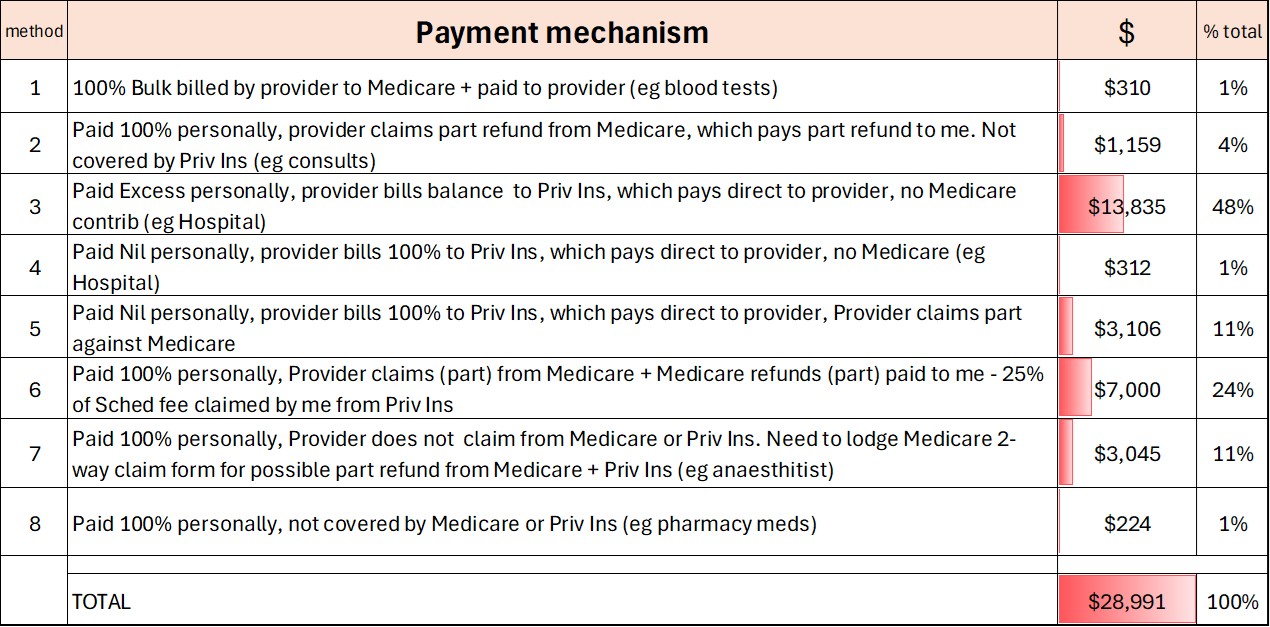
For example – what I have called ‘method 1’ is items that are 100% ‘bulk-billed’ from the provider straight to Medicare, and then Medicare pays 100% of the bill, so I never see or pay a bill. In my case this was just the blood tests, So fully-covered Medicare ‘bulk-billed’ costs amounted to just 1% of the total cost.
At the other end of the scale is ‘method 8’ – items that I paid personally, with no contribution from either Medicare or private health insurance – like pharmacy meds. Also 1% of total costs. (I acknowledge that some of the pharmacy meds are probably subsidised by the PBS which I guess is funded by the Medicare Tax.)
In between are six other methods of payment, each with a different order of events – who pays, who claims, who refunds. Some things have contributions from Medicare but not private insurance. Others have contributions from private insurance but not Medicare. Some have contributions from both, but a different order of who pays and who refunds, etc.
Confusing? It certainly was for me!
Why is it important? Because it is quite easy to accidentally double pay a bill, or not pay a bill, or not claim where I should have claimed, or claim where I should not have claimed. Especially when recovering from an operation, or under the influence of drugs (medical of course!), and/or feeling less than my best physically and/or mentally!
I am only two months into this journey, so I am sure to learn more as the journey continues.
Next stop – chemotherapy! (starting today). That will be a whole new adventure on which I will report in due course. Wish me luck!
‘Till next time. . . . safe investing – and stay healthy!
See also –
- My Life in Weeks: 83% done, but there’s a nasty new twist this year. “Life’s like a box of chocolates. . .” (4-Jan-2026)