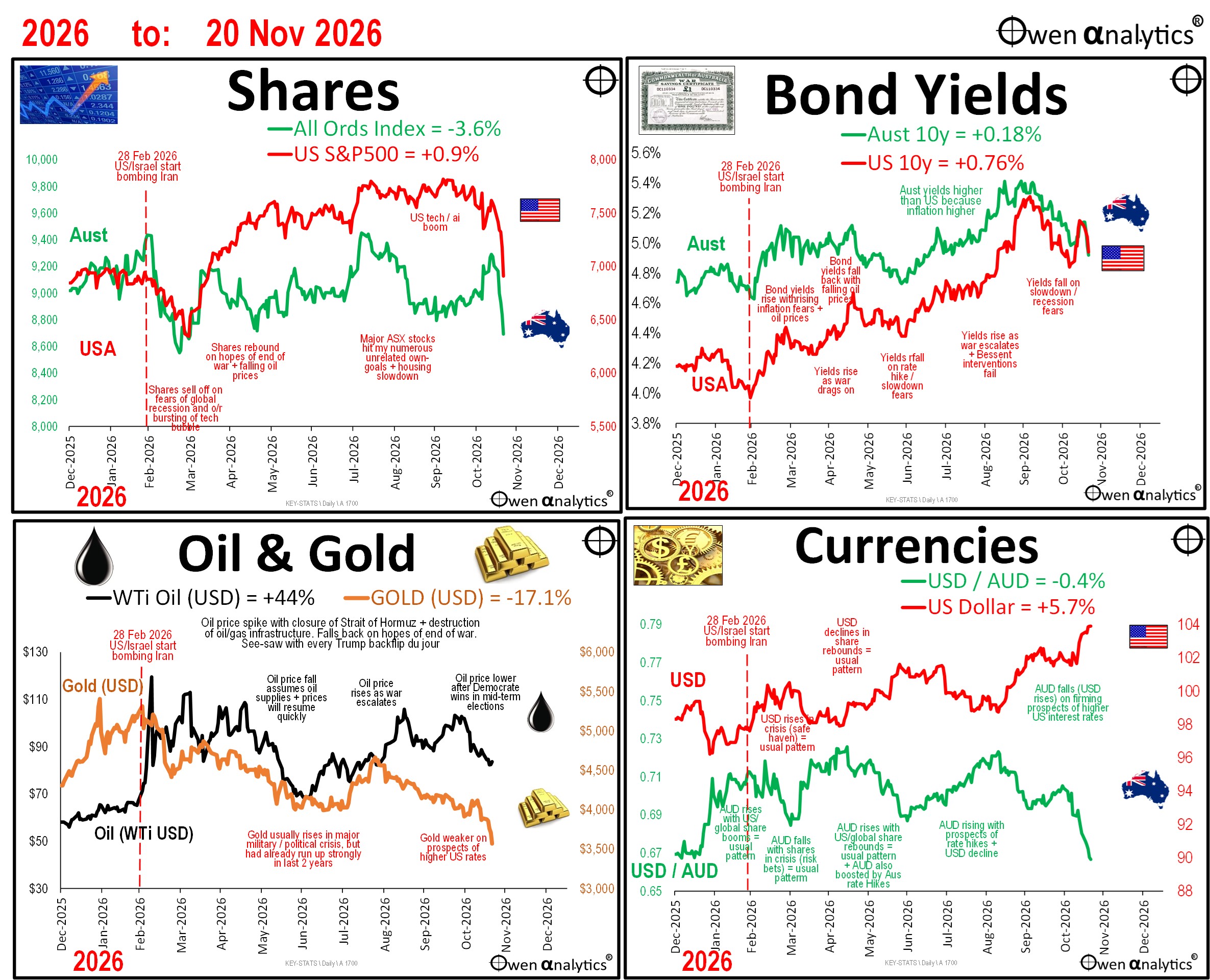
Owen’s Market Pulse: 20 Nov 2026 - More nails in the coffin for the ai boom?
Last week I wrote that Nvidia founder/CEO Jensen Huang’s sudden implosion that triggered Nvidia’s share price plunge by one-third was “probably just another factor culminating in the end of the ai bubble (along with persistent inflation, rising cash rates, rising bond yields, failed IPOs, escalating wars, out-of-control deficits/debts, regulatory attacks, worsening ai / cyber hacks). While these negative factors pile up, the final trigger is often some completely unrelated event.”
This week added more nails in the coffin. Nvidia’s broadening scandal overshadowed its good profit results. Trump’s threat to tax US companies investing in data centres outside the US will probably be another TACO brain spasm but it adds to the pile of negatives.
Share markets
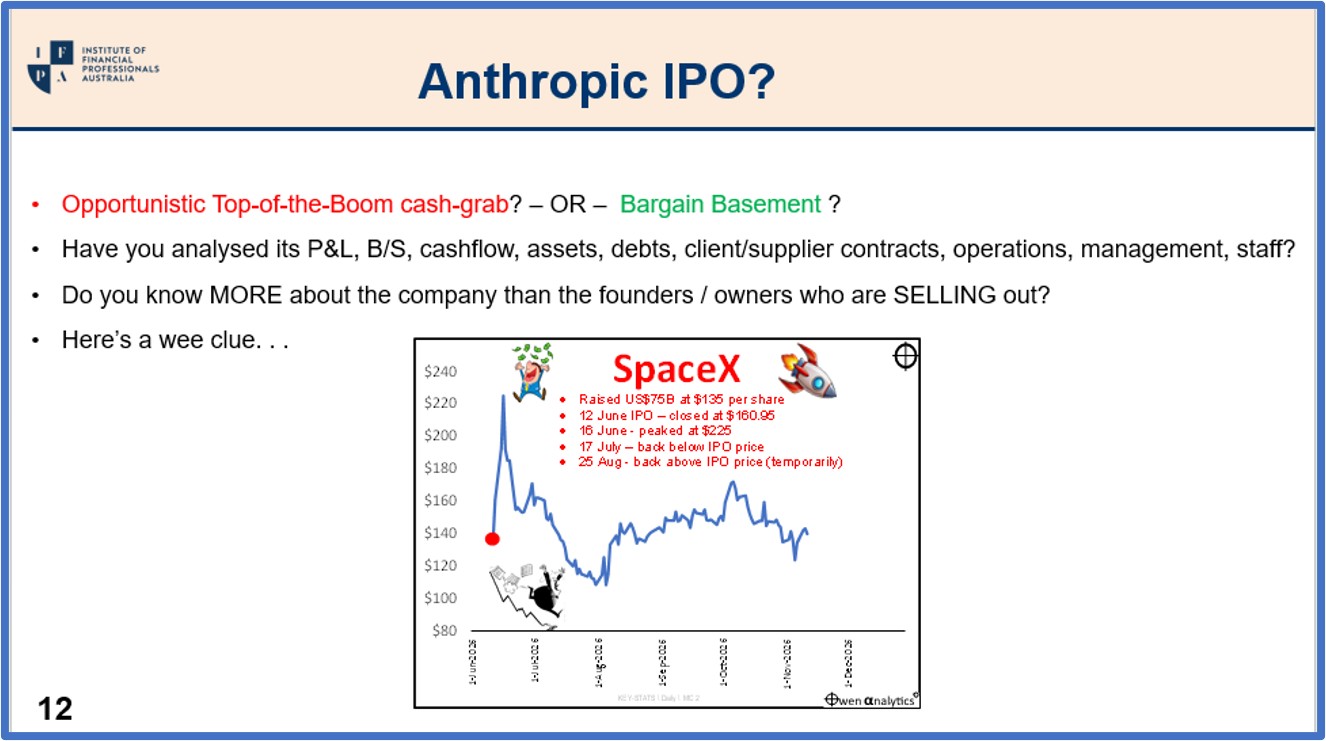
The only positive was Anthropic (the company, not its new shareholders). Its opportunistic top-of-the-boom FOMO cash-grab raised $98b at $83 per share. Shares started trading at $97 on Thursday, peaked at $115, but fell back to $88.91 by Friday’s close.
Here’s what I said about the Anthropic IPO in my recent webinar for IFPA (before the IPO) -
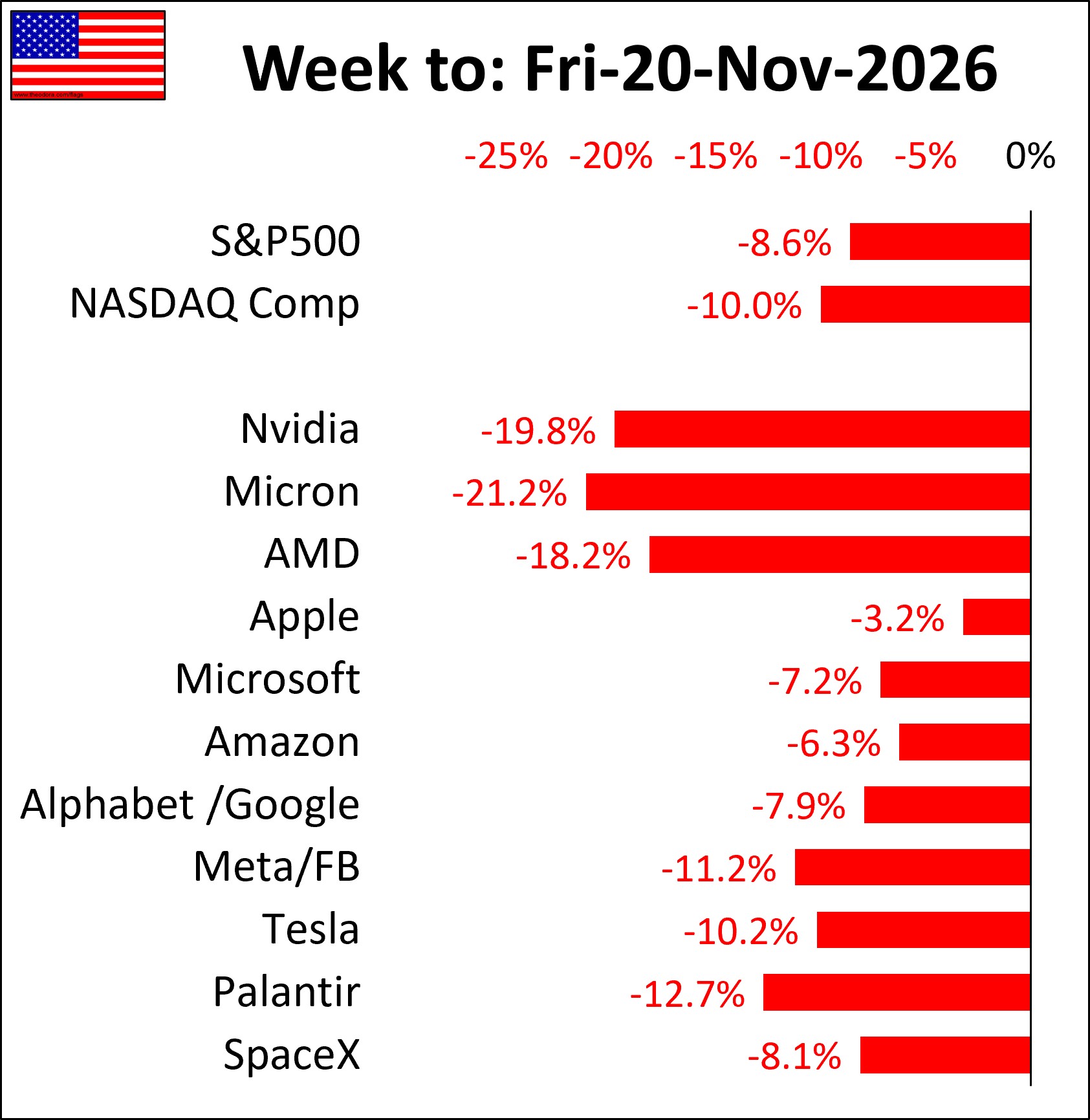
Just about everything else was down. The NASDAQ Composite fell 10% for the week and the broader S&P500 fell 8.6%. Now 11.6% below its 6 October peak, but is still ahead for 2026 year to date (just).
OIL
Down further. Back below $85 in US and below $95 in Europe on hopes that new best buddies Trump and Putin will stop their wars on Iran and Ukraine. Fat chance. Their egos won't allow it
GOLD
Down further. Below $3,600/oz on likely higher US interest rates.
ASX
The ASX was also down 5.6% for the week. Now down 4% for the year. Although we have virtually no tech sector, BHP is now a copper play, so it fell with global copper prices. Data centres consume less than 2% of world copper demand, but copper and copper miners like BHP are seen as proxies for the ai trade.
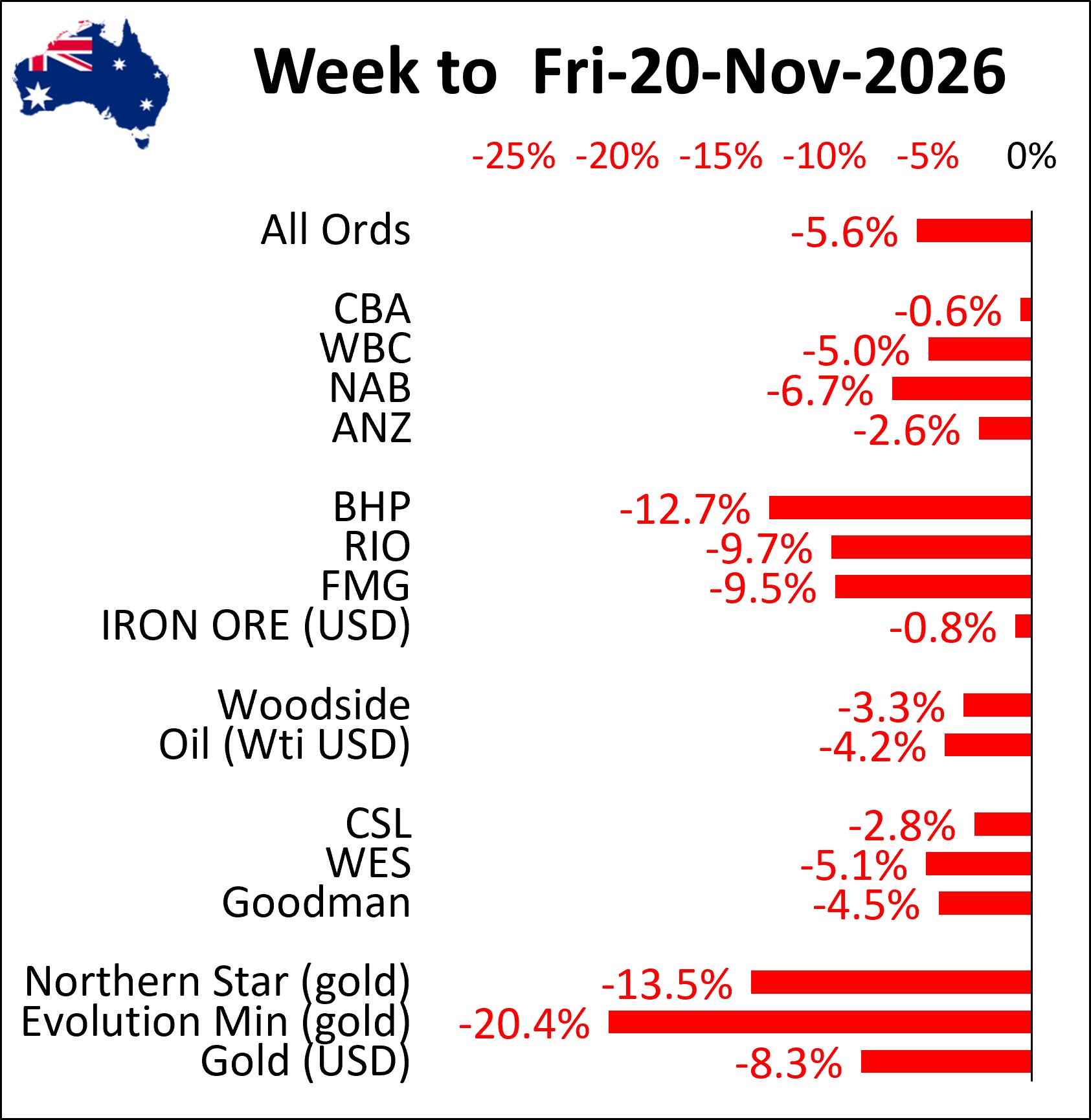
ASX Gold miners were also down heavily with lower gold prices, and oil/gas stocks fell with oil prices. The banks were also down due to more talk of recession, falling house prices, rising unemployment, and more retailers going under.
BONDS
Bonds had a rare positive week. Yields on 10-year US and Aust treasuries are back down below 5% on recession fears, but yields are still up across the board year-to-date (inflation, deficit spending sprees, foot-dragging by central bankers).
FX markets
The USD and AUD are following their usual pattern: USD rising as a ‘safe haven’, AUD falling as a ‘risk’ play.
MY TAKE
I repeat last week’s warning that more money is lost trying to avoid corrections than in the actual corrections themselves (Peter Lynch, 1989). I have not under-weighted shares, but I am biased toward ‘Quality’, ‘Low Volatility’, and ‘Fundamental Indexing’ (which are defensive in nature), and I am sitting on a lot of cash waiting to deploy. No rush. Better buying opportunities on the way.
For a deeper dive into these topics see the articles below - or browse the hundreds of free articles on my web site (100% cost-free. 100% conflict-free. 100% ai-free).
Backgound
I track and analyse thousands of data points across all markets and asset classes, but the most important barometers and drivers of local and global markets for my day-to-day purposes (answering questions from media & colleagues, and mentoring advisors & portfolio managers in managing their client portfolios and client comms) are the following key items:
- Share markets (Australia & US)
-
- the Aussie market as it still anchors most long-term diversified portfolios
- the US market as it dominates (financial and sentiment) global markets
- Treasury bonds (Aus & US)
-
- because fixed rate bonds still make up a sizeable chunk in most long-term diversified portfolios,
- and because treasury yields reflect expectations of future inflation and interest rates, which directly affect other asset classes including shares, real estate, commodities, currencies.
- Currencies (AUD & USD)
-
- The AUD because it is a ‘risk’ currency, which it ALWAYS falls in general global sell-offs as global (mainly US) investors dump foreign risky assets and retreat to the safety of the US. Conversely, but in general global rebounds and booms, the AUD usually (but not always) rises as foreign investors (mainly US) venture back in.
- The USD as it is the global reserve currency on which everything else is anchored,
- Oil – because fuel prices filter directly or indirectly into just about every inflation category, and inflation expectations drive interest rate decisions and bond yields, which in turn affect the pricing of all other assets.
- Gold – as it is the original ‘hard currency’ and it is still a good proxy measure for how investors, governments, and central banks are felling about future inflation and political / civil / military unrest and disruptions.
This handy set of four charts track changes in these key markets since the start of 2026, and is my quick go-to daily reference point.