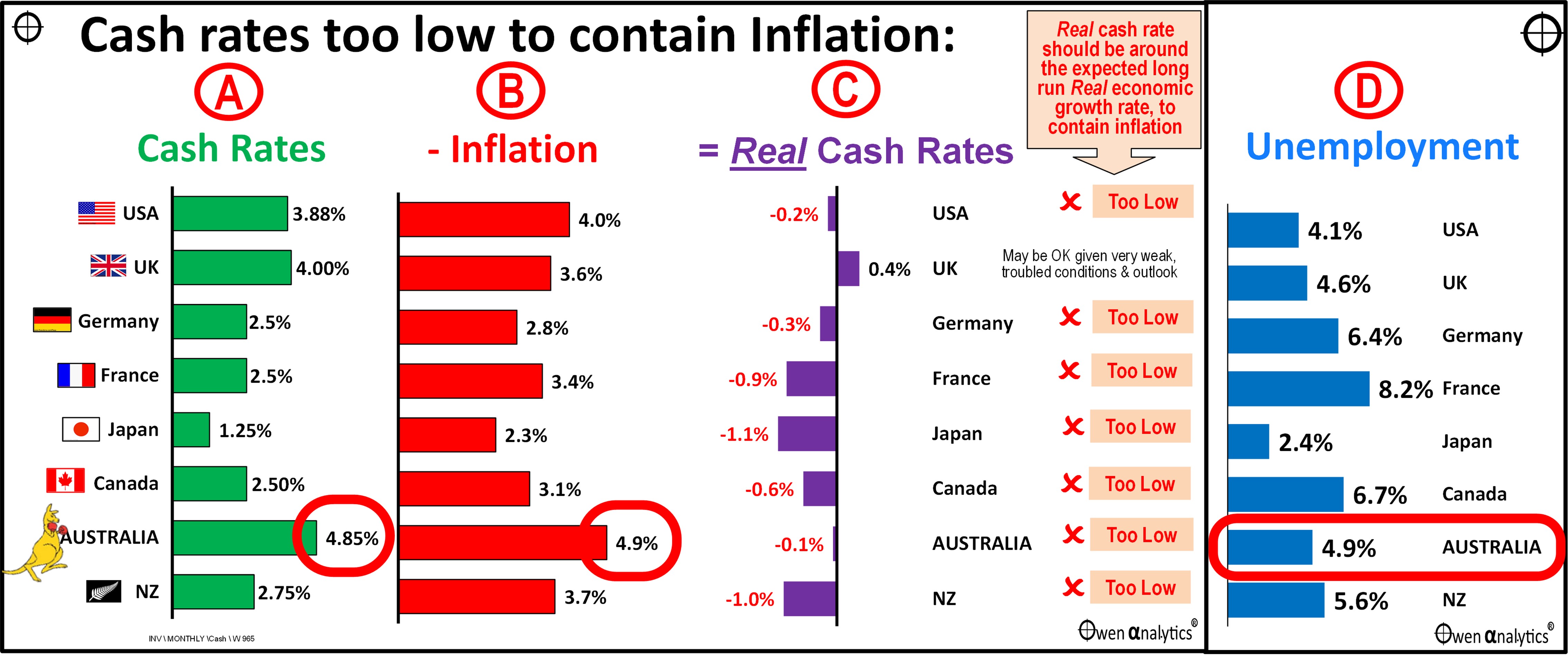
Cash Rates still too LOW relative to Inflation. The cure? Higher CASH rates, higher UNEMPLOYMENT or Recession. Hopefully not together (the 1970s stagflation nightmare scenario)
Greetings fellow investors.
Australia still has the highest inflation AND highest cash rate in the rich world. But Jim Charmer continues to smirk and blame foreign wars! Here are the FACTS:
· BEFORE Russia invaded Ukraine in Feb 2022, inflation was already 3.5% annual rate and 5.0% annualised 3-month running rate.
· BEFORE the start of the US-Iran war in March 2026, inflation was already 3.7% annual and 5.2% running rate
But government keeps spending and borrowing as Commonwealth debt sailed passed A$1 trillion (plus another $860B in State debts).
Impact of wars on fuel prices
The wars did raise fuel prices but these were ONE-OFF rises in the price LEVEL, NOT an on-going rise in the RATE of price GROWTH (ie not ‘inflation’).
Eg the introduction of the GST in July 2000 was a one-off rise in the price LEVEL, not a ‘baked in’ rise in the inflation RATE. (I use the term ‘baked in’ because that is how RBA chief Michele Bullock described Australia’s current inflation problem - 3 Nov 2026 RBA speech.)
Who’s to blame for domestic inflation?
1) Federal government deficit/debt-fuelled spending - business-case-free hand-outs / subsidies to political pet projects; productivity-free wage rises; non-means-tested handouts / subsidies / welfare; non-means-tested ‘cost of living relief’ that entrenches inflation;
2) State governments’ out of control deficit/debt-fuelled spending sprees;
3) The RBA – kept cash rates too low for too long in Covid; ultra-cheap lending to banks intended for business but instead just inflated the housing bubble; three unjustified rate CUTS in 2025 (election year)
The first three rate hikes in 2026 are just reversals of the three unnecessary rate cuts in 2025, so we’ve only really had two rate hikes this cycle.
Real cash rates
The key is REAL cash rates (cash rate minus inflation, chart C). Australia’s Real cash rate is still far too LOW to contain inflation. What is the ideal non-inflationary Real cash rate (known as r*)?.
The Real CASH rate should average around the same as the expected long-run average real economic GROWTH rate. From 1980 to 2009 (GFC), Australia’s REAL cash rate averaged 3.5% - ie cash rates averaged 3.5% above inflation. The same as our real GDP growth rate of 3.4% pa above inflation for the period.
Future real economic growth of say 2.5% pa would require cash rates of around 2.5% above inflation ie nominal cash rates averaging around 5% to 5.5%.
Even the government’s latest pessimistic Intergenerational Report forecasts real economic growth of just 2% for the next 20 years, which would call for Real cash rates around 2%. Not Zero as it is now.
Real cash rates are also still too LOW in other rich countries, except perhaps UK due to its weak and troubled outlook.
Unemployment
Our UNEMPLOYMENT rate is also on the rise (Chart D), but still lower than Canada, NZ, Germany, France and others. The RBA is prepared for unemployment to rise further to slow spending and inflation.
The Cure?
The CURE for our inflation problem? With cash rates still far too low relative to inflation, and federal / state governments refusing to run SURPLUSES to slow demand (their main policy tool), inflation would be tamed by higher unemployment, with or without higher cash rates, and/or a significant economic contraction (recession).
The worst case scenario is all three, with persistent inflation preventing aggressive rate cuts - the nightmare 1970s ‘Stagflation’ scenario unfolding now.
'r*’ (r-star)
Central bankers use the term ‘r*’ to refer to the ideal non-inflationary real cash rate. There is much debate on the optimal value of r*. Probably the leading thinker on r* is John C Williams, and he is also the most relevant authority as he is President and CEO of the Federal Reserve Bank of New York, and Vice Chair of the Federal Open Market Committee which sets Fed rates.
Estimating r* is difficult (Williams calls it a ‘hall of mirrors’) because it involves not only estimating likely future economic growth but also estimating future supply and demand for savings. Here is a recent paper by Williams on r*.
For more on RBA inflation targeting and r* -
· Australian inflation well ABOVE target once again. Here’s how I rate the RBA’s record on inflation targeting (20-July-2026)
‘Till next time – happy investing and stay healthy!