Saturday, September 19, 2026

linkedIn

Iran war hands politicians another free ticket to blame oil prices for inflation & rate hikes!

14 Mar 2026 6 month(s) ago 2 Comments

Key Points:

    • The new war in Iran is about to hand politicians yet another ‘get out of jail free card’ – to blame rising oil prices for inflation, diverting attention from the real causes of persistent inflation: loose fiscal policies (spending sprees financed by deficits and rising debts), loose monetary policies (low nominal and real interest rates), plus some pre-existing supply constraints.
    • Politicians of all flavours to this day still universally blame the 1970s inflation and stagflation on the oil shocks in 1973-4 (Yom-Kippur war/OPEC embargos) and 1979 (Iranian revolution).
    • They also routinely cite rising energy prices following Russia’s invasion of Ukraine in 2022 as a main cause of the post-Covid stimulus inflation.
    • The problem is that inflation was ALREADY high and rising well BEFORE each of these oil shocks. Here are the facts:
    • BEFORE the 1973-4 oil shock, inflation was already running at 7.4% in USA, 9.3% in UK, and 10.1% in Australia.
    • BEFORE the 1979 oil shock, inflation was already running at 8.9% in USA, 7.8% in UK, and 7.7% in Australia.
    • BEFORE the Feb 2022 Russian invasion of Ukraine, inflation was already running at 7.8% in USA, 4.8% in UK, and 3.5% in Australia.
    • BEFORE the end of Feb 2026 start of US/Israeli bombing of Iran, inflation was already running well above target: 2.4% in the USA, 3% in the UK, and 3.8% in Australia. And that was while oil prices were falling over the prior year!
    • Get ready for another barrage of lies that will blame the war in Iran for inflation, rate hikes, and rising mortgage repayments.
    • Once again diverting attention from the real causes – uncontrolled, largely ill-directed, productivity-sapping government deficit spending sprees, plus still loose monetary policies (low nominal and real rates).
    • We deserve better!


Today’s charts show oil prices, annual CPI inflation rates in USA, UK and Australia before, during, and after the three ‘oil shocks’ that are universally but incorrectly blamed for inflation, plus the current situation:


Here are the facts about oil prices and inflation:

1973-4 oil shock

The main events included:

  • The ‘Yom Kippur’ War (6-25 October 1973) in which Arab states led by Egypt and Syria (and backed by USSR) attacked Israel (backed by US) to try to win back territory seized and occupied by Israel in the 1967 ‘Six-day war’.
  • From 17 October to January 1974 – several initiatives by Saudi Arabia and other OPEC members to cut production, raise prices, and impose embargoes on US in retaliation for US backing Israel.

As a result of these measures, the benchmark oil price quadrupled from US$2.90 to $11.65. Here is what happened to oil prices and inflation before, during and after the crisis:


Impact of the oil price spike on inflation? Only a late contributor, NOT the primary cause. By September 1973 (before the oil shock), inflation was already running at very high and rising levels:  

  • 7.4% in USA
  • 9.3% in UK
  • 10.1% in Australia

The main reasons for rising inflation in the early 1970s included rising government spending from the mid-1960s (including tax-cuts, ‘nation-building’, social infrastructure, Vietnam War spending), some very poor and counter-productive policy responses to inflation in the early 1970s, and some monetary policy errors.

1979 oil shock

The main events in the late 1970s oil shock included:

  • November 1978 Iranian oil worker’s strike.
  • 11 Feb 1979 – Iranian Revolution, resulting in the overthrow of US/UK backed Shah of Iran (House of Pahlavi, which had ruled since 1941), and replaced Ayatollah Khomeini’s Islamic Republic.
  • 4 Nov 1979 – Tehran students siege of US embassy, taking 52 US hostages who were finally rescued 444 days later on 19 Jan 1981 after several failed and costly attempts by the US.
  • 22 Sep 1980 – Iraq (Saddam Hussein) invades Iran to capitalise on the revolutionary turmoil in Iran.

Here is what happened to oil prices and inflation before, during and after the crisis:


Impact of the oil price spike on inflation? Only late a contributor, NOT the primary cause. By October 1978 inflation was already running at:

  • 8.9% in USA
  • 7.8% in UK
  • 7.7% in Australia

Once again, the real causes of the 1970s inflation and stagflation (simultaneous inflation and low economic growth) had their roots in the rising government spending from the mid-1960s, poor/counter-productive policy responses to inflation from the early 1970s, and monetary policy errors throughout the 1970s until the appointment of new Fed Chair Paul Volcker in August 1979.

2022 Russian invasion of Ukraine

Likewise, inflation was already running out of control by the end of 2021, which was BEFORE Russia invaded Ukraine (February 2022).

Here is what happened to oil prices and inflation before, during and after the crisis:
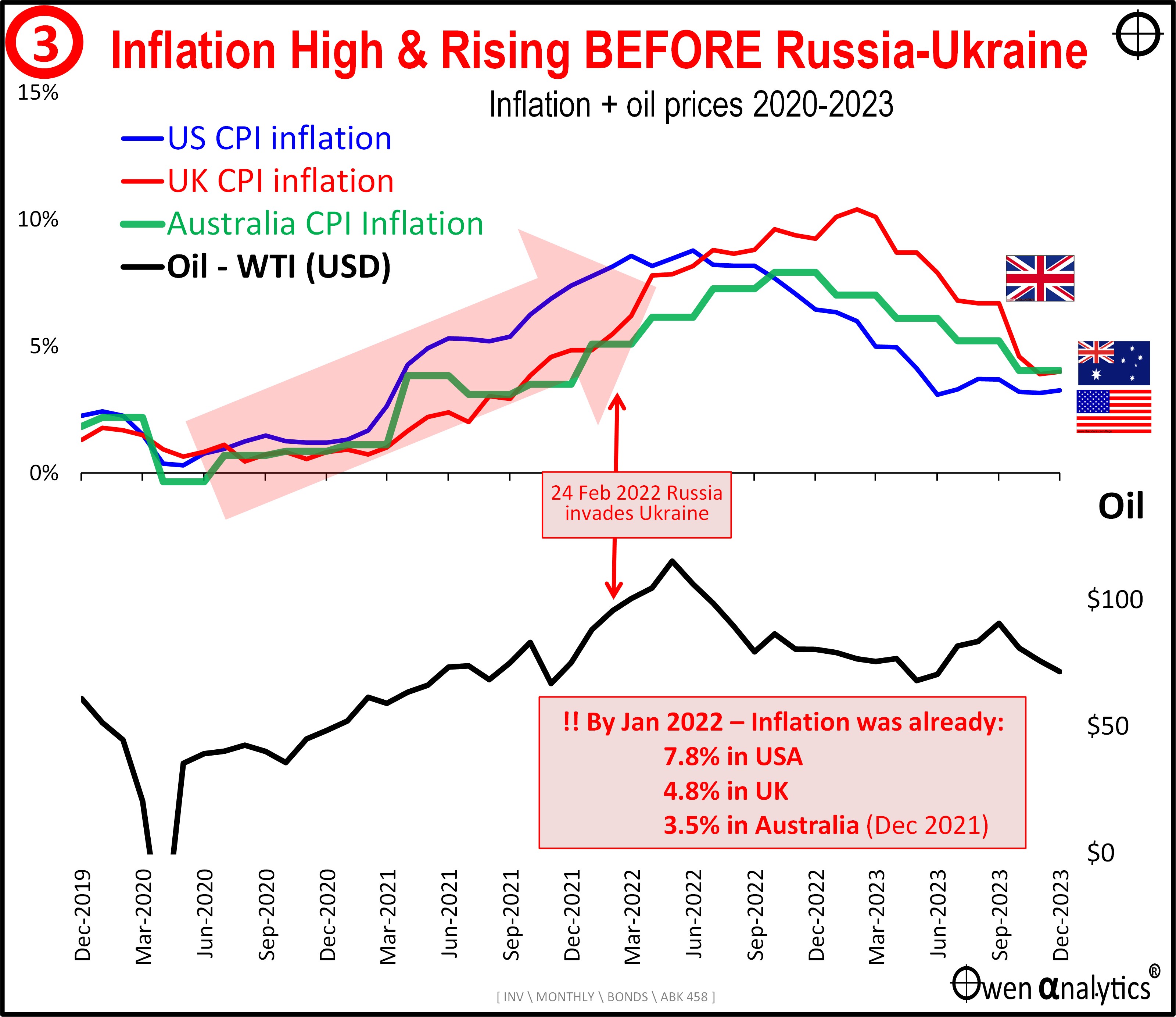
 

Impact of the oil price spike on inflation? Only a later contributor, NOT the primary cause. By December 2021 which was BEFORE Russia invaded Ukraine (24 February 2022), inflation was already running at:

  • 7.4% pa in USA (and annualised quarterly rate of 9.8% pa)
  • 5.4% pa in UK (and an annualised quarterly rate of 9.4% pa).
  • 3.5% pa in Australia (and an annualised quarterly rate of 5% pa).

Each of these were well above target ranges already. Nothing to do with Russia.

The post-Covid inflation was the result of ultra-loose fiscal policies (governments throwing money at anything that moved, running up wartime-like deficits and debts), plus ultra-loose monetary policies (central banks cutting interest rates to zero and even negative (Japan, Europe), artificially supressing long rates with ‘QE’ money printing, handing out ultra-cheap loans to banks, etc).

There were also supply constraints that raised prices, but they were the direct and indirect results of government policies (lockdowns, closed borders, etc).

2026 War in Iran

Here we are again with inflation running above target here and in other countries – despite oil prices declining over the prior year, and now another oil price spike is about to let governments here and everywhere divert attention from the real causes of persistently high inflation.

Oil prices had been declining during 2025 but suddenly shot up to $120 (for one day - Sunday 8 March 2026) but quickly fell back to $100, where it is now (13 March). This is still below the price peaks in early 2022 after Russia’s invasion of Ukraine.

Here is the current picture on oil prices and inflation:
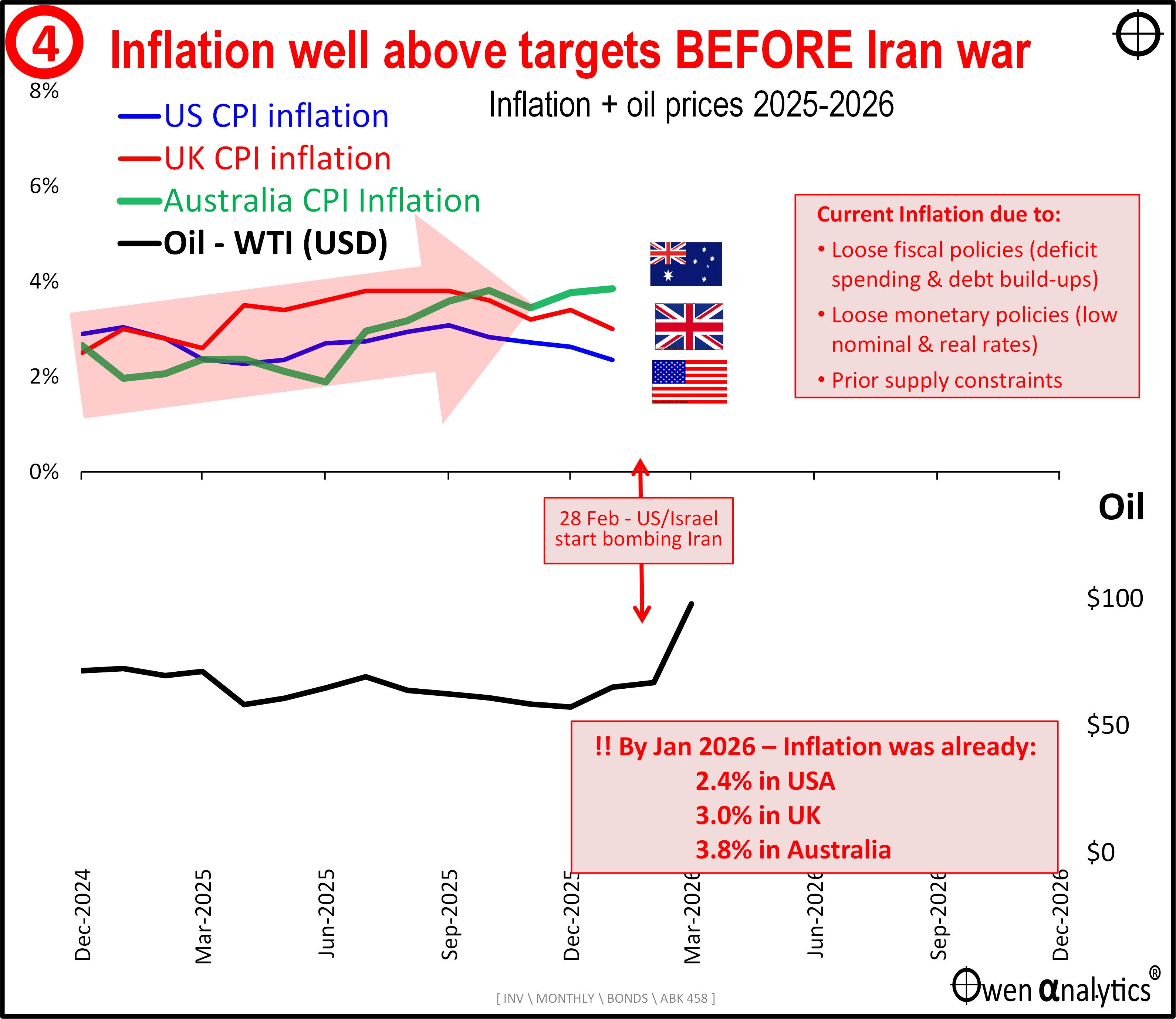
 

By January 2026 (before the end of Feb 2026 start of US/Israeli bombing of Iran), inflation was already running well above target:

  • 2.4% in the USA
  • 3% in the UK,
  • 3.8% in Australia.

And that was with oil prices falling over the previous year while inflation still remained stubbornly high.

Get ready for another barrage of lies and mis-directions that will blame the war in Iran and resultant oil price spike for rising inflation, interest rate hikes, and rising mortgage repayments.

Government ministers and even the RBA will start pointing mainly to ‘international events’ and ‘external influences’ out of their control.

Once again diverting attention from the real causes – uncontrolled, largely ill-directed, productivity-sapping government deficit spending sprees, plus still loose monetary policies (low nominal and real rates).

We deserve better!

‘Till next time – happy investing and stay healthy!


See also:


Related Articles

2 Comments

Existing Comments

Thanks dave. I do what i can!
Thanks for reading + please keep up the likes + comments!
Cheers
Ao

Ashley owen
March 15, 2026

Nothing like some good economic history to assist with the current analysis. Thanks Owen.

David Matthews
March 14, 2026

Leave a Reply

Ashley Owen


Please subscribe to my Newsletter, connect on LinkedIn, or follow me on Twitter X 


Experiences


Director/Principal, Owen Analytics Pty Ltd (current)

Investment Markets Research & Analytics, Portfolio Construction & Management, Corporate Finance, Venture Capital, M&A, and IPOs. Investment Committee membership, consulting to advice firms and financial institutions.

Co-founder & Regular Contributor, Firstlinks (current)

Co-founder of Australia's leading investment and superannuation newsletter and website for industry professionals and investors.

Non-exec Director, Third Link Investment Managers (current)

Leading Australian equities fund-of-funds that donates all management fees to Australian charities. The fund has donated in excess of $21m to a range of Australian chartities since inception in 2008. 

Chief Investment Officer, Stanford Brown (past)

Responsible for managing over $2 billion AUM in multi-asset class portfolios and discretionary accounts at a privately-owned advice practice.

Director & Joint CEO at Philo Capital Advisers Pty Ltd (past)

Specialises in investment portfolio construction & management, multi-asset class asset allocation, and global macro strategies.

Check out my full bio here

“Ashley is one of the best writers and thinkers on financial markets in Australia. His unique analysis and research is always fact-based and insightful, not the usual uninformed market noise and waffle that infects the mainstream financial media.”

Graham Hand - Editorial Director of Morningstar Australia, including Founder/Managing Editor of FirstLinks, Australia’s leading newsletter and publishing service on wealth management, superannuation, and personal finance.

“Ashley has the rare ability to ground insightful analysis in solid data and to present it in readily understandable ways. His wry, detached style and focus on the long term is rare and willingness to share a lifetime of learning and thinking appreciated by all who come to know him.”

Toby Potter - Chair, Institute of Managed Account Professionals (‘IMAP’), the peak industry body for the discretionary managed accounts industry in Australia, representing investment managers,  advisers, Managed Account providers, and technology companies. It is the primary thought-leader for the industry in Australia, and provides training and industry events and conferences.

“Over the past 20 years, Ashley has been an invaluable assistance to me, as a reliable source of unbelievably strong and interesting data, and many good investment ideas.” 

"The depth and quality of Ashley’s research and analysis of investment markets is the best in the business.”

Dr Don Stammer - Australia’s most respected economic writer, commentator, and speaker for the past 40 years, with a distinguished career including the Reserve Bank of Australia, Chief Economist at Deutsche Bank Australia for 21 years, chair of nine ASX companies, plus numerous non-listed and not-for-profit boards.

“Ashley’s unique fact-based analyses and insights into Australian and global markets are always worth reading. He has an incredibly deep and comprehensive store of financial markets data.”

Chris Cuffe, AO – One of Australia’s best known and most experienced investment managers – former CEO of industry giants Colonial First State, then Challenger Financial; founder and Chair of Australian Philanthropic Services, and Third Link Growth Fund; current/former chair, director and/or investment committee member of numerous funds including UniSuper, Argo Investments, Hearts and Minds Investments, Paul Ramsay Foundation, and many others.

“What sets Ashley Owen’s analysis apart from investment banks and the financial press is his deep fact-based understanding of long-term financial data, rather than getting caught up on the daily noise over issues that may generate trades or sell newspapers today, but will be irrelevant and misleading two years from now.” 

Hugh Dive, CFA. Chief Investment Officer, Atlas Funds Management, and frequent expert commentator quoted in the AFR.

‘For many years, Ashley has been my go-to source of information and analysis on what’s going on in financial markets and why.’

“Ashley has an encyclopaedic knowledge of the markets – I call him Mr Google!”

Noel Whittaker, AM – Australia’s best-known personal finance writer, columnist, and media commentator for the past three decades. He has written more than 20 books on personal finance, his regular columns on personal finance are published in almost every major Australian newspaper, and he appears regularly on radio and TV as an expert on finance and investing.

"I read all of Ashley's research on financial and economic issues. His data resources, deep knowledge, and original analysis put him in a class of his own."

Ian Macfarlane AC - Former Governor, Reserve Bank of Australia (Australia's central bank), 1996-2006. Former Director, Woolworths, Leighton Holdings, and ANZ Bank. Also on the International Advisory Boards of Goldman Sachs (2007-2016),  the China Banking Regulatory Commission (2011-2014), and director of the Lowy Institute for International Policy (2004-2017).

Copyright © 2026 Owen Analytics

About Ashley Owen | Terms and Conditions | Privacy Policy | Archive | Disclaimer

The information contained in this document relates to historical, factual events and returns, and contains general commentary and observations about financial markets, asset classes, and asset allocation. This document, or any part thereof, does not, and is not intended to, constitute investment advice, or financial advice, or financial product advice, in any jurisdiction in which it is published, re-published or read. It does not recommend, encourage, or influence readers to buy, hold, sell, or deal in any financial product or security. Where securities of financial products are mentioned, it is purely for the purposes of illustration, context, and/or education, and not intended to influence anyone to buy, hold, sell, or deal in it. The information is current when written. All reasonable measures are taken to ensure its accuracy at the time of publication, but the author accepts no responsibility or liability for any errors or omissions. This document is only provided to, and intended for, holders of Australian Financial Services Licences. It should not be used or relied upon by any person or entity other than a duly licenced AFSL holder, or authorised representative thereof. The author receives no benefit, financial or otherwise, from any product provider, or product issuer, or any other firm involved directly or indirectly in the provision or services in or to financial markets or industries, whether mentioned in the report or not. Any opinions expressed by the author are his alone, and are intended for the purposes of education.