Key points:
- How I ended up on the right side of both the mid-1980s share market boom and the October 1987 crash.
- How I came across and put to work the 4 Rules that work in all market cycles.
- How the real world is the exact opposite of what academic finance theory teaches.
- How one-off extreme ‘outlier’ events like the 1987 crash are ignored by finance theory, but they are what define our lives, and determine our future wealth.
- This is the story of my experiences before, during, and after the Crash
Today's story is Part 3 of my thee-part series on the 1987 crash.
Real world -v- finance theory
The October 1987 crash taught me lessons that form the core of my investment philosophy. In many ways it is the exact opposite of academic finance theory. 1987 serves as a reminder to ignore finance theory and focus on what happens in the real world.
Finance theory likes nice, neat lines, it assumes that prices are always ‘fair’, that all buyers and sellers are perfectly rational at all times, that everyone is armed with perfect and instant knowledge of every single piece of information affecting the price of every asset in the world, that market parameters are always stable and static, and that returns are ‘random’ and ‘normally distributed’.
In the real world, every one of those assumptions is patently wrong.
‘Outliers’ define our lives
Finance theory dismisses one-off extraordinary events like the 1987 crash as random anomalies, simply ignoring them as statistically irrelevant ‘outliers’, and placing no importance on them. In financial mathematics, the statistical outliers are bundled up together and hidden in the ‘error term’ at the end of the formula – ignored and forgotten as irrelevant, with no bearing on the outcome. (Trust me – I teach this stuff!)
I believe in the exact opposite. The extreme outliers are actually the cornerstones of our experiences, they define our lives, and can create or destroy wealth - much more so than so-called ‘normal’ markets. Human life, wealth and happiness is about the one-off outliers.
On our death beds it is the extraordinary and rare outlier events we will remember – our first relationship, first heart break, marriage, birth of children, the loss of close family members, the first job, the windfall sale of a business, the tragic accident, the against-all-odds sporting wins, etc.
It is the once-in-a-life-time ‘outlier’ experiences that shape us as humans.
Outliers determine our wealth
In my experience meeting hundreds of advisers and thousands of their clients, what makes the big differences to their wealth over time is not whether they saved 0.5% in fees here or there, or whether they got an extra 0.5% in returns on a particular fund.
The big differences in determining our wealth and living standards in ten or twenty years are the results of what we do or didn’t do in the big outlier events – especially in the crazy booms and devastating crashes.
I have met many investors who were so traumatised by the big crashes (the 1987 crash, the 2000-2 tech wreck, the 2008-9 GFC, etc) that they panic-sold at the bottom. In many cases it was not voluntary - they were sold up by margin lenders. I have met couples who sold out at the bottom of the GFC, put the money they had left after the losses into bank term deposits, and sat there for the next 15 years, terrified of getting back into the market, and watching their deposit interest rates go to zero, and their wealth being destroyed by inflation.
I have also met investors who got so caught up in the euphoria at the tops of booms, geared up to invest, and some who even sold their homes and then geared up further, to throw everything in the market. I saw this in 1987 and again in the 2003-7 China/credit boom. They lost everything in the crash, and are now renters for the rest of their lives.
What determines if you are rich or poor in future decades hinges on what you do in the frenzied booms and in the frenzied busts along the way.
Doing nothing is actually quite hard!
A far better option of course is to simply do nothing - just ignore the markets completely and go about your daily lives. But a lot of people can't resist chasing the boom. They see their friends making 20% per year or more as the boom gathers pace, and they can't resist having a go themselves (FOMO).
But inevitably they also can't stand the pain of a big sell-off, especially when they got in late at a high price, which is when most people do. As a result they end up 'buying high' and 'selling low'.
Lead-up to the mid-1980s boom
I was lucky enough to be on right side of the both the mid-1980s boom and also the 1987 crash. Mostly it was luck – right place, right time.
I had started out in the early 1980s as a lender with Citibank and Midland Bank (now HSBC). I learned about booms and busts first hand in the aftermath of the building boom at the end of the 1970s which collapsed in the early 1980s recession. A lot of buyers paid (and borrowed) too much for properties in the boom and were wiped out when prices fell in the recession.
For example, first home buyers would buy a house for say $60k (remember the median Sydney house price was $60k in 1980), using say $50k of debt. When interest rates rose to 20% and unemployment shot up above 10% in the early 1980s recession, many distressed borrowers/sellers could only get say $50k for their property, which wiped out their equity entirely, and still left them in debt, after costs. Hardest hit were new housing estates in outer suburbs, and new high rise units.
(In those days before bank deregulation, mortgages were tightly rationed and interest rates were set by the government, so home buyers would get part of the loan as a first mortgage at the regulated rate of say 9% (in 1979), and then borrow the rest on a second mortgage or finance company loan at a much higher rate, say 15%. But in the 1981-3 recession, regulated mortgage rates shot up to 13%, and commercial rates got to 20%.)
In the aftermath of the recession, I was mainly doing commercial asset-based finance, but I also refinanced a lot of those unfortunate buyers/borrowers who had been caught in the boom/recession cycle, especially in new housing estates in outer Melbourne, and in new high rises on Queensland’s Gold Cost.
Yes, you CAN lose money in housing - big time. Just wait for a recession! Remember those?
Taking the plunge
By 1986 I had been promoted from regional lending manager to financial controller roles, building pricing models, profitability models, and management accounting systems for Midland Bank’s finance company, and building money market models for Midland’s merchant bank.
But the markets were booming again in the mid-1980s, with the newly de-regulated banks going mad and throwing money at literally everything that moved.
I was young and single with no debt, so I left the safety net of a salary and moved back to Sydney. I teamed up with three other characters, and we set up a little investment firm. We were a motley bunch - Ted was a wily ex-stockbroker from the late 1960s mining boom, Sam was a tax expert from a chartered accounting firm in West Africa, Howard was an English merchant banker and accountant, and I was a young lender / financial controller with a couple of law degrees and a speciality in spreadsheets (remember ‘Lotus 1-2-3’, the forerunner of Excel?). I was more than a decade younger than the others, but eager to learn.
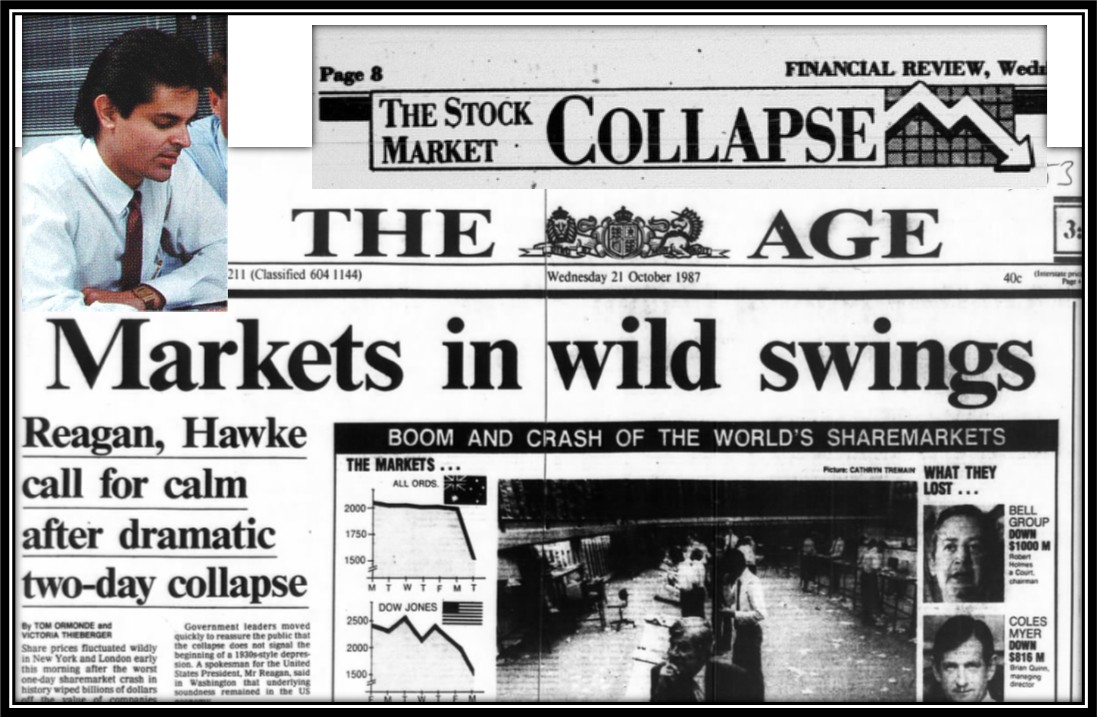
(That’s me in the top left corner of the news clipping pic, taken from a 1987 prospectus for one of our companies we floated before the crash. Look at that hair!)
4 rules of the market
We had four fundamental rules (mainly from Ted, the ex-stockbroker with long experience through booms and busts):
Rule 1: Recognise when you are in a boom or a bust. Easy enough from a distance but it’s harder when you are actually in the middle of it at the time. It is the exact opposite of finance theory. Prices are hardly ever ‘fair value’ – they are constantly lurching from fundamentally over-priced in booms to under-priced in busts, and back again.
Rule 2: Never buy in a boom - sell instead. Likewise: never panic sell in a bust - buy instead.
This is more difficult than the Rule 1 because you are always having to go ‘against the crowd’ and against the weight of media hype and ‘expert’ opinions.
(I learned many years later that this is essentially Warren Buffett's rule: “Be fearful when others are greedy, and greedy when others are fearful.” – in his 1986 Berkshire Hathaway shareholder letter, published in February 1987 – talking about the very same boom in the US.)
So far, fairly straight-forward. But the real key was Rules 3 and 4.
Rule 3: If you’re in a boom and have nothing to sell – find or build something to sell!
Our little firm built and listed (‘IPO’ in today’s lingo) four companies in the boom - two gold refineries, a finance company, and a ‘cash box’. A cash box is the ultimate bubble stock - it has nothing in it except cash and maybe a vague idea about what we might do with it. But in a bubble people bid up the price anyway!
Today, what we used to call ‘cash boxes’ are now called ‘SPACs’ (‘Special Purpose Acquisition Vehicles’ – mainly for tech stocks), or ‘BDCs’ (‘Business Development Companies’ for private credit). Same crazy idea - same crazy result!
Rule 4: Never use debt.
This no-debt rule was extremely unfashionable in the debt-fuelled 1980s! Debt was like big shoulder pads, pleated pants and skinny ties - everyone had them! To avoid debt, we paid cash up front for everything, or went without, instead of leasing it. Meanwhile, everyone else had leased fit-outs, leased computers, leased phone systems, leased furniture, leased cars, and even leased boats!
But avoiding debt meant we survived the 1987 crash and were ready to pick up bargains in the wreckage that followed.
Signs of bubble
We never bought any shares, businesses, or companies in the 1986-7 bubble (Rule 2). Signs of a bubble were everywhere - there were ‘hot stock’ shows on TV, talk-back radio, magazines, newspapers (there were no blogs or social media or internet back then - not even mobile phones).
For a more detailed outline of the market frenzy at the time see:
(We did do a commercial property development in St Leonards, Sydney that we sold at a profit in 1989 before interest rates got to 20% - but that was in the post-crash property boom, not in the stock market boom/bust.)
While everybody was buying, we were selling
While everybody else was panic-buying (and gearing up) in the 1986-7 boom (FOMO in today’s lingo), we were busy building and selling things.
The gold refining companies were bought by global gold refiners, and the finance company was bought by a national real estate chain (Its CEO was one of the cowboys who went to jail after the crash - see my Part 2 story).
We even built a TV production studio (in Camperdown, Sydney) that produced and packaged shows for FNN in the US (the forerunner to Ted Turner’s CNN), and we sold it to a listed media firm.
Even the cash box (listed on the Perth ‘Second Board’ stock exchange) was bought by a corporate raider in Perth to use as a listed vehicle for take-overs. He borrowed too much and was bankrupted in the recession.
The bust
The boom is only half of the story. The other half of Rule 2 is that in a bust: you buy when everybody else is panic selling. If you have no debt (Rule 4) you can survive even the worst crash and retain control. It is sad to see people sold up by margin lenders and banks in the busts.
But when you borrow money, you give up control to the lender, and they will always sell you up at the worst time, at the worst price.
The 1987 crash was actually worse than the 50% index fall
The All Ordinaries index collapsed by 50% from 2,306 on 21 September to 1,151 on 11 November 1987 (including its biggest ever one-day fall of -25% on Tuesday 20 October). But even a total market index fall of -50% masks the fact that hundreds of stocks were left completely without buyers. So in reality the true market had probably collapsed 70% or more if there were any buyers to set market prices.
Bargains
We picked over the ashes. Most of what we found was worthless, but some were real bargains. For example, we bought one of the Elders group companies (Remember John Elliott?) for $1 (no, not $1 per share, $1 for the whole thing, with no debt). Turned out it had 35 subsidiaries in Australia and around the world, and we spent the next couple of years sorting through the ruins and finding some amazing things.
(We did the same again in the late 1990s ‘dot-com’ boom – following the same 4 Rules. Built a ‘dot-com’ in 1998-9 and floated it in early 2000 before the tech-wreck crash. Because it had no debt (everything was paid for in cash up front as per Rule 4), it survived, and was bought by a Berkshire Hathaway company in 2006 - but that’s another story for another day!)
Regrets?
1987 was a great learning experience for me. In my first jobs in the early 1980s I had learned lessons from the bust that followed the late 1970s boom, but I did not actually experience the boom that led to the crash. But the 1987 boom/bust experience I saw the whole boom/bust cycle from being right in the middle of it.
I do have some regrets. In late 1986 when I was building money market models for the merchant bank, I got an offer to be posted to Wall Street, but I declined and instead moved to Sydney to jump headfirst into the market. I always wonder what would have happened had I gone to Wall Street, but that is not a regret.
There were a few business ideas we developed that went nowhere. We probably tried to develop too many ideas, but I guess you need to try a lot of things to find what actually works. But if you have no debt (Rule 4) the downside is limited, but the upside is virtually unlimited.
I was also probably too careful and could have taken more risk personally at the time. You can always make more money if you borrow - but I’m too cautious and I’m not that greedy.
These lessons, and the same 4 Rules, have applied in every cycle since then. And because all markets are driven by human fear and greed (which are hard wired into human nature), the same 4 Rules will probably apply to all cycles in future as well.
The markets today?
If I were still young and hungry, I would be flat out building a fin-tech, or an ai app, or a neo-cloud business (whatever that is) to sell into the current boom. But I am old and tired and am now in the ‘giving back’ phase of life, volunteering and mentoring.
(on second thoughts - maybe I'll just look up 'neo-cloud' to see what it is . . . .Nah, just kidding!)
‘Till next time. . . . safe investing – and don’t forget the 4 Rules!
See also:
For my most recent monthly update on local & global markets for Aussie investors: