Greetings fellow investors! - Here’s my monthly snapshot on global markets for Aussie investors. What happened where and why.
Key points:
-
-
- Global share markets posted a seventh straight month of gains, through yet another US debt ceiling / government shut-down crisis.
- Wrap-up of shares here and around the world - what were the winners, losers, and why?
- The US Fed's 5th rate cut despite still-high inflation, but the RBA is not rushing to cut rates here.
- Gold enters retail silly-season.
- Plus I cover currencies, commodities, interest rates, inflation, crypto, and more.
World share markets enjoyed a seventh straight month of gains in October as the global boom continued, fuelled by oodles of liquidity financed by cheap money and deficit spending sprees everywhere.
Two major boosts during the month were the US Fed’s fifth rate cut despite still-high inflation on every measure, plus Trump’s latest TACO trade with China (deals on fentanyl, soybeans, rare earths, plus much lower tariffs than Trump had threatened just days earlier), although both of these developments came toward the end of an already good month.
Also going on in the background is the latest US federal government shutdown from the beginning of October. It a couple of days it will become the longest in a long history of US government shutdowns (overtaking the longest of 34 days in 2018). The shutdown only applies to around 25% of federal government spending – it does not affect social security, Medicare, interest on debts, essential workers like immigration & customs, hospitals, medical, air traffic controllers.
However, unlike previous shutdowns where the hundreds of thousands of staff were resumed their jobs with backpay at the end of the furlough period, this time it looks like a sizeable proportion of them will be told they are no longer required. So it may well turn out to be a mechanism for massive DOGE cuts. We’ll see.
But first - my essential 1-page snapshot chart - covering Australian and US share markets, short and long-term interest rates, inflation, and the AUD/USD exchange rate. As usual, there are two versions – first is the traditional version on a single chart:

Plus the alternate version below, requested by several advisers - showing Australian and US inflation separately in the lower sections:

Share markets
Global share markets rose for a seventh straight month, which is the longest run-up since 2021 in the Covid rebound. The US market posted eight new all-time record highs for the month, and Australia posted four.
Global Industry Sectors
Unlike previous months, October was rather mixed across the main industry sectors (middle chart below).
Most discretionary spending stocks were lower (except Amazon and LVMH), and most staples were also weaker (except Nestle, Coca-Cola and Pepsi) – reflecting weakening consumer spending in the US, Europe, and China, and also absorbing some tariff impacts.
Best sectors for the month were IT (mainly the big chip-makers Samsung Electronic, Taiwan Semiconductor, Intel, Broadcom, AMD), and Health-Care (mainly Novo Nordisk’s rival Eli Lilly, recovering further from its big sell-off over the past year. However, Novo - maker of diabetics/weight-loss drugs Ozempic and Wegovy - was down again, and is now down -60% from its mid-2024 highs).
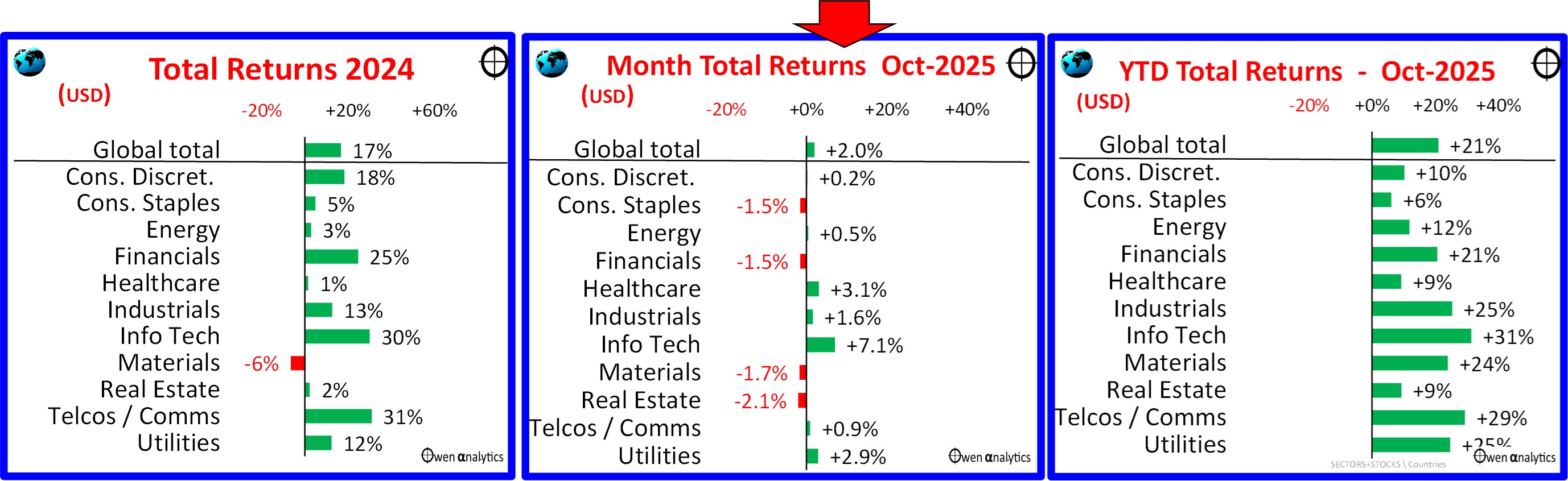
Financials were also lower, with fallout spreading from private credit collapses. This is probably just the tip of the iceberg for the inevitable unravelling of the recent private credit boom.
For the 2025 year to date (right chart above), most global sectors are heading for another year of above-average returns.
Major global stocks
Here is the picture for the largest global stocks (all of which are US based):

US quarterly earnings have been strong Amazon, Google, Apple, and Nvidia, while Netflix and Meta disappointed. Nvidia soared above $200 to become he first company in history to hit a US$5 trillion market value.
After the strong gains in October (middle chart), most of the major global stocks are well ahead for the calendar year to date (right chart). Leading the pack are the (current) perceived winners from ‘ai’: Nvidia, Broadcom (ex-Hewlett Packard), Alphabet/Google, and Microsoft.
Mag-7 update
For context, here are the share price charts for the so-called ‘Magnificent Seven’ stocks over the past decade (plus I have added China’s Alibaba and Tencent):

(For the benefit of new readers, have not used any y-axis scale trickery here – the vertical y-axes all start at zero, and have regular, nominal scales, which highlights the explosive share price growth of the US giants from very low levels in the past decade.)
China’s Alibaba and Tencent are up in the Chinese rally this year, but both are still below their 2021 peaks. By comparison, all of the US majors are well above their previous peaks in the 2021 Covid stimulus boom, even Tesla finally.
The US tech giants are still very expensive on a range of metrics. See my recent report on how they stack up individually on revenues, profits, dividends, and pricing -
Profits and Pricing
Although it is early days in the latest quarterly reporting season for US companies (for their September quarter results) it has been strong so far, with 85% of companies beating consensus estimates. In the most recent full reporting season (for June quarter results), 77% of S&P500 companies beat expectations, and it was also 77% for the March quarter.
Strong profits, despite all that is going on in the world, plus the US Fed rate cuts, have been the main drivers of US and global share markets this year.
Profit outlooks
Consensus forecasts for the next couple of years are pencilling in a further +14% EPS growth again for calendar 2025, and then +17% growth for calendar 2026. These would appear to be very ambitious to say the least as Trump’s tariffs have not really had a chance to eat into US consumer spending nor US company profits yet.
The problem is that S&P500 pricing is at a very bullish 31 times trailing (past 12 months) earnings, and 26 times next year’s ambitious earnings forecasts. These are very optimistic multiples on very optimistic earnings outlooks – a double layer of over-confidence, and highly vulnerable to any negative shocks from left field.
But so far, investors have shrugged off Trump’s tariff tantrums, Moody’s US credit downgrade, the US debt ceiling / government shut-down crisis, and ongoing wars in the Middle East and Ukraine. Are US company earnings and investor optimism invincible? Thus far, the TACO trade is holding.
I recently published a six-part series on pricing of global share markets to better understand their implications -
For more on US profits and pricing – see:
Major country share markets
Most of the main global share markets continued their upward march in October (middle chart), and most are heading for good returns again for the 2025 calendar year (right chart) –
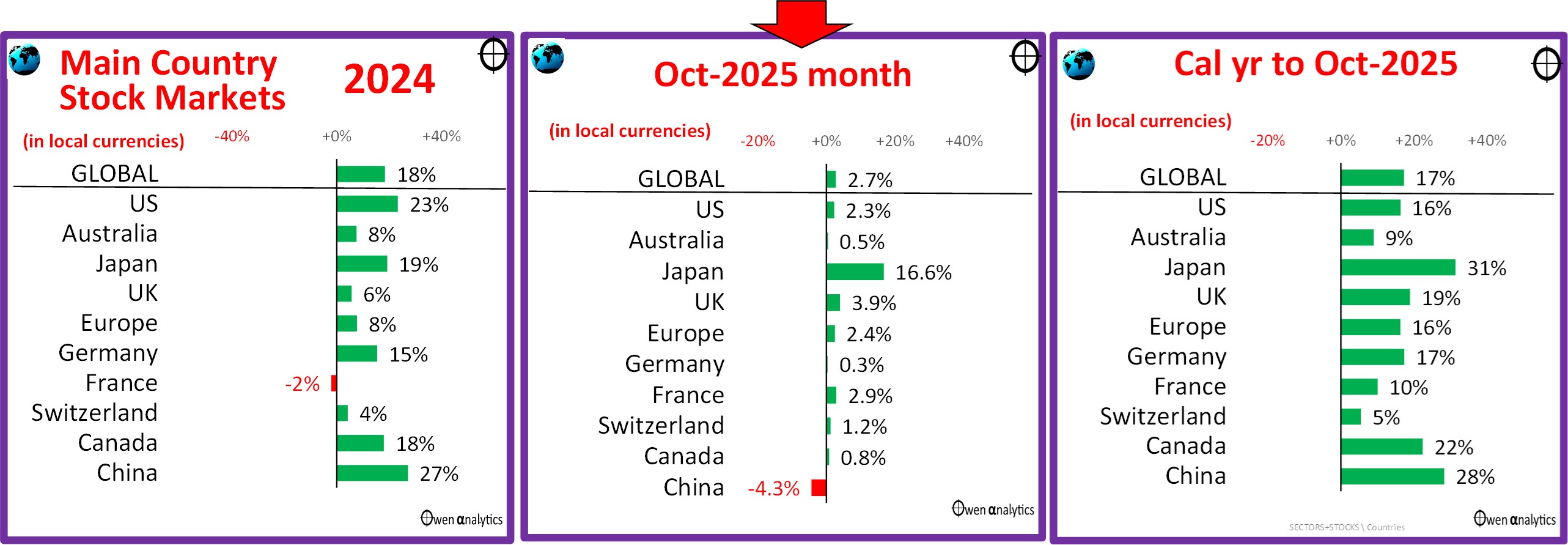
The notable exceptions are Australia (see below), Switzerland (with declines from major exporters like Nestle, and especially pharmaceuticals like Roche, to be hit hardest by Trump’s new pharma tariffs), and also several major French and German exporters for similar reasons.
Japan shot to the lead in October – mainly due to Softbank benefiting from its US big tech bets. For the year to date Softbank is now up +195%. Also strong are Nintendo +41%, Sony +29%, whereas Toyota and other large manufacturers are flat.
Australian shares
The most obvious feature of the first two charts at the top of this report is the fact that the US market (red line in upper section of both charts) has more than doubled 100% since the start of 2020 (pre-Covid), while the Australian share market (green line) is up by only one third over the same period. This reflects the relatively much poorer underlying fundamentals in Australia versus the US (profits, dividends, and returns on equity). I cover this aspect in some detail in my stories on share market pricing and valuations - refer to the links to the 6-part series above.
The local Aussie share market was up just a fraction in October (middle chart below), defying the global bullish trend. Here are the main ASX stocks:
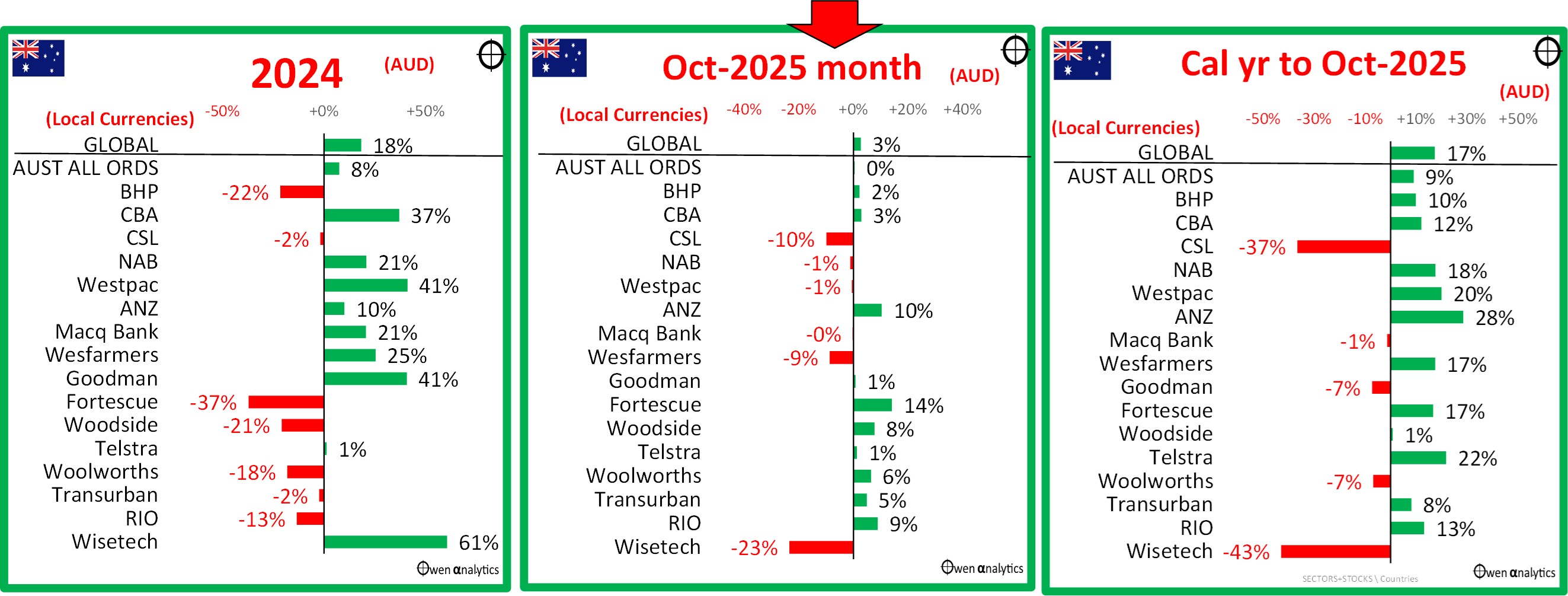
The big miners were stronger virtually across the board in October, with rising commodities prices (see below) and Albanese (ie taxpayers and future taxpayers) handouts galore benefiting many of the smaller miners.
The main drag on the overall index was CSL, which sank below $200, losing seven years of gains (with yet more problems adding to its pile of woes), and Wisetech (continuing battle between CEO/owners versus board/governance).
Higher inflation figures ended hopes for further rate cuts and sent retailers mostly down (Wesfarmers, JB, Coles) as well as gambling stocks (Aristocrat, Lottery Corp). The big banks were flat-ish overall, but the big gainer was ANZ, with new CEO Matos’s grand plan to revive the smallest and weakest of the big-4. As a decent-sized shareholder of ANZ (legacy shares from the early-mid-1990s), my assessment of the probably of success for Matos is approximately zero.
For 2025 year to date (right chart above) the overall ASX market looks like it is heading for an average-ish year (possibly better than 2024), but it is still lagging the US and global share indexes. The big drags on the local market continue to be CSL, Wisetech, Woolworths, and the overall dominance of two structurally weak sectors – banks and miners.
Inflation & interest rates
First, to the US market because the US drives all global markets including the ASX. The Fed has cut rates five times since the post-Covid recession surge – in September, November, and December of 2024, then in September and October 2025.
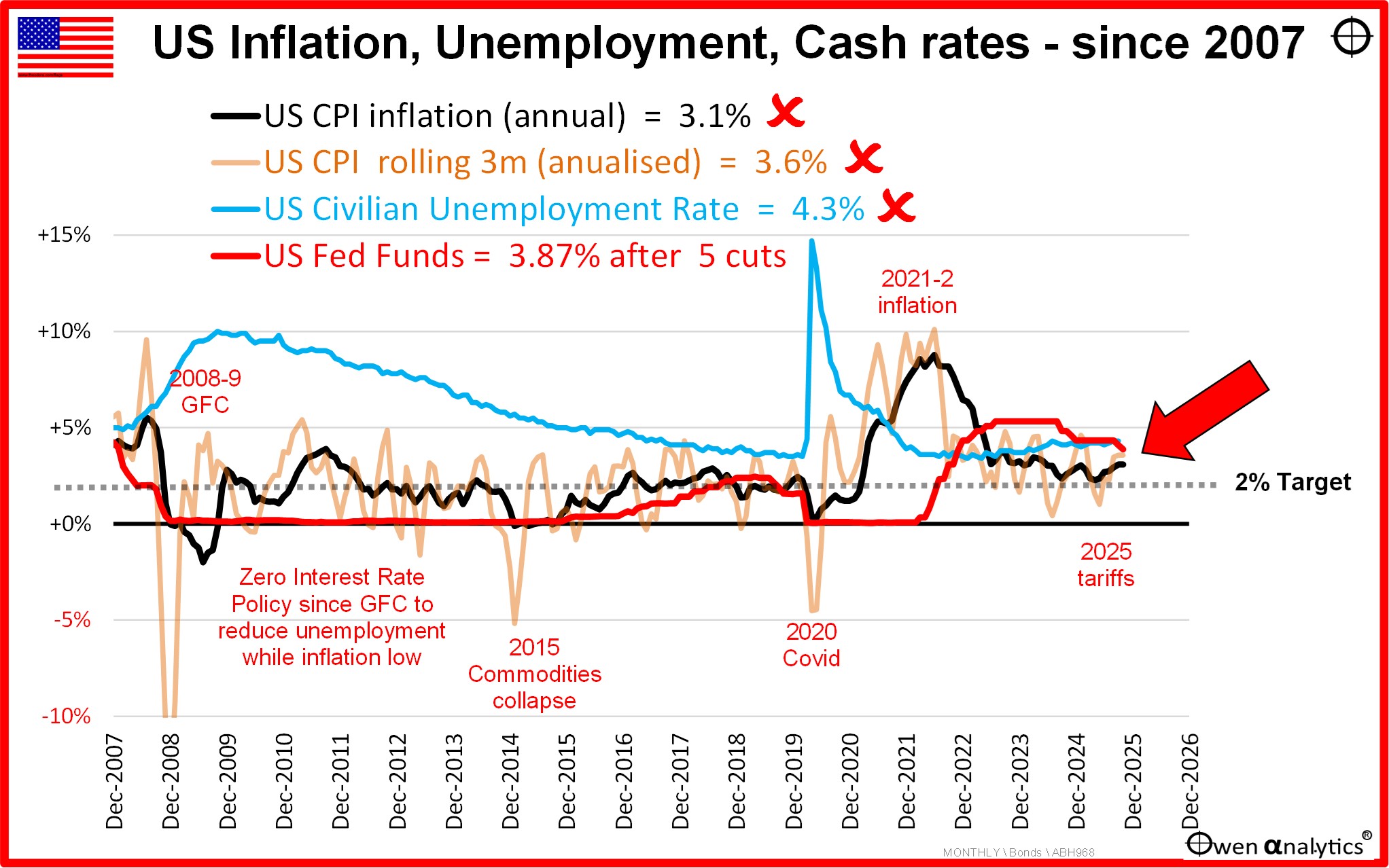
The 12-month inflation rate is still a rather high 3.1% (up from 2.9% prior month), including some elements of tariff impacts, and the annualised 3-month rate has risen further to 3.6% (up from 3.5%). The Fed’s preferred measure, Personal Consumption Expenditure (PCE) is also higher at 2.7% (from 2.6%), still higher than the 2% target.
The US jobs market remains surprisingly strong. The unemployment rate has risen to 4.3%, which is still relatively tight. Thus far we have seen little impact of Trump’s tariffs on trade, prices, inflation, or jobs. But it is early days yet. (NB this is the August rate because data releases are being affected by the government shutdown.)
I give it 3 crosses out of 3 for inflation control.
Despite inflation above target and unemployment still at inflationary levels, the Fed made a 4th rate cut on 17 September, and 5th cut on 29 October reflecting Fed Chair Powell’s recent policy shift from inflation to jobs and stability. However, he has warned that this may be the last cut for a while. We’ll see.
Bottom line = no compelling reason to cut rates – with inflation still high, unemployment low, and the economy humming along.
Although Powell has warned there may be no further rate cuts in the near future, his term as Fed Chair ends in February 2026, and the new Trump-appointed Chair is likely to start cutting rates again, and this prospect is keeping share markets bullish.
Australian inflation, interest rates, unemployment
Australia also gets 3 crosses out of 3 for inflation control.
Inflation in Australias also remains problematic, but for different reasons. The RBA has only three rate cuts in this cycle (Feb, May, August 2025), while most other countries have made several more cuts as inflation has edged down. (For example, there have been 8 rate cuts in Europe, 7 in Canada, 7 in NZ, 5 in UK, 5 in the US)
Here is the Australian picture:

The 12-month CPI inflation rate is still rather high at 3.2% (up from 2.0% last month), and the annualised 3-month rate is even higher at 4.8% (up from 4.8%). The main problem areas are housing rents, electricity, gas, healthcare, tobacco, and education costs. The RBA’s preferred ‘trimmed mean’ measure is back up to 3.0% (was 2.7%).
As in the case of the US, the most obvious motivation for a further series of rate cuts would be a local recession, which would lift unemployment and probably soften inflation pressures, allowing (or necessitating) rate cuts.
Unemployment in Australia has been rising slowly but steadily over the past year, from a low of 3.4% in late 2022, and is now up to 4.5%. This is finally getting back up to the level RBA regards as a neutral rate – ie no longer inflationary (RBA’s non-accelerating inflation rate of unemployment (‘NAIRU’) of around 4.5%)
‘Participation rates’ (the number of people in the workforce as a percentage of working age population) are still near record highs, due almost entirely due to expansionary government-related hiring. The government sector has been expanding, but the real economy is doing it tough, with rate hikes eating into top-line revenues and raising financing costs.
Bottom line = no great pressure or reason to cut rates – with inflation still high and unemployment still relatively low, but at least now not inflationary.
For my assessment of the impact of wages on inflation -
Exchange Rates
The Aussie dollar fell back -0.8% against the USD in October despite the Fed cutting rates while the RBA held rates flat. But the AUD rose against the weaker Pound, Euro, and much weaker Yen. The Yen in particular is suffering a lack of confidence with fears of inflationary fiscal and monetary policies under new LDP leader Sanae Takaichi.
The US dollar index rose against all major currencies (especially against the weaker Yen) in October, but is still weaker against other currencies for the year to date - down 1.5% against the Yen, -10.1% against the strong Euro, -4.7% against the Pound.
But the US dollar is down just -2% against the RMB this year, which is where it needs to fall most. Beijing has been cunningly depressing the RMB almost tit-for-tat against the US dollar in order to maintain trade advantages in the wake of Trump’s tariffs.
For the big picture on the strong US dollar and why Trump it trying to talk it down – see:
Commodities markets
Commodities prices were mostly up in October (upper chart), but are a mixed bag for calendar 2025 year to date (lower chart) -

Most industrial commodities continued to strengthen after some recent Chinese stimulus announcements (Tibet dam, Shanghai housing rule boost), rising global military spending, and the latest Trump-Xi trade ’deal’. Of most importance to ASX returns - iron ore remained above $105/tonne, and gold rose 5%.
Gold prices rose +14% in the first half of the month, but then fell back -10% to end the month up +5%. Many readers will have seen news pictures of hundreds of people lining up in long queues stretching around the block outside gold bullion outlets – including one in Martin Place Sydney – after gold hit $4,000/oz. I walked past the Martin Place store a few times to check out the frenzy. But when the price dropped back -10%, the lines were gone.
Crazy stuff! If they were happy to line up for hours to buy it at $4,300, why would they suddenly not want to buy when it was much cheaper at $3,900 a week later?
Despite the minor fall late in the month, gold still up +54% for the 2025 calendar to date (in US dollar terms). The rise has been driven by fist-full of festering fears – including inflation, political unrest, military tensions, and general distrust in traditional financial institutions. (Gold is the best performer in my own long-term ’10-4 All-weather ETF portfolio’).
We are probably in the early stages of the next big commodities cycle, but currently most industrial commodities markets are suffering from weak prices due to sluggish global demand and over-production. Hence the very poor performance of Australia’s big miners weighing heavily on ASX returns in recent years.
Bitcoin down
I would have thought that Bitcoin should also benefit from those same fears driving up the gold price, but it fell back 4% in October.
While I have always liked the underlying principles behind Bitcoin (a utopian world completely beyond the reach of governments, taxes, banks, intermediaries, regulations, creditors, etc), it is still too volatile and speculative for serious long-term investment portfolios. However, blockchain and stable-coins probably do have some useful potential roles in the financial system architecture.
For my outline of Trump’s grand vision for stable-coins and blockchain – see my recent webinar –
See also –
- 3/4-time score check on returns for asset classes & diversified portfolios in 2025. Another good year so far! (9 Oct 2025)
‘Till next time – safe investing!