Monday, October 12, 2026

linkedIn

Wages falling further behind inflation – government and RBA stoking, not attacking, inflation

28 Aug 2026 1 month(s) ago

Wages-Inflation.jpg


Greetings fellow investors!

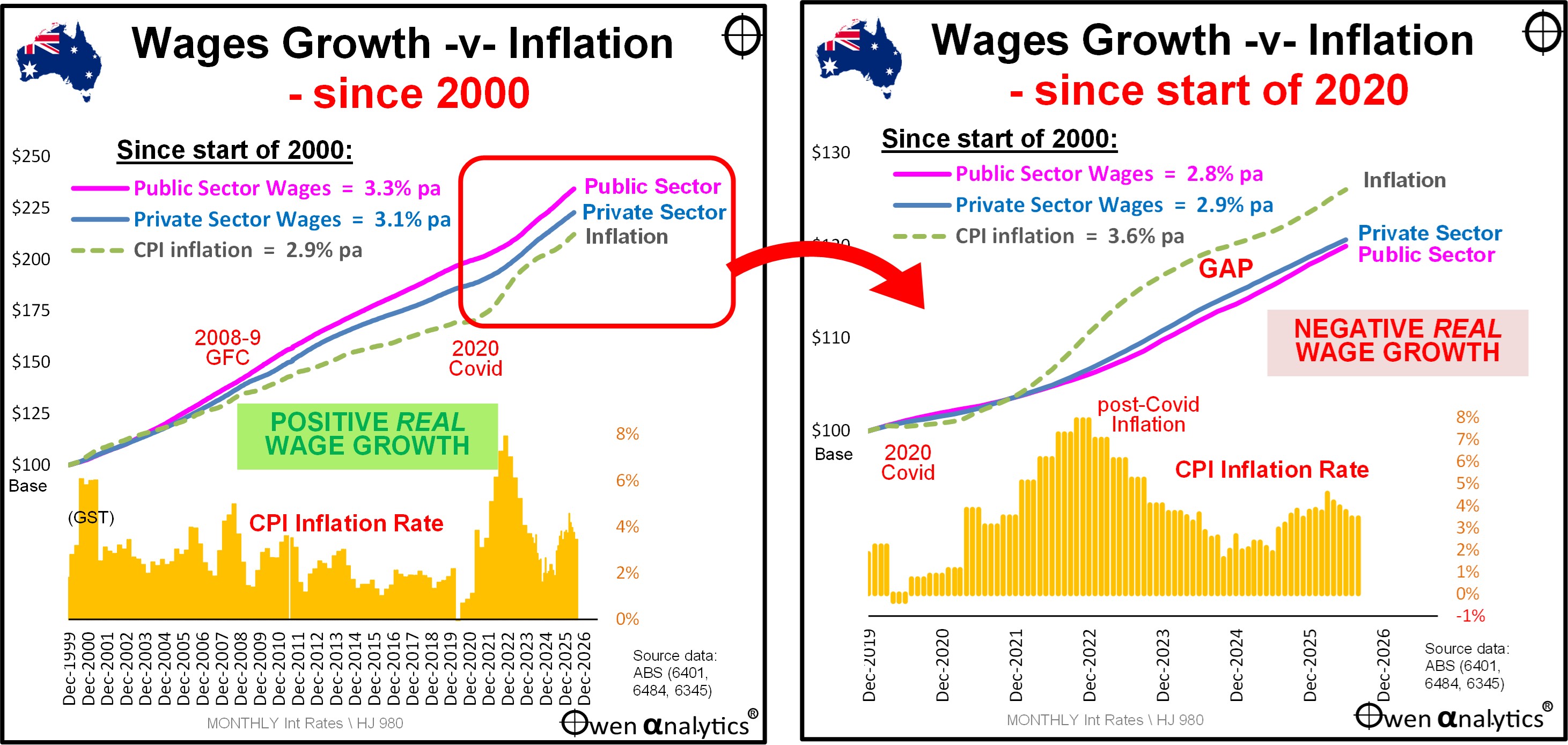
So far this century, wages in Australia have grown comfortably AHEAD of inflation (left chart), with public sector wage growth (pink line) leading private sector wages growth (blue).

However it is a very different picture when we look at just the post-Covid period of high inflation.

Since the start of 2020 (right chart), wages have LAGGED well behind inflation, with both private and public sectors suffering NEGATIVE real wage growth.

Post-Covid inflation

Since Covid, public sector wages have lagged the private sector, despite the rapid rise of public sector employment and wage rises at Federal and State levels.

The GAP between consumer prices (grey dotted line) and wages reached its widest point in mid-late 2023.

The gap narrowed a little in 2024 as wage rises gained some ground against prices, but the gap has been WIDENING since late 2025 as inflation picked up again.

Inflation causes

Governments and central bankers are always quick to blame inflation on war-time fuel price spikes, but inflation in Australia was already running ABOVE 5% BEFORE Russia invaded Ukraine, and was still running above 4% BEFORE the US started its war on Iran. 

See –

·        Iran war hands politicians another free ticket to blame oil prices for inflation & rate hikes (14-Mar-2026)

The real causes of the post-Covid inflation have been unnecessarily loose Monetary policy (RBA keeping interest rates too low for too long), and loose Fiscal policy (unrestrained deficit spending sprees from Federal and State governments, including cash hand-outs, subsidies, productivity-free wage rises.)

The problem is that the simplistic/populist solution – increasing wages to compensate for rising prices without any gains in productivity - just intrenches the inflationary spiral further. Giving people more money to chase the same quantity of goods and services pushes up prices, because (a) the wage rises increase input costs of the items, and (b) suppliers are incentivised to raise prices because supply has not expanded.

Outlook?

The outlook is not encouraging:

First: Monetary policy. The RBA committed a series of mis-steps since Covid. It raised interest rates LATER, SLOWER, and LOWER than the rest of the world, resulting in our inflation remaining HIGHER. It then gave us three unnecessary rate CUTS in 2025 that revived inflation and had to be reversed in 2026. The RBA remains reluctant to rates now even with inflation still well above target, unemployment below the ‘non-inflationary rate’, and unemployment kept artificially low by government job creation.

Second: Fiscal policy. Federal and State governments continue on their inflationary spending sprees running wartime-like deficits and racking up debts. They continue to pander to populist demands for hand-outs, subsidies and productivity-free wage rises.

In addition, all political parties are caving in to populist demands to cut immigration – from backpackers to students to skilled migrants, putting further upward pressure on wages and inflation.

It is not good enough to just sit back and wait for global oil prices to fall. The focus must shift from compensatory wage rises, hand-outs and subsidies, to cutting un-productive spending, and lifting worker productivity / output.

That is the only way to increase real wages and living standards sustainably.

We need a return to old-fashioned discipline and fortitude on both Monetary and Fiscal policies. That requires vision, tough decisions and sensible debate, not just glib, populist, knee-jerk short-term ‘fixes’.

Why is this important for investors?

Although this article is about aggregate wages and inflation averaged across the nation, and not individual wages and inflation for each person, the aggregate numbers are what drive official policies and decisions, which in turn drive interest rates, financial markets and returns in our investment portfolios.

Further reading:

On inflation –

·        What’s your personal inflation rate? And how it affects your investment strategy & retirement planning (14-Jul-2026)

·        Australian inflation well ABOVE target once again. Here’s how I rate the RBA’s record on inflation targeting (20-July-2026)

·        Why are Australian cash rates HIGHEST in the world? Five simple reasons (20-Apr-2026)

On why inflation is critically important for investors –

·        Inflation BIG Picture: Boomers got rich by lucky timing. Next Gen to get higher inflation & rates (25-May-2026)

·        The Low Inflation era of great returns is over. Investing just got a whole lot harder! (16 Apr 2024)


‘Till next time – safe investing and stay healthy!


Related Articles

Leave a Reply

Ashley Owen


Please subscribe to my Newsletter, connect on LinkedIn, or follow me on Twitter X 


Experiences


Director/Principal, Owen Analytics Pty Ltd (current)

Investment Markets Research & Analytics, Portfolio Construction & Management, Corporate Finance, Venture Capital, M&A, and IPOs. Investment Committee membership, consulting to advice firms and financial institutions.

Co-founder & Regular Contributor, Firstlinks (current)

Co-founder of Australia's leading investment and superannuation newsletter and website for industry professionals and investors.

Non-exec Director, Third Link Investment Managers (current)

Leading Australian equities fund-of-funds that donates all management fees to Australian charities. The fund has donated in excess of $21m to a range of Australian chartities since inception in 2008. 

Chief Investment Officer, Stanford Brown (past)

Responsible for managing over $2 billion AUM in multi-asset class portfolios and discretionary accounts at a privately-owned advice practice.

Director & Joint CEO at Philo Capital Advisers Pty Ltd (past)

Specialises in investment portfolio construction & management, multi-asset class asset allocation, and global macro strategies.

Check out my full bio here

▼

‘For many years, Ashley has been my go-to source of information and analysis on what’s going on in financial markets and why.’

“Ashley has an encyclopaedic knowledge of the markets – I call him Mr Google!”

Noel Whittaker, AM – Australia’s best-known personal finance writer, columnist, and media commentator for the past three decades. He has written more than 20 books on personal finance, his regular columns on personal finance are published in almost every major Australian newspaper, and he appears regularly on radio and TV as an expert on finance and investing.

“Over the past 20 years, Ashley has been an invaluable assistance to me, as a reliable source of unbelievably strong and interesting data, and many good investment ideas.” 

"The depth and quality of Ashley’s research and analysis of investment markets is the best in the business.”

Dr Don Stammer - Australia’s most respected economic writer, commentator, and speaker for the past 40 years, with a distinguished career including the Reserve Bank of Australia, Chief Economist at Deutsche Bank Australia for 21 years, chair of nine ASX companies, plus numerous non-listed and not-for-profit boards.

"I read all of Ashley's research on financial and economic issues. His data resources, deep knowledge, and original analysis put him in a class of his own."

Ian Macfarlane AC - Former Governor, Reserve Bank of Australia (Australia's central bank), 1996-2006. Former Director, Woolworths, Leighton Holdings, and ANZ Bank. Also on the International Advisory Boards of Goldman Sachs (2007-2016),  the China Banking Regulatory Commission (2011-2014), and director of the Lowy Institute for International Policy (2004-2017).

“Ashley’s unique fact-based analyses and insights into Australian and global markets are always worth reading. He has an incredibly deep and comprehensive store of financial markets data.”

Chris Cuffe, AO – One of Australia’s best known and most experienced investment managers – former CEO of industry giants Colonial First State, then Challenger Financial; founder and Chair of Australian Philanthropic Services, and Third Link Growth Fund; current/former chair, director and/or investment committee member of numerous funds including UniSuper, Argo Investments, Hearts and Minds Investments, Paul Ramsay Foundation, and many others.

“Ashley has the rare ability to ground insightful analysis in solid data and to present it in readily understandable ways. His wry, detached style and focus on the long term is rare and willingness to share a lifetime of learning and thinking appreciated by all who come to know him.”

Toby Potter - Chair, Institute of Managed Account Professionals (‘IMAP’), the peak industry body for the discretionary managed accounts industry in Australia, representing investment managers,  advisers, Managed Account providers, and technology companies. It is the primary thought-leader for the industry in Australia, and provides training and industry events and conferences.

“What sets Ashley Owen’s analysis apart from investment banks and the financial press is his deep fact-based understanding of long-term financial data, rather than getting caught up on the daily noise over issues that may generate trades or sell newspapers today, but will be irrelevant and misleading two years from now.” 

Hugh Dive, CFA. Chief Investment Officer, Atlas Funds Management, and frequent expert commentator quoted in the AFR.

“Ashley is one of the best writers and thinkers on financial markets in Australia. His unique analysis and research is always fact-based and insightful, not the usual uninformed market noise and waffle that infects the mainstream financial media.”

Graham Hand - Editorial Director of Morningstar Australia, including Founder/Managing Editor of FirstLinks, Australia’s leading newsletter and publishing service on wealth management, superannuation, and personal finance.

Copyright © 2026 Owen Analytics

About Ashley Owen | Terms and Conditions | Privacy Policy | Archive | Disclaimer

The information contained in this document relates to historical, factual events and returns, and contains general commentary and observations about financial markets, asset classes, and asset allocation. This document, or any part thereof, does not, and is not intended to, constitute investment advice, or financial advice, or financial product advice, in any jurisdiction in which it is published, re-published or read. It does not recommend, encourage, or influence readers to buy, hold, sell, or deal in any financial product or security. Where securities of financial products are mentioned, it is purely for the purposes of illustration, context, and/or education, and not intended to influence anyone to buy, hold, sell, or deal in it. The information is current when written. All reasonable measures are taken to ensure its accuracy at the time of publication, but the author accepts no responsibility or liability for any errors or omissions. This document is only provided to, and intended for, holders of Australian Financial Services Licences. It should not be used or relied upon by any person or entity other than a duly licenced AFSL holder, or authorised representative thereof. The author receives no benefit, financial or otherwise, from any product provider, or product issuer, or any other firm involved directly or indirectly in the provision or services in or to financial markets or industries, whether mentioned in the report or not. Any opinions expressed by the author are his alone, and are intended for the purposes of education.