My recent article (‘Where are you on the inflation pyramid? Inflation differences by household type’) outlined how Australian retirees, on average, face HIGHER inflation rates than working households. Self-funded retirees on average experienced LOWER than CPI inflation, whereas retirees on government aged pensions suffered HIGHER than CPI inflation.
The problem is that no household is ‘average’, so it is important to understand what your own personal expense inflation rate is in order to estimate how much CAPITAL you need per dollar of expenses, and how much you can afford to SPEND given your current level of capital, to ensure that your living standards are maintained and not eroded over time.
Although the headline ‘Consumer Price Index’ (‘CPI’) rate is a published as single number, that single number is an average over a wide range of goods and services that have very different inflation rates. For example if CPI inflation was say 3% in a given year, some items of spending would have risen by more than double or treble the rate of CPI), while other items will have fallen in price.
Today’s chart shows average inflation rates for the main categories of spending items since 2000.
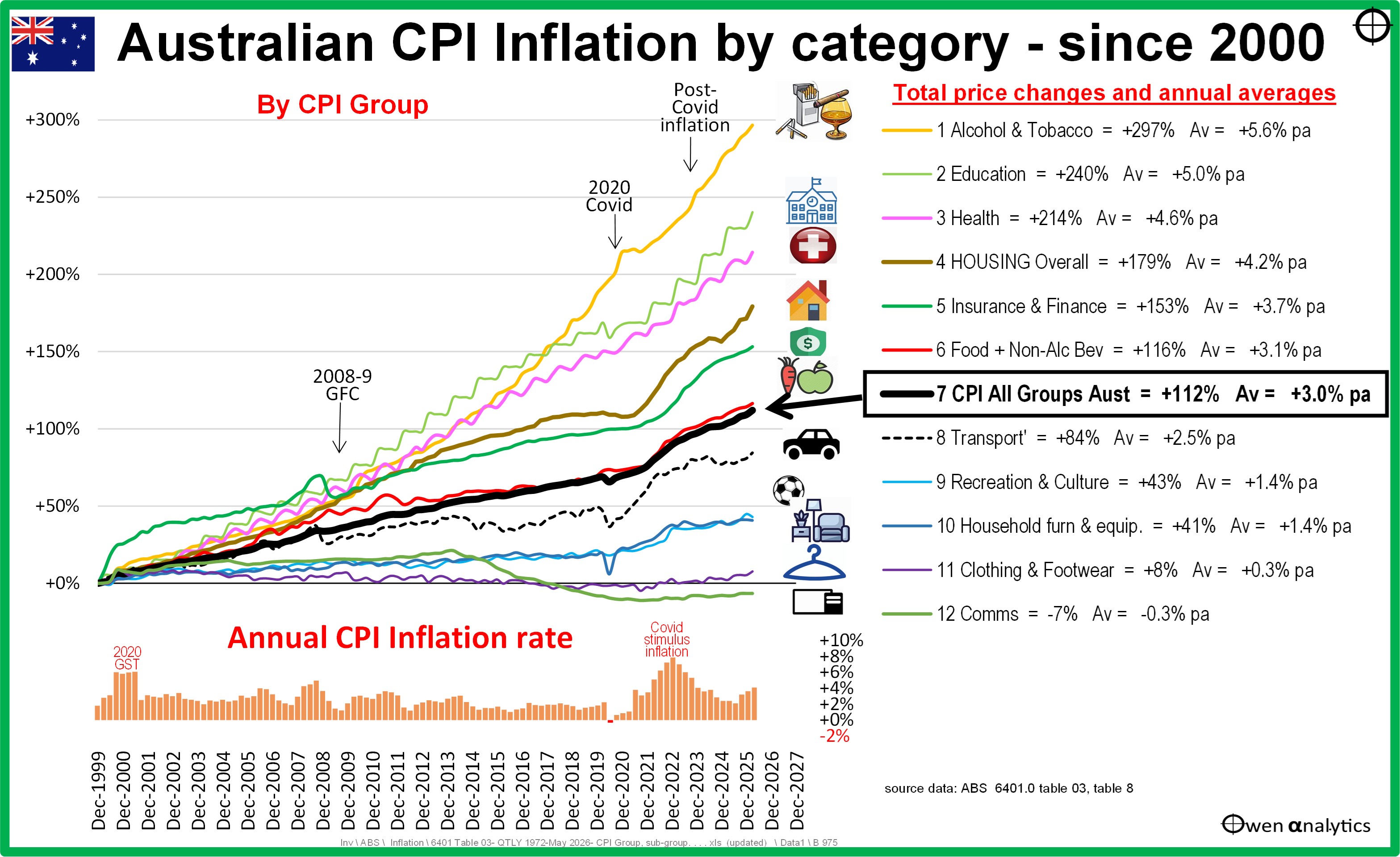
At one extreme, alcohol and tobacco prices have nearly trebled in price (with average inflation rate twice that of CPI. Other categories of higher than CPI price growth include education, health care, housing, insurance, and food.
Housing costs in particular have risen by well over the average CPI inflation rate. While renters have been hit hard by rents rising by more than CPI inflation, home owners have been hit much harder, with much higher than CPI price rises for gas, electricity, water/sewerage, property taxes and dwelling construction costs. I will cover this in more detail in a separate story.
Some things get cheaper over time
Meanwhile, other items like computers, phones, TVs and other tech gadgets have actually FALLEN in price (ie negative inflation) over the same period. For example, the first flat screen TVs in the early 2000s cost tens of thousands of dollars but now you can by much larger and higher quality TVs for a few hundred dollars. Same for laptops, phones and other tech gear.
My first Toshiba laptop in the 1990s was a heavy beast of a thing that cost $20k ($42k in today’s dollars), but today with the same money I can buy a HUNDRED much smaller and lighter laptops, each with thousands of times the storage and processing power of that first single Toshiba.
Broadly, Items with large components of Australian labour (eg healthcare, education, household construction & repairs, power, water, gas) have prices rising at much HIGHER rates than the national average ‘CPI’, while items imported from low-wage countries have much LOWER than average CPI price inflation (clothing, footwear, furniture, computers, phones, appliances, cars, etc).
Anything touched by Australian hands is expensive and suffers higher than CPI inflation because of our high wages, high taxes, and low productivity.
Impact on investing and retirement planning
It is important for long-term investors to understand that their own ‘personal inflation rate’ may be quite different from the published CPI inflation rate.
Why? Because investment strategies that are indexed to inflation – like ‘inflation-indexed’ bonds and ‘inflation-indexed’ annuities are indexed to the overall average CPI inflation rate, but is that going to cover your own ‘personal expense inflation’?
Most long-term pension/retirement funds target long-term returns at a specified margin above CPI inflation. Almost all Big Super funds in Australia (including Industry, Corporate and Retail funds, and even the Future Fund) set a ‘CPI+’ target in their long-term return objectives.
A very common long-term return target for pension funds in Australia and around the world is ‘CPI+4%’. Why target 4% above inflation?
Because if a fund generates net total returns averaging CPI+4% per year, it theoretically allows for withdrawals of 4% of the balance each year, leaving the balance after withdrawals to keep growing for CPI inflation, so that the fund, and future withdrawals, keep pace with inflation and do not lose ‘real’ purchasing power over time – ie preserves living standards.
This is known as the ‘4% rule’. It is no accident that initial minimum withdrawal rate for Super funds in Pension phase in Australia is set by legislation at 4%.
If your expenses are rising by MORE than the published national CPI inflation rate, then you will need MORE investment CAPITAL per dollar of spending – ie you can afford to SPEND less of your capital each year (eg less than the theoretical 4%).
If you want to keep the balance growing in future to cover your expense inflation - ie if your expense inflation is HIGHER than CPI, if you withdraw the required 4% each year, your fund and future withdrawals will NOT keep pace with your expense inflation. Your standard of living will DECLINE over time , and/or you will RUN OUT OF MONEY sooner than you expect.
Conversely, if your own expense inflation is LOWER than CPI, and is likely to remain lower indefinitely, then that provides a layer of added confidence that that your ‘CPI+’ investment strategy will be able to maintain your living standards in future, and reduce your risk of running out of money.
Note of course that there are many other factors in long-term retirement planning, including allowances for rising health-care and medical costs in later years, unforeseen lump sums required for nursing homes, divorce, helping family members, etc, etc. See –
· What's your Number? Part 1: 'How much do I need to retire?', 'How much can I afford to spend?' (10 May 2024)
· 'What's your Number? Part 2: 17 key factors driving 'How much do I need' & 'How much can I spend?' (14 May 2024)
· How to not run out of money in retirement - 4 big problems with relying on ‘life expectancy’ tables (6 June 2024)
The power of compounding
Differences in annual inflation rates for different households may appear small and unimportant, but the power of compounding magnifies even very small annual differences into very large differences in wealth and living standards over long periods like 30 years of retirement.
It is now tax season in Australia, an ideal time to get to know your own expense inflation and how it impacts your long-term investment planning and strategies.
Talk to your adviser about your own ‘personal inflation rate’ and whether you have the right long-term retirement portfolio and strategy given your personal inflation rate, and whether it is consistent with your views on the balance between spending it during your lifetime versus preserving it for the next generation.
Some further reading on inflation
· Where are you on the inflation pyramid? Inflation differences by household type (26-Jun-2026)
· The Low Inflation era of great returns is over. Investing just got a whole lot harder! (16 Apr 2024)
· Australia’s highest cash rate in the world just got even higher – and the job’s not done yet! (5-May-2026)
· Inflation BIG Picture: Boomers got rich by lucky timing. Next Gen to get higher inflation & rates (25-May-2026)
· How the RBA scores on its inflation goal? Somewhere between 3 and 10 out of 10. Overall I give it 8 out of 10. Why so high? (6-Feb-2026)
· Iran war hands politicians another free ticket to blame oil prices for inflation & rate hikes (14-Mar-2026)
‘Till next time – happy investing and stay healthy!
Visit my web site for hundreds of original articles on a wide range of topics for advisers, portfolio managers, and serious long-term investors.
https://www.owenanalytics.com.au/
· All completely free of charge. Free of conflicts. Free of ‘ai’.
· All original research and analysis.
· No ads, No marketing material, No sponsored material at all.
· Not ‘monetised’ in any way. No ‘revenue model’.
· Newsletter cost-free and conflict-free.
· Guaranteed No ‘hot stocks’, No ‘hot tips’.
· Guaranteed No ‘ai’. All human.
Enjoy!