Key points:
-
-
- House prices have been rising again since March 2025 with the RBA interest rate cuts, and prices are now set to accelerate with the new first home buyer lending rules.
- Since Covid, house prices have soared, but rents have risen by only half as much, so gross rental yields for landlords have halved while interest rates have risen.
- Given continued strong immigration and slow new construction activity, there will be enormous pressure (and scope) for landlords to raise rents.
- Tenants will have to cope with rising rents, plus the nightmare of seeing price rises take the dream of home ownership further out of reach.
- Why I have recently renewed my interest in housing markets.
Today’s charts look at how price inflation has affected home owner (house prices), tenants (rental inflation), compared to overall price inflation (CPI) in recent years.
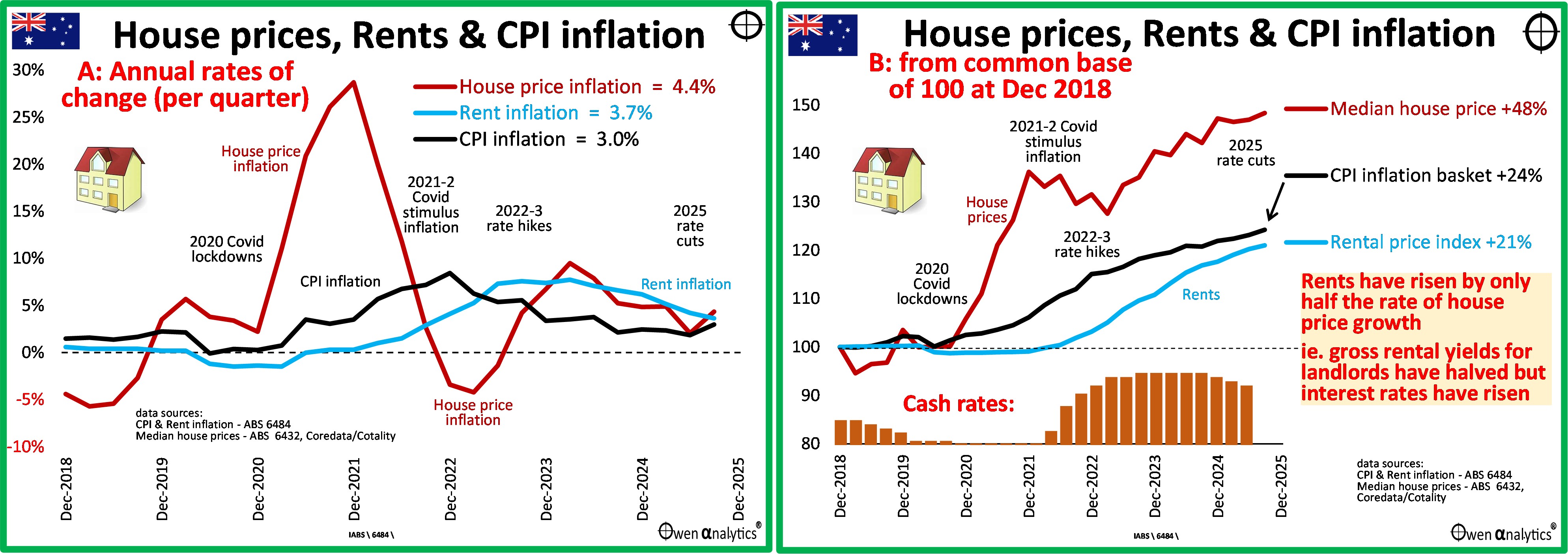
The left chart shows annual rates of price changes for capital city median house prices (maroon line), average rents (blue line), and the CPI inflation basket (black). This highlights the tremendous surge in house prices during the Covid rate cuts and cheap loan bonanza, followed by price falls when rates were hiked aggressively in 2022. Next to the house price surge, CPI inflation peaking at 8% at the end of 2022 (black line) looks rather mild indeed!
(Note my usual qualification with aggregate statistics like median house prices and average rents. Housing is not a fungible commodity market in which every asset is the same. Each property is different and can sell for very different prices for a host of reasons. Over the years, I have been to many auctions where two identical houses side by side on the same street go for very different prices – even on the same auction day. In any given market, there are properties that sell for more than they logically should, and there are others that sell for less. Housing is probably the least efficient market of all thanks to the huge role played by emotion for many, or perhaps most, buyers and sellers. I mainly use aggregate data to illustrate trends and cycles.)
Currently, rental inflation is running at 3.7% pa, which is higher than overall CPI inflation of 3.0%, but house prices are now rising at an even higher 4.4% pa.
(For house price data I use the capital city average of median prices – ABS 6432, supplemented by CoreData/Cotality data. For CPI and rental inflation I use ABS 6484).
Overall price growth
While the left chart shows annual rates of price changes, the right chart is better at showing overall growth in prices over time. It shows the three price indexes – median house prices (maroon), rents (blue), and the overall CPI inflation basket (black) from a common base of 100 as at December 2018.
In the lower section of the right chart I have also included cash rates, which drive house price growth.
Since the start of 2019, median capital city house prices have risen a total of +48%, but average rents have risen by ‘only’ +21%, which is actually less than the overall CPI basket, which up by +24% over the same period.
House prices
We can see from both charts that median house prices surged during the ridiculous Covid-era RBA free money bonanza in 2020 and 2021. The RBA shovelled money to the banks at 0.1% and the banks on-lent it to property buyers and investors at very low rates (but still at good margins for the banks). The resultant policy-induced lending/buying frenzy boosted median house prices across Australia by a crazy 35% by the end of 2021. Thanks RBA!
Poor policy for at least two reasons. First - it favoured incumbent property owners (mostly older, already rich folk like me!). Second, the RBA’s attempt to peg cash rates for three years at 0.1% by artificially suppressing 3-year bond yields lured hundreds of thousands of eager home buyers / borrowers (“Lowe’s lemmings”) who believed the RBA would stick to its plan and not raise rates for three years. But the RBA almost immediately changed its mind and hiked rates 13 times during the period it was supposed to keep rates flat. All it achieved was a massive boost in prices and a horde of borrowers with mortgage stress as rates rose.
When the RBA woke up to its error and reluctantly hiked interest rates in 2022 and 2023, house prices fell, but median house prices were still 25% above pre-Covid levels by the end of 2023. As the rate hikes eased from late 2023, house prices resumed their rise and peaked at the end of 2024.
When the RBA finally started cutting interest rates from February 2025, house prices have started to rise again.
First home buyer scheme extended
With house prices on the rise again with RBA rate cuts, the government is now adding more fuel to the fire by extending its first home buyers scheme.
Under the new rules, from the start of October 2025, first home buyers (with no means test) will be able to borrow 95% of the purchase price of a property with just a 5% deposit, and they will escape the usual requirement to take out mortgage lenders insurance (LMI) for lending above 80% of the purchase price. The risk of value shortfall will now be borne up by tax-papers! Thanks – what did I do wrong to deserve that?!
(There is very little risk of loss, at least in the case of houses in the inner areas of the three big cities, as long as the government keeps immigration rates high, and keeps supply limited by stifling new construction activity.)
Increased demand from these new buyers/borrowers with lower deposits, all chasing the same existing stock of properties to purchase, will just push prices up further – duh!
The winners will be the existing home owners (ie me) who see their theoretical property values rise, and also the early first home buyers under the extended scheme who can get in quick, before they push up prices for others.
Bad policy, with bad results for ‘intergenerational equity’, which is what the policy is ostensibly aimed at.
Rents
While house prices were soaring during the crazy, virtually-free-money Covid stimulus boom, rents remained virtually flat up until the middle of 2022. Part of this was no doubt due to governments’ rent rise restrictions during Covid, and also governments’ Covid lockdown disruptions to employment and hiring.
Rents finally began to increase from late 2022, and have been increasing at more or less the same rate since then.
We can see from the right chart that average rents (blue line) have lagged overall inflation (black line), and rents have also lagged house price growth (maroon line) by a big margin.
Tenants don’t really care what crazy prices their landlords paid to buy the property they rent, nor what interest rates the landlords have to pay on their debts. All tenants care about is that their rent is affordable, and are not hiked unreasonably. So far, rents have risen by less than the overall CPI inflation basket.
Tenants are probably in for a rude shock over the next year or so as landlords increase rents to try to cover their costs of interest and outgoings. With new housing construction still in the doldrums, buried in red tape, green tape, and entrenched NIMBYism, landlords will probably have the upper hand, and tenants will have few options.
Housing is still the number one wealth builder for Aussies
Housing and rental properties are still the largest asset and the most favoured wealth-building scheme in Australia. Numerous surveys show that most Aussies still regard the superannuation system as too complex, vague, opaque, and remote. Housing is much more real, concrete, tangible, and owner-occupied housing is still the most tax-advantaged asset of all.
Why my renewed interest in housing?
Over the past 40 years I have owned 13 residential properties (including five investment properties) in Sydney, Melbourne, and South-East Queensland. All have been houses, not flats or strata. Housing (owner-occupied and investment) has been a major contributor to my overall wealth over the years. With the share market booming for the last couple of decades, I have reduced it down to one owner-occupied house and no investment properties. I have been debt-free for the past 20 years, after the shock of having an 18% mortgage in the late 1980s.
Why my renewed interest in housing now?
The wonderful era of disinflation since the early 1990s in Australia (and since the early 1980s in the US) boosted returns from shares and bonds, but that era is now well and truly over. We are now into a new era of sticky inflation and relatively low growth (call it ‘stagflation’ if you like), These conditions are particularly unfavourable for ‘debt’ investments (cash, credit, bonds).
Moderate or ‘sticky’ inflation is less damaging for ‘equity’ in businesses (shares, although over-priced and volatile), but it is also relatively favourable for so-called ‘real assets’ like commodities and real estate.
For more on the impact of inflation on different types of assets, see -
Commercial property markets are currently experiencing a variety of problems:- the office sector is being affected by declining demand with the ‘work-from-home’ revolution and over-supply in many areas; the retail sector is affected by the ongoing ‘Amazoning’ of retailing that accelerated during Covid; and the industrial sector is being increasingly caught up in the data centre boom/bubble that will probably end badly.
The real estate sector with the greatest tax-advantages and strongest fundamentals is housing, especially in Australia. Unlike the US and Europe, the Australian housing market has some unique advantages – boosting demand (including high immigration, highly concentrated population in three large cities), and restricting supply (rising costs of construction, materials and wages, physical barriers to urban expansion, and entrenched NIMBY-ism).
One downside of residential property investing is the currently very low rental yields – but that may be about to change as rents keep rising. The search is on!
‘Till next time . happy investing!