Greetings fellow investors!
February was certainly another interesting month, and ended with a bang – with US/Isreal bombing Iran. We will see the effects on markets from the start of March trading.
But first - my essential 1-page snapshot chart - covering Australian and US share markets, short and long-term interest rates, inflation, and the AUD/USD exchange rate. As I warned in last monthly report, I have dropped the first version (all on one chart) and just have the second version (showing Australian and US inflation and interest rates separately in the lower sections) from now on.
It is my go-to chart that tells me what happened when and why, whenever answering queries from advisers, investors, doing webinars, market updates, etc.
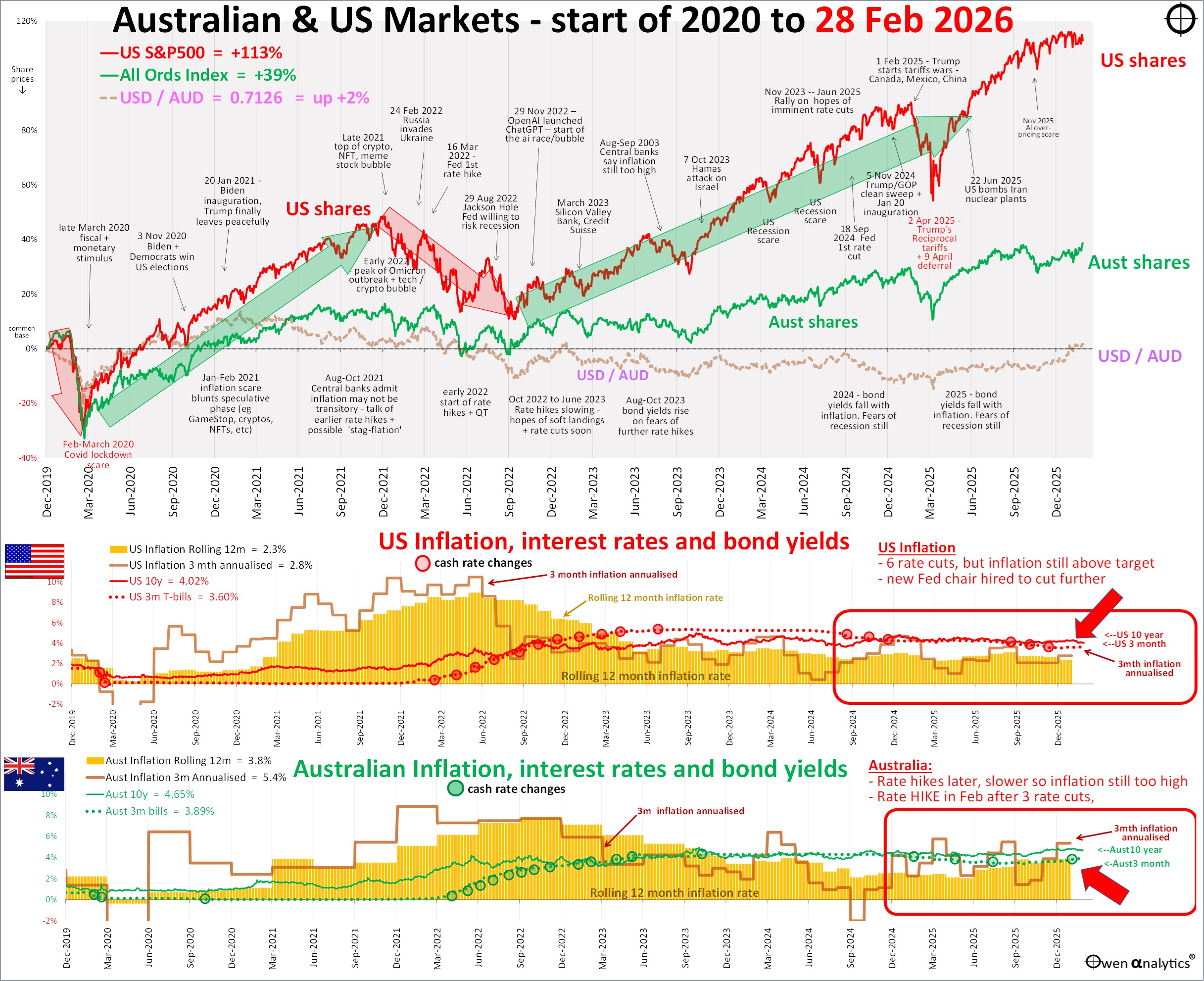
Not only does it have all the detail I need, but even from the back of the room, you can esily see the big picture on where we are for share markets, currency, inflation, long & short interest rates.
Main themes
The main global themes in February included:
- Inflation remained sticky in Australia, US and elsewhere. In Australia the Reserve Bank became the first major central bank to start raising interest rates after the recent cuts. More on this below.
- The bank of Japan has also been hiking interest rates, but it did not cut rates after the Covid stimulus inflation spike, so it was not a turnaround from cuts to hikes there. The RBA is the first turnaround.
- Speaking of Japan, stand-in LDP leader Sanae Takaishi won the election for PM. She is known for her conservative views, traditional family values, anti-gay rights, and Thatcherite economics (small government, fiscal responsibility), but she won the election for PM on a platform of anti-China rhetoric, tax cuts, and even bigger government spending! Popoulism wins over principled policy! Hence the surging inflation fears, bond yields, and rate hikes in Japan.
- Trump’s tariff war took a blow when the US Supreme Court over-ruled Trump’s IEEPA reciprocal tariffs, but Trump immediately hit back with new 10% then 15% global tariff for 150 days from 24 Feb using the untested s.122 of the 1974 Trade Act. Who knows what the outcomes and impacts will be.
- Trump turned his attention from Venezuela, Gaza, Greenland, and Minesota, and started a new war in with Iran. This will play out in March and beyond.
- Share markets rose across the board, except in the US where software stocks continued to be hit by fears of ai destruction of revenue streams. There has been a dramatic shift away from ‘asset-lite’ companies to companies with hard assets. Have US big-tech been oversold? Are they cheap or still expensive?
Much happened in the rest of the world of course, but nothing affects global markets (including Australia) as much as US events because the US still has the largest, deepest, most liquid capital markets in the world.
Inflation & Interest rates
Australia
Inflation in Australia remains problematic – with strong jobs markets, robust consumer spending, and open-cheque book government deficit spending sprees at Federal and State levels. The RBA finally had to hike rates in early February, the first central bank in the world to reverse course since cutting rates after the Covid-stimulus inflation spike.
Regular readers would know that I had been saying for a year that the three rate cuts in 2025 were not justified and would not hold.
Probably, the rising AUD would have in time caused downward pressure on prices and inflation, and may have saved the RBA the need to hike rates. But the RBA said it would be ‘data dependent’, and so when the data kept going the wrong way, they had painted themselves into a corner and had to act.
Given the time lags from cause to effect, it is unclear of course whether further rate hikes are needed to bring inflation back into target range.
The reverse course from rate cuts to rate hikes has put a pause on the booming housing market, but not at the entry level, which is still rising thanks to the extra tax breaks and hand-outs.
For my assessment of the RBA’s track record on inflation since the early 1990s – see –
USA
US inflation is still running above target on any measure – annual 2.4% rate, or an annualised 3-month running rate of an even higher 2.7%, and the Fed’s preferred measure (PCE – Private Consumption Expenditure) is also running hot at 2.9%. All far too high, and ordinarily would require rate hikes, especially as consumer spending remains strong and unemployment tightened further to 4.3%.
Despite all of this inflationary pressure, the Fed has cut rates six times under enormous political pressure, including threats of criminal prosecution of Jay Powell, who has stood firm. Trump’s new Fed chair Kevin Warsh may turn out to be another Marriner Eccles (obediently followed FDR’s instructions to cut rates and keep them low for a decade to reduce the cost of the US government’s War-time debt load). Alternatively, he might be another William McChesney Martin (appointed in 1951 to specifically continue to the artificial suppression of interest rates to help the government, but he immediately disobeyed orders and hiked interest rates to attack the Korean War inflation spike.
One of the bullish factors supporting share markets is the hope that Warsh will follow Trump’s instructions and cut rates further, or at least not raise rates, plus also reduce long-term rates by re-starting QE bond buying (although Warsh is highly unlikely to do that, given his frequently aired concerns over the size of the Fed balance sheet).
Commodities
Commodities markets had a good month in February (and that was before the Iran bombing), lifting most of the ASX mining market. The only exception was iron ore, which slide back below $100/tonne, with the tussle between China and the big Aussie miners over pricing mechanics. Chinese steel production is flat but the new supplies out of Guinea (Simandou) are putting downward pressure on prices.
However, gold (plus silver), and other industrial and battery metals were stronger in Feb. Oil prices were up for the month, even before the US/Israeli bombing of Iran. Gold and oil will certainly spike upward early in March as a result.
The medium term commodities rally is gathering pace, driven by several themes. ‘Sticky’ inflation is causing the paper money prices for ‘real’ assets (real estate, commodities) to rise. Actually, it’s not really commodities prices rising relative to paper money – it is the debasement of paper money relative to real assets. But it appears as if commodities prices are rising.
Industrial commodities demand is also being boosted by the global military build-up, the race to ‘renewables’, and the extraordinary ai/data centre boom, which is also creating unprecedented demand for industrial metals, energy and water.
We also have the ‘debasement’ trade (rising government deficits and spending, more central bank money printing) – and rising political turmoil inside the US and around the world, lifting precious metals.
Silver? - Readers would know that I have studied gold in quite a bit of detail over the past several decades, and I hold gold in several forms – including in my own published ETF portfolio (and advised portfolios). However I know very little about silver and consider the current rally to be mainly FOMO-driven.
Bitcoin? – Global strife (inflation, political unrest, wars, debt crises, etc) should be good for bitcoin, which was supposed to be ‘digital gold’ and a solution for the decaying US dollar. However, bitcoin fell another -20% in February and is now down by -46% from its peak in October 2025. So much for ‘digital gold’! I hold no bitcoin, or other cryptos or NFTs or meme coins.
Australian Shares
The local share market rose +3% in January, double January’s rise. This is a good start to the year after a rather pedestrian +7% gain in calendar 2025, when it lagged most global markets badly.
The main winners for the month were the two largest sectors – banks and miners.
The big banks were all up big time thanks to some good operating results. CBA surged +17%, back near its record highs of mid-2025. NAB +13%, Westpac +10%, and ANZ +9% (although ANZ was the big winner for 2025, up +27% for the year, as new CEO Nuno Matos’ aggressive plans appear to be making progress). The rest of the ‘financials’ sector was mostly a sea of red ink, for a variety of reasons.
Miners were up virtually across the board with good price rises on most mining commodities. The exception was iron ore, which fell back below $100/tonne, but the spike in copper prices lifted BHP to a new all time high. More on commodities below.
The rest of the mining market was mostly a sea of green, lifted by commodities prices – including gold miners, copper, lithium, nickel, rare earths. Even Woodside managed a gain with higher oil prices.
Outside of the banks and miners, the rest of the market has been heading down for the past six months. The main drag on the rest of the market has been CSL, which is continuing its tale of woes, most of which are own-goals. The share price down below $150, less than half its Covid peak six years ago.
Also dragging the market down are our small band of ‘tech stocks’, also suffering a spate of own-goals, plus fears of ai damage, which sent Wisetech, Xero, REA, Seek, Carsales, lower.
Woollies (+16%) looks like regaining the momentum from Coles (-3%) with strong results.
Global shares
Global share markets were up in February, after a strong start to the year in January, and following three great years of returns in 2023-4-5. All sectors did well in Feb apart from software firms, being hit by fears of ai destroying their business models. As a result, the US was the only major market to post a decline in Feb while the rest of the world was strong.
Amazon was down -12%, Microsoft -9%, Meta/Facebook -10%, Alphabet/Google -8%, Palantir -6%, Adobe -11%, Oracle -12%, and also spread to integrators like IBM -22%. Telsa was down another -6% (but mainly car troubles there). The ai rot also extended to Chine stocks like Alibaba -16%, Tencent -15%, Baidu -19%.
Also being hit by ai bubble fears were several of the US financial stocks, with rising concerns over exposures to private credit lending to ai firms and data centres, directly and indirectly via hedge funds, venture capital, retail private credit funds. This space is riddled with related party transactions, concocted accounts, and fudged valuations, so nobody actually knows what potential losses are where.
But more than offsetting these losses were strong gains elsewhere – including consumer staples (with strong consumer spending still), fossil fuels (oil price spike on middle east war fears), healthcare, industrials, industrial materials,
Bonds
Bond markets posted small positive gains as yields fell across the world on slowing growth fears, perhaps echoing the fear of US deflation, unemployment and business failures as ai devastates companies and jobs.
However, this outlook is inconstant with current strong jobs markets, consumer spending, and corporate profits, although these are backward looking measures, whereas bond yields are forward looking.
Slowing growth outlooks are also inconsistent with credit spreads, which have widened a fraction in February, but remain very tight, allowing very little room for corporate failure.
Regular readers will know that I have been out of fixed rate bonds since 2021 in my own (and advised) portfolios, with fears of sticky inflation coming to fruition.
Currency markets
The Aussie dollar had another strong month in February, rising above 71 US cents for the first time since the start of Feb 2023, thanks mainly to rising commodities prices, and also to the RBA rate hike plus prospects of more to come.
The US dollar also rose a fraction in February, mainly against the pound (further problems with the Starmer government), and the yen (with the election of Takaichi and her plans to cut taxes and lift spending).
But Trump continues to do his best to bring down the US dollar to make US exports cheaper for foreign buyers, and also make imports more expensive for US importers and consumers. Talking down the dollar is a much more sensible strategy than unilateral tariffs, but the dollar is still relatively strong, despite the decline over the past year, and is only back down to where it was ten years ago.
For more on the myth of the decline/death of the US dollar, see -
What lies ahead?
I see several themes driving markets in the medium term:
- Continued shift from rules-based order and win-win multi-lateral trade to power-based order and win-lose trade deals. Trump did not start this. The shift started in the 2010s with US/Europe letting Putin take Crimea in return for cheap gas for Germany/Europe, and US/Japan letting China militarise the South-China Sea. It has certainly accelerated under Trump. Lower cross-border trade & investment, more reliance on government subsidies & distortions, inflationary on-shoring of uneconomic industries.
- Sticky inflation - political pressure on central banks to keep rates low – populist pressure on governments to keep deficit spending. Tariffs + onshoring adding to costs/prices. Bond yields to stay elevated or even drift up further, risk of bond yield spikes, or sudden need for rate hikes, unsettling / breaking share markets.
- Share markets continue to be supported by good profit growth for now. Shares everywhere are expensive but buoyed by loose monetary & fiscal policies, plus a near certainty that governments will throw ‘free’/borrowed money at any problem.
- Commodities rally gathering pace – rising demand soaking up over-supply, ai / data centre boom (industrial metals, energy, water, land), global re-armament – especially Europe, Japan, Canada. This should support ASX market, as long as banks avoid a local recession.
- De-dollarisation fears are probably over-done, but is driving up gold, silver, but not bitcoin. US treasury yields not at risk for now (and even fell in February).
- The current boom will end one day of course. All markets everywhere, including and especially Australia, are over-priced on fundamentals, not just US-big tech. However, each boom is different and the triggers for the inevitable bust are different each time. See my recent 6-part series on share market over-pricing and where we are now –
- World share market pricing - Part 3: Forward P/E ratios and earnings growth assumptions – The US market is actually better placed than most! (20 Aug 2025)
- I have not changed my asset allocation in portfolios (my own and for investment committees) and it has done rather well – beating Big Super by about 2% pa, thanks mainly to two themes - having Gold, and zero interest duration (no fixed rate bonds). A lot has happened in that time and I have left it alone to do its work. That’s the point of an ‘all-weather’ portfolio – I don’t need to constantly worry and fiddle with it. When I get some time in the coming months I will certainly take a look and see if I need any adjusting.
‘Till next time – safe investing, and stay healthy!
Plus check out my recent webinar on global markets for Aussie investors –
For my wrap-up of asset class returns in 2025 –