Key Points:
-
-
- Three-quarters of the major wars and military flare-ups in the past century were accompanied by rising share markets (even the BIG ones during WW2).
- The main reason is that wars generally create sudden increases in demand and spending, flowing through to company profits and share prices, despite higher inflation.
- However, even with higher inflation, in most cases the military crises triggered surges or rebounds in share markets.
- Here I look at 31 selected wars and military flare-ups since 1939 (including WW2) up to Russia’s 2022 invasion of Ukraine.
- I measure impacts on the US and Australian share markets: the length and depth of the sell-off, and gains/losses over 3-months and 12-months.
- Results: the initial shocks caused mostly sharp but short sell-offs, but two-thirds recovered within three months, and three-quarters were ahead by 12 months.
- More than half of cases, both US and Aussie share markets posted better than historical average returns from pre-crisis levels (and even higher from the crisis lows).
- Main chart shows impacts on the Australian market after 12 months, but refer to full story for details on the length, depth of initial falls, plus impacts over different periods – on both the US and Australian share markets.
- BOTTOM LINE: OVERALL, MILITARY SHOCKS OVER THE PAST CENTURY (EVEN THE ‘BIG ONES’) WERE NET POSITIVE FOR U.S. AND AUSTRALIAN SHARE MARKETS.
- There are some very surprising outcomes – eg many of the ‘BIG Ones’ like Pearl Harbor had rather minor impacts on share markets.
- Where military crises did trigger a big sell-off for shares, there were usually more potent but unrelated causes (eg GFC, tech-wreck, aggressive rate hikes for pre-existing inflation).
- While past provides no guarantees for the future, this is a good reminder that wars and military flare-ups (even very major ones) have generally triggered short, sharp but temporary share sell-offs that recovered quickly, and in most cases actually resulted in higher than average returns over the following year.
- While every war and military flare-up is different, the LESSONS FOR INVESTORS are always the same: (1) don’t panic sell (or panic buy!); (2) take your own time to form your own views; and (3) make up your own mind based on your own individual circumstances, goals, needs, and risk tolerance.
Impacts of military/geo-political crises on share markets
This study looks at the short term impacts of crises on share markets because the sudden escalation of conflict is what captures headlines and triggers investor panic.
I look at 31 selected wars and military flare-ups/crises since 1939. They include events in the lead-up to WW2, then during WW2, and the major conflicts since then, up to and including Russia’s 2022 invasion of Ukraine:
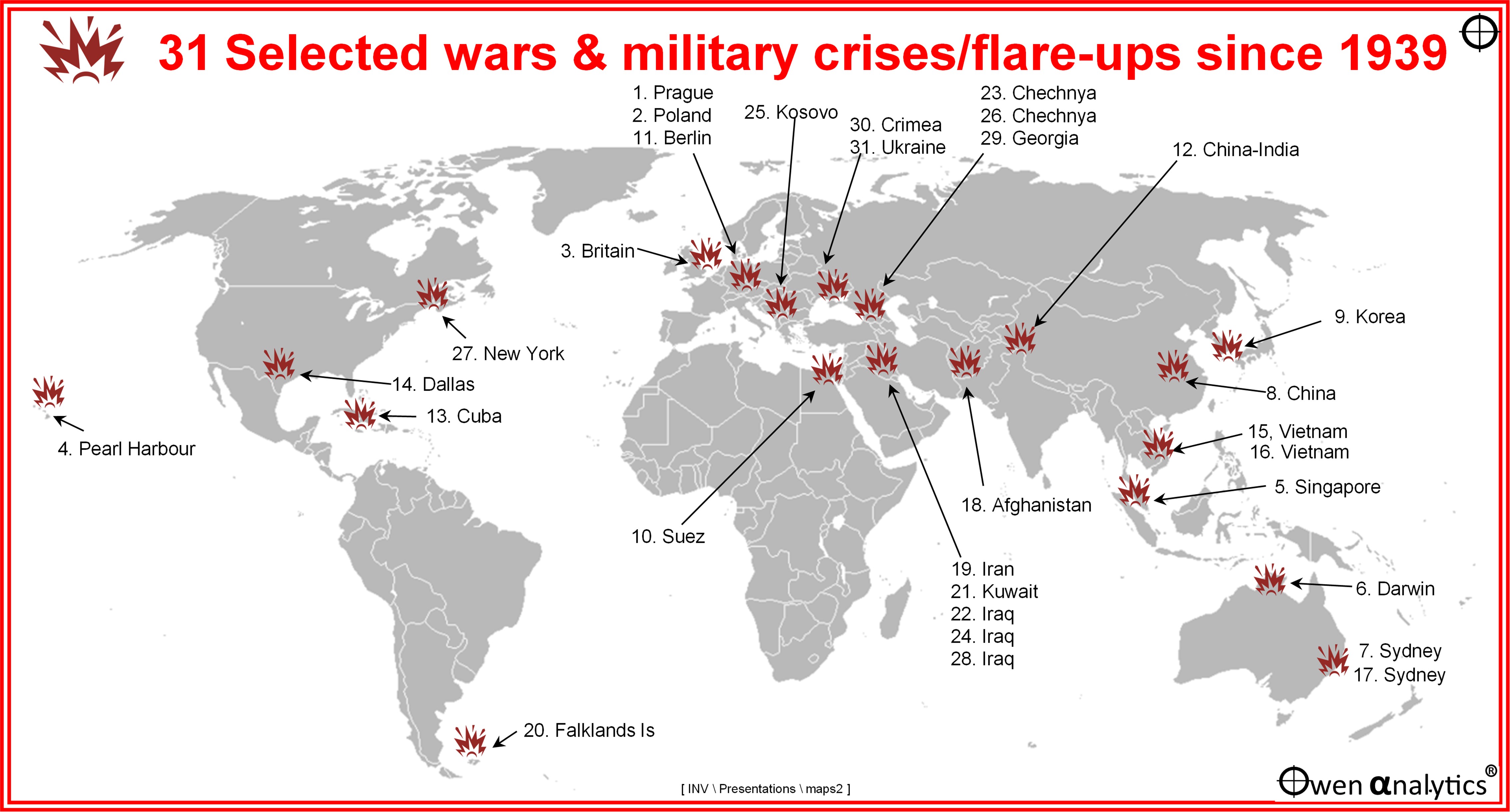
There were hundreds of other incidents and wars during the past century, including dozens of post-WW2 wars for colonial independence across the world, and countless civil and internecine wars, but here I have selected the main events affecting the major powers, and affecting Australia (as a UK/US ally).
I measure impacts on the US and Australian share markets: the length and depth of the sell-off, and gains/losses over 3-months and 12-months.
Events on Australian soil
Because I am primarily interested in Australian investors, I have included three events with foreign elements that occurred on Australian soil:
-
-
- Japanese bombing of Darwin and northern Australia starting on 13 February 1942 (6);
- Japanese subs shelling ships in Sydney Harbour on 7 June 1942 (7);
- Ananda Marga bombing of the Sydney Hilton Hotel on 13 February 1978 (17).
The first two of these brought WW2 to Australian soil, and the third (Sydney Hilton bombing) is included here because (a) it was the first fatal terrorist attack in Australia; (b) the hotel was hosting the Commonwealth Heads of Government meeting at the time, which included a number of possible international targets; c) an Indian-based international organisation (Ananda Marga) was a main suspect; and d) there was a significant amount of evidence pointing to the possibility that the police, defence forces and/or security forces (ASIO) were involved as conspirators and/or in a cover-up, adding to the geo-political intrigue, exacerbated by the NSW government hastily closing down the official enquiry, preventing key witnesses from being called.
(As an aside, I was working at the Sydney Hilton on the night of the bombing as a room-service busboy while at university. The bombing occurred just after I finished my night shift. Three people died and eleven were injured in the bombing. Despite my Indian/Sri Lankan heritage and appearance – it wasn’t me!)
Impacts on US share market
I generally start with US reactions to events, even for Aussie investors and portfolios where I do most of my work, because Australia follows US reactions virtually in lock-step in almost all situations.
The tables below summarise the short-term impacts of these events. There are four columns of impacts:
A) the duration of the fall in number of days to the bottom of the share market sell-off (if any);
B) the depth (percent fall) of the share market sell-off (if any);
C) the 3-month percentage gain or loss from the level the day before the crisis; and
D) the 12-month percentage gain or loss from the level the day before the crisis.
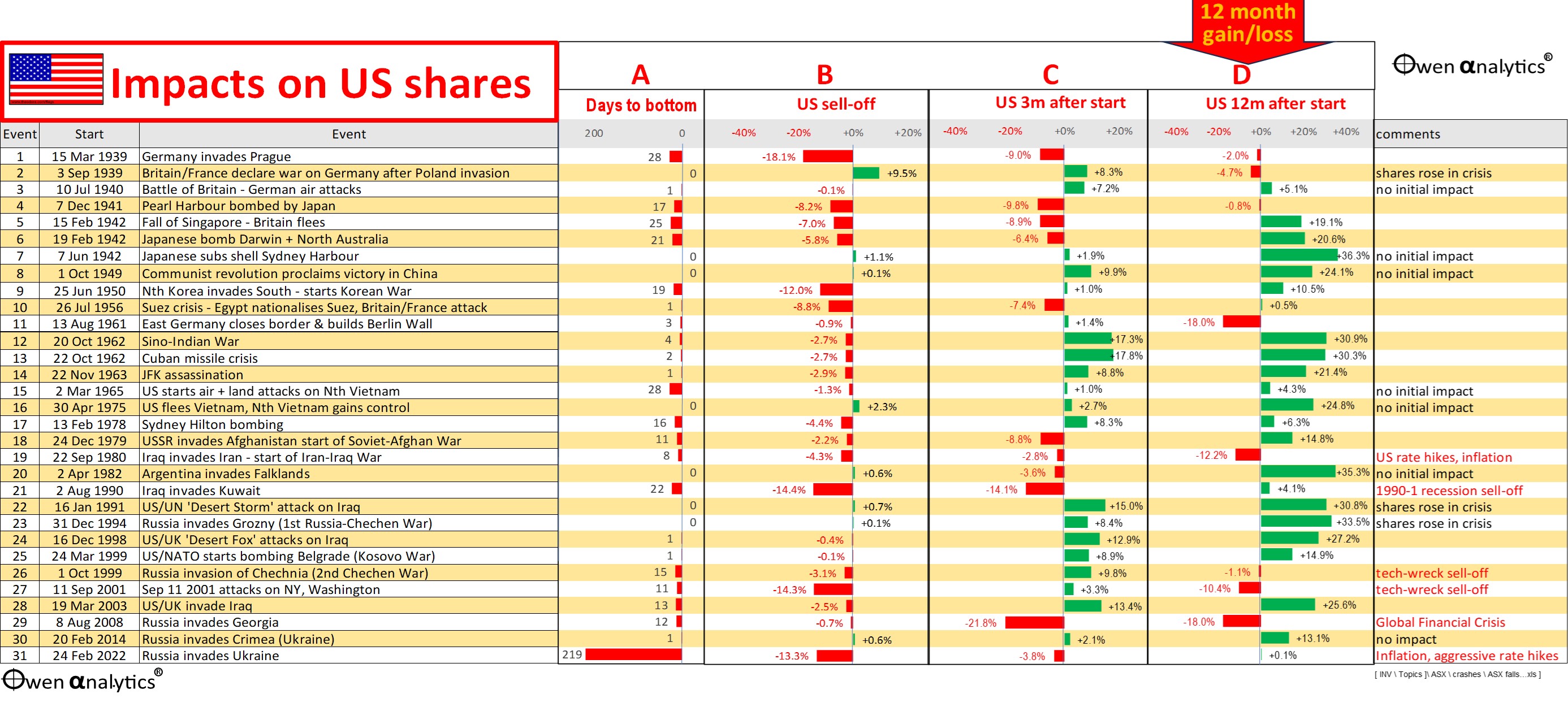
(For US shares I use the Dow Jones Industrial Average as a proxy for the overall ‘market’ as it has a much longer history than other main US daily indexes. Despite its narrow coverage it is still a very representative indicator of overall investor sentiment.)
Here’s how the numbers stack up for the US market:
-
-
- In 77% of events (24 out of 31) share markets sold off from the outbreak (column B).
- However, in almost all of these, the sell-offs lasted just a few days (column A). The median sell-off was a fall of just -2%, the average was just -4%. Only 5 (16%) of the events caused a sell-off worse than -10%.
- After three months from the trigger (column C), in 20 out of 31 (65% of events), markets had already recovered and moved ahead of their pre-trigger levels.
- After twelve months from the trigger (column D), 23 out of 31 (74% of events), markets had moved ahead of their pre-trigger levels.
- More importantly, after 12 months, 55% of the time markets were more than 10% above their pre-trigger levels. This means most of these crises produces better than average gains.
- The median 12-month price gain from the start of the crisis was 13%, and the average was 12%. – both better than historical average gains for the US market!
- In the few instances where share markets were not ahead 12 months later (column D), these were due to other factors at work (see comments at right). These included unrelated negative market events like the ‘GFC’, the ‘tech-wreck’, aggressive rate hikes, or economic recessions unrelated to the wars.
Overall, these major wars and crises over the past century were a net positive for the US share market!
2022 Russian invasion of Ukraine worse than Pearl Harbor!
Out of this list of major wars and military flare-ups (including those in WW2), the longest sell-off by far, and the second deepest, was the February 2022 Russian invasion of Ukraine (Event 30 on the table).
However, the Russia-Ukraine war was not the main factor behind the longer and larger sell-off in US shares during 2022. The primary cause was the series of aggressive Fed rate hikes to counter the sudden Covid stimulus inflation spike.
In contrast, the Japanese bombing of Pearl Harbor (Event 4) was without doubt the most serious and far-reaching military flare-up for the US in the past 150 years as it immediately threw the US full-scale into WW2. But the impact of the Pearl Harbor attack on the US share market was remarkably mild: falling just -8% over 17 days, and then back to square one within a year, as the War raged on in Europe and the Pacific.
WW2 was actually a very positive experience for both the US and Australian share markets – for different reasons. For my detailed look the impacts of WW2 including lead-up before and aftermath – see:
Impacts on Australian share market
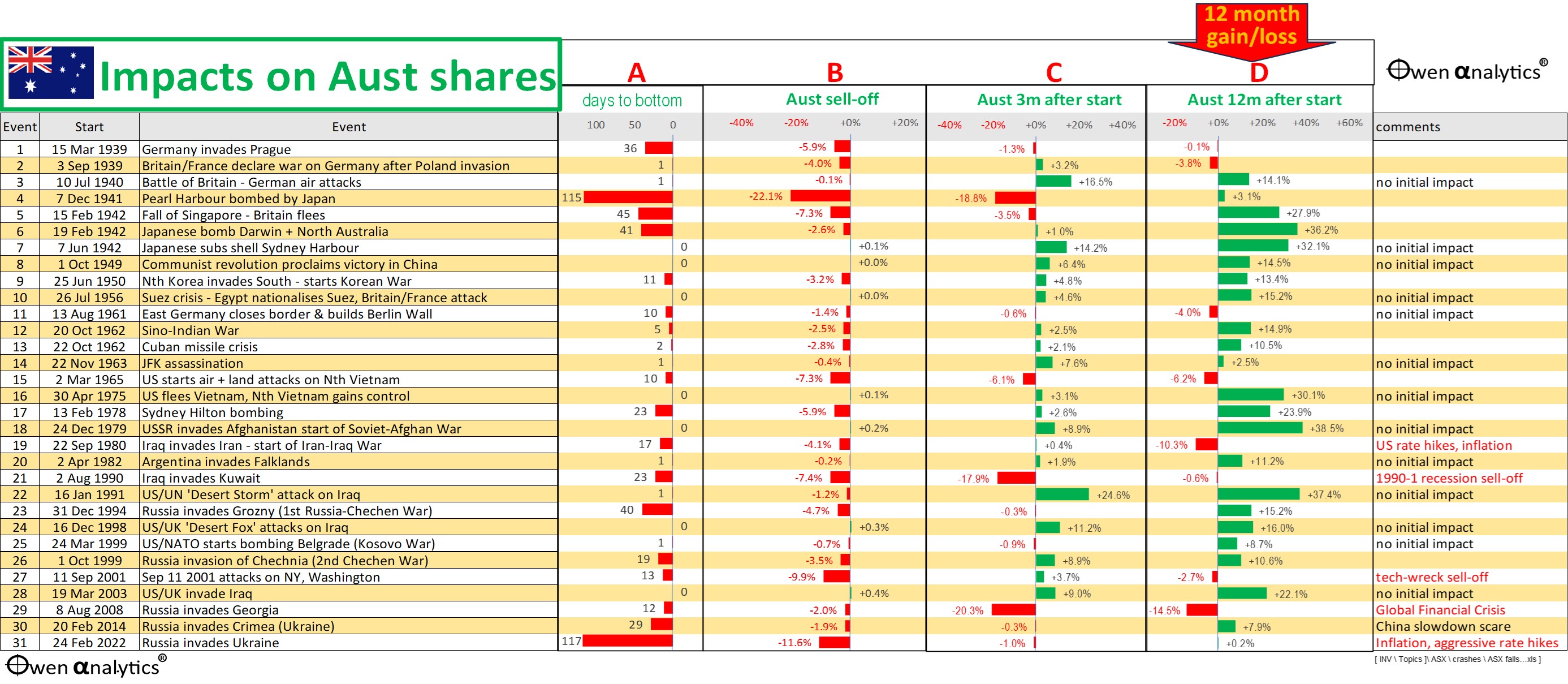
The next table below shows the impacts of the same crises on the Australian share market.
The impacts of these wars and military flare-ups on the Australian share market were almost exactly the same as on the US market - ie most of the events triggered immediate panic sell-offs for a few days, but recovered over the ensuing months.
Here’s how the numbers stack up for the Australian share market:
-
-
- In 77% of cases (24 out of 31) share markets sold off from the outbreak (column B). This is the same as for the US market (above).
- However, in almost all of these, the sell-offs lasted just a few days (column A). The median sell-off was a fall of just -3%, the average was just -2%. Only 3 (10%) of the events caused a sell-off worse than -10%. (better than the US market).
- After three months from the trigger (column C), in 20 out of 31 (65% of events), markets had already recovered and moved ahead of their pre-trigger levels. (same as US).
- After twelve months from the trigger (column D), 23 out of 31 (74% of events), markets had moved ahead of their pre-trigger levels (same as US).
- More importantly, after 12 months, 58% of the time markets were more than 10% above their pre-trigger levels. This means most of these crises produces better than average gains. (even better than the US!).
- The median 12-month price gain from the start of the crisis was 11%, and the average was 12%. – both better than historical average gains for the Australian share market! (similar to the US).
- In the few instances where share markets were not ahead 12 months later (column D), these were due to other factors at work (see comments at right). These included unrelated negative market events like the ‘GFC’, the ‘tech-wreck’, or economic recessions unrelated to the wars.
Overall, these major wars and crises over the past century were a net POSITIVE for the Australian share market as well!
Ahh, but ‘this time is different!’
Of course every event that affects markets will be different. Every event is different, and always be in the future. For example, in wars today we have the dramatic use of drones, all sorts of war applications for artificial intelligence and robotics. In the near future we may also have lasers from satellites.
However, don’t forget about the devastating impacts of some the of the war-time ‘innovations’ used in some of the wars in the above tables - like chemical warfare, machine guns, gas chambers, jet fighters, cluster bombs, and nuclear bombs – which resulted in the deaths of tens millions of people (mainly civilians) and complete physical destruction of entire countries.
We can always hope that wars will be non-existent in future, or at least less destructive as past wars, but it seems we can’t escape hard-wired human nature.
What to do?
While the past provides no guarantees for the future, this exercise is a good reminder that wars and military flare-ups (even very major ones that resulted in the deaths of tens of millions of people) ) have generally triggered short, sharp but temporary sell-offs that recovered quickly, and in most cases actually resulted in higher than average returns within a year after the crises.
On average, the 31 major wars and military flare-ups actually produced better than average returns on the US and Australian share markets – just by ignoring the noise and sticking to their long-term plans.
Unfortunately, many investors are tempted to panic sell into the initial herd-like race for the exits or, worse still, are sold up by margin lenders. (Margin lenders generally sell you up at the worst time at the worst price!)
However, for the more considered active investors, by the time they sit back, collect information, weigh up the evidence and the options, the market has in most cases already rebounded into the next rally.
While every war and military flare-up is different, the lessons are always the same – don’t panic sell (or panic buy!), take your time, make up your own mind based on your own circumstances, goals, needs, and risk tolerance.
‘Till next time – safe investing and stay healthy!
For my detailed look at the impacts of WW2 (including lead-up before and aftermath) on share markets – see:
See also -
For my latest monthly report on global markets for Aussie investors -