Greetings fellow investors!
Here’s my quick run-down on bond markets. Bonds are not very popular with self-directed investors in Australia, at least not for the past 60 years (trading of shares overtook bonds on Australian stock exchanges in the late-1960s when minerals discoveries kicked off another resources boom, and tax breaks for bonds were removed).
But bonds ARE a huge deal for Big Super (industry, corporate, retail) funds, and also for advice firms that run standardised model portfolios, because they ALL have large mandatory allocations to bonds. Why? Because they slavishly follow flawed academic textbook finance theory.
Fortunately self-directed investors and independent portfolio managers can take a step back and look at how the real world works, rather than be bound by dogmatic academic theories.
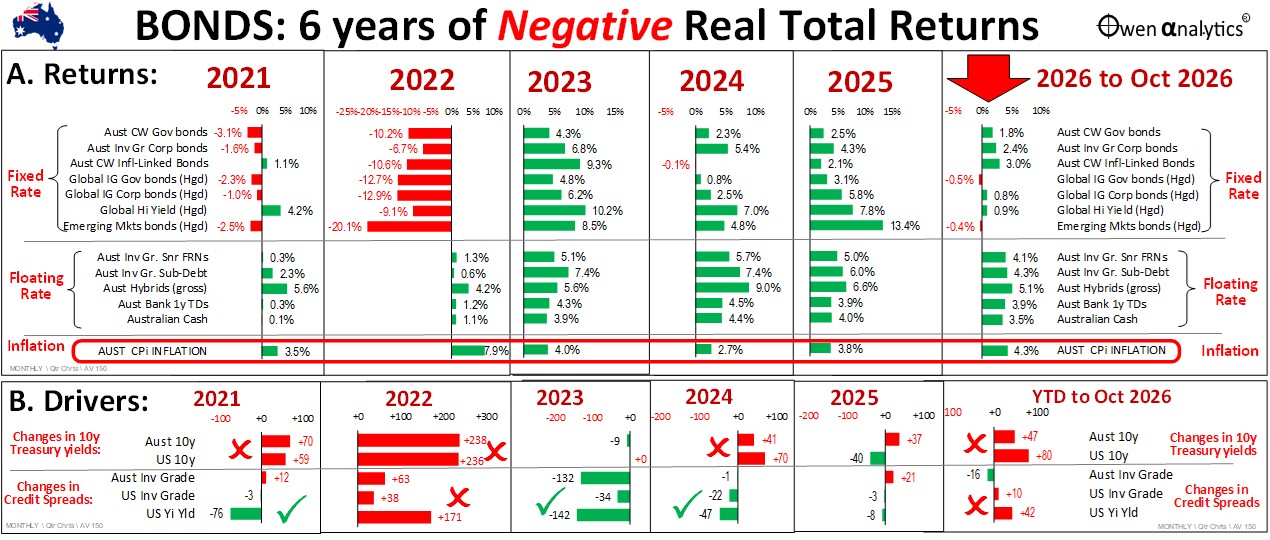
Bonds: 6 years (so far) of Negative Real returns. Worst period for bonds since 1973-81 ‘stagflation’. Why I have been out of bonds since 2021
2026 will make it 6 years of NEGATIVE REAL total returns from fixed rate bond markets here and around the world. It’s the worst period for bonds since 1973-81 (‘stagflation’). Probably not over yet.
Poor bond returns have been a major drag on Big Super (industry, retail, corporate funds) as they ALL have large mandatory allocations to Aussie and global fixed rate bonds. Why? Because textbooks say bonds are ‘defensive’ (they can be sometimes, but NOT in inflationary conditions – which is NOW!)
The upper row of charts show total returns from the major bond markets since 2021 (foreign bonds are in hedged AUD as per usual practice). At the top are the main FIXED RATE bond markets: Aussie, global, government, corporate, high-yield, emerging markets.
Below these are the main FLOATING RATE debt sectors. The difference is that FIXED rate bonds (where Big Super is stacked) are HURT by rising inflation and interest rates, but FLOATING rates BENEFIT from rising inflation and interest rates.
(These charts only include publicly traded markets, not ‘Private’ credit – which have opaque / fudged valuations / pricing, and are in trouble due to overly aggressive/poor lending. I have none)
I have been completely out of FIXED rate bonds in portfolios since 2021. My ‘defensive’ allocations have been in FLOATING Rate (FRNs, Sub-debt, plus Gold) because I sensed the world was heading into a new era of rising inflation & interest rates. Most institutional funds (eg Big Super) don’t have that luxury. Their trust deeds mandate large allocations to fixed rate bonds whether they like it or not.
The bottom highlighted row in the upper chart is Australian inflation, which has been out of control since Covid. Returns on fixed rate bond markets have mostly been BELOW inflation over the past 6 years.
Two main drivers of Bond returns:
What drives bond returns?
(1) changes in treasury YIELDS (inflation outlooks), and
(2) changes in credit SPREADS (recession/ bad debt fears).
These are highlighted in the lower section (B) of the above charts.
Sovereign government bonds ('treasuries') are affected only by treasury yields, while corporate and semi-government bonds (eg State governments) are affected by both treasury yields and credit spreads. The term 'credit spread' refers to the additional yield over and above the treasury yield that is demanded by investors to compensate for the risk of default by the issuer. Treasury (government) bonds are assumed by finance theory to be 'risk-free', and therefore not subject to a credit/default spread.
Increases in either yields or spreads are BAD for returns. Declines in either are GOOD for returns.
In most environments treasury yields and credit spreads go in OPPOSITE directions, so the return impacts partially or fully cancel each other out. Eg In booms & rebounds (2021, 2024) YIELDS rise (hurts returns) but SPREADS contract as bad debt fears recede (boosts returns). In slowdowns and recessions, YIELDS usually fall (boosts returns) but SPREADS blow out with bad debt fears (hurts returns). But that is only when the slowdown is NOT due to inflation.
The worst conditions are when YIELDS and SPREADS both rise TOGETHER as they did in 2022, which was the worst year for Australian bonds since our 1931 national default, and worst year for US bonds since 1920-1 post-WW1 inflation crisis.
Year by year since Covid
In 2021(Covid lockdown rebound) - treasury yields rose (inflation fears, hurt returns), but credit spreads were flat. The exception: High Yield (junk bond) spreads contracted as bad debt fears receded (good for returns), resulting positive returns from High Yield bonds, but negative returns in the main sectors.
2022 (rate hikes started) - yields rose (inflation fears, hurt returns), but spreads also rose at the SAME time (bad debt/recession fears from aggressive rate hikes, also hurt returns), resulting in the worst bond returns in a century
2023 (more rate hikes) - treasury yields were flat, while credit spreads fell (bad debt/recession fears faded). As a result, most bond markets posted positive returns, but barely above inflation.
2024 (tech boom) - treasury yields rose (inflation fears, hurt returns), while credit spreads fell (bad debt/recession fears faded). This is your classic boom scenario. Low positive returns, but negligible after inflation.
2025 (‘ai’, Trump tariffs) - treasury yields and credit spreads were flat – low positive returns but mostly below inflation
2026 to Oct (sticky inflation still despite rate hikes, cracks in the ai bubble) - treasury yields are up (inflation fears again, hurt returns) but credit spreads ALSO mostly up (fears of defaults, especially ai-related). 2026 looks like being another ‘double whammy’ year of rising treasury yields PLUS increasing credit spreads – like 2022 but not as severe.
This new era of higher inflation and interest rates is probably with us for a while yet (other than very brief respite in recessions). I will probably remain out of fixed rate bonds (and private credit) for another few years.
For more on my views on the new higher inflation and interest rate era –
· The Low Inflation era of great returns is over. Investing just got a whole lot harder! (16 Apr 2024)
· Inflation BIG Picture: Boomers got rich by lucky timing. Next Gen to get higher inflation & rates (25-May-2026)
· My latest podcast with Michael Yardney: Why Boomers got lucky, and why future returns will be very different for today’s investors (14-Sep-2026)
· US 10-year yields ‘soar’ above 5%. Shock Horror! But actually they’re still rather LOW relative to history, logic, fundamentals, and inflation. Get used to it! (27-Sep-2026)
‘Till next time – happy investing and stay healthy!