March 2026 was certainly one of the more eventful months for investment markets! Here’s my quick wrap-up on global markets for serious long-term Aussie investors, including shares, interest rates, inflation, bonds, cash rates, currencies, commodities, and more.
I outline two practical and logical reasons to be bullish in the medium term – one is my take on Trump’s war agenda, the other is chronic fiscal diarrhoea.
Key points:
-
-
- Shares fell in virtually across the board in all sectors and markets with the notable exception of oil/gas producers which soared on prospects of profiting from the mayhem.
- The mini-sell-off has been very minor so far, and share markets everywhere (not just US tech) remain vastly over-priced still. If this is the start of a proper correction, we ain’t seen nothin’ yet.
- Bond markets also posted losses as yields rose in expectation of higher inflation and interest rates.
- The AUD fell and US dollar rose, as per the usual pattern in global panics.
- Aside from fossil fuels, other industrial commodities prices fell, including even gold.
- I outline two reasons to be bullish in the medium term – one is my take on Trump’s war agenda, the other is chronic fiscal diarrhoea.
But first - my essential 1-page snapshot chart - covering Australian and US share markets, short and long-term interest rates, inflation, and the AUD/USD exchange rate. As I warned in last monthly report, I have dropped the first version (all on one chart) and just have the second version (showing Australian and US inflation and interest rates separately in the lower sections) from now on.
It is my go-to chart that tells me what happened when and why, whenever answering queries from advisers, investors, doing webinars, market updates, etc.
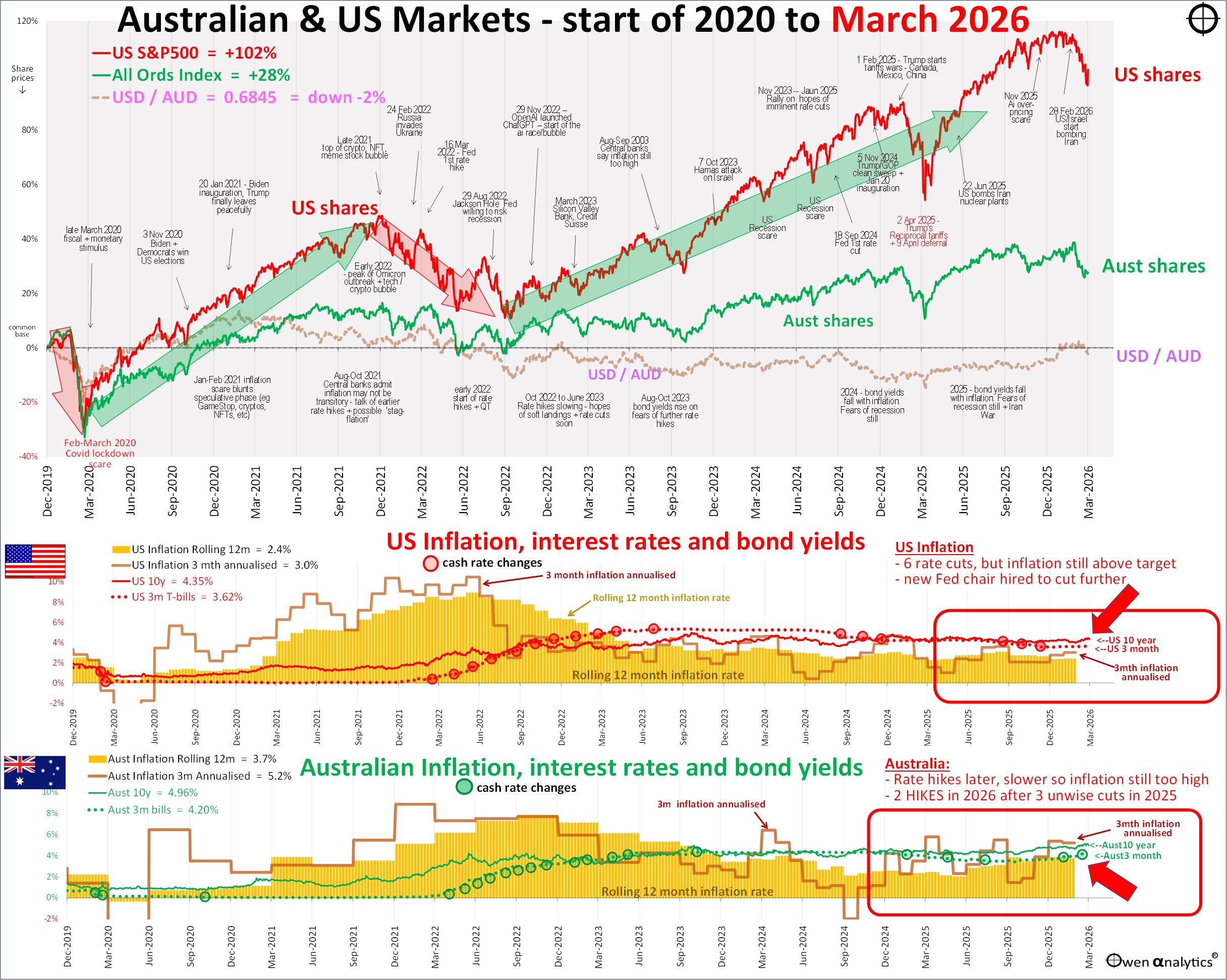
Not only does it have all the detail I need, but even from the back of the room, you can easily see the big picture on where we are for share markets, currency, inflation, long & short interest rates.
I will get into shares in a moment, but from the back of the room you can see that even though share markets had a very poor month in March (top right corner of the chart – red for US, green for ASX), we can see that is barely a hiccup in the scheme of things, and is still on a strongly upward overall trend.
Bottom line – if you were rattled by the volatility and price falls in March then you ain’t seen nothin’ yet! (or you are too young to remember what a proper sell-off looks and feels like!)
Share markets
Global share markets sold off in March, with just about everything down except for oil/gas stocks profiting from higher prices with the Strait of Hormuz closed.
Selling everything else across the board apart from oil/gas stocks is crazy of course. It’s just an irrational knee-jerk panic which we see in every ‘crisis’. At the risk of injecting some facts into the debate, see:
And:
These fact-based articles demonstrate that most of the big wars/crises, including those involving oil price spikes, inflation, and even ‘big’ wars, were actually mostly positive for shares in a large majority of cases (after initial short-term panic sell-offs of course).
Global Industry Sectors
The next charts show total returns from global sectors for March 2026 (middle chart), calendar year to date (right), compared to 2025 (left chart):
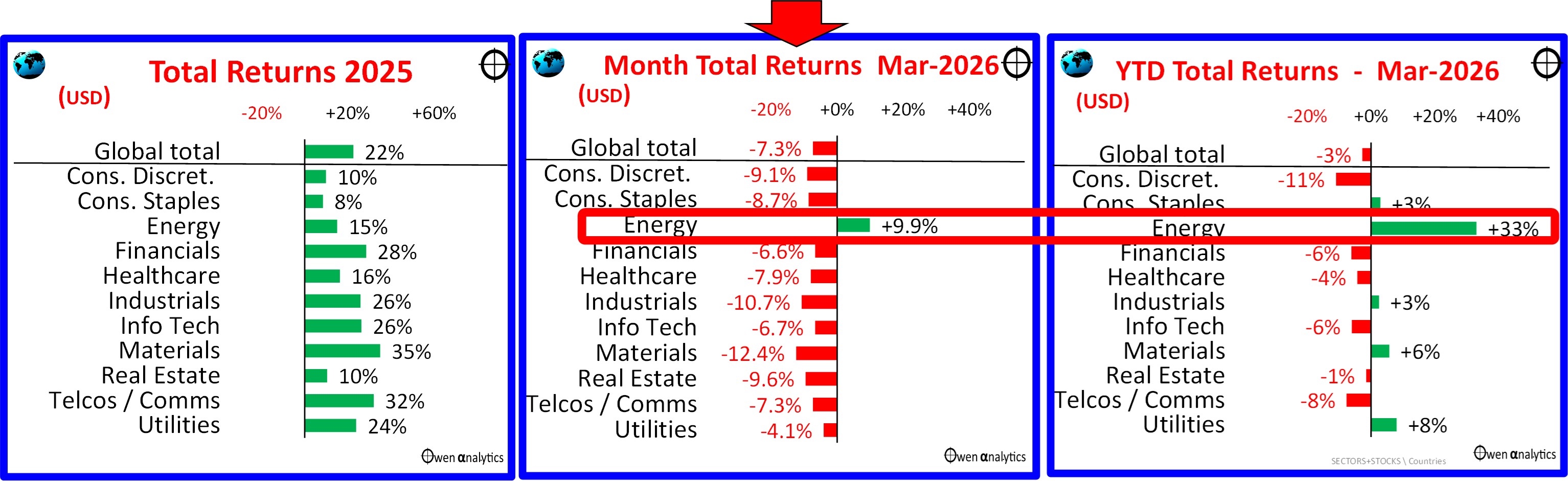
The only sector up was fossil fuels (‘energy’) – with across the board double-digit rises as they are expected to reap rewards from higher prices, margins, and profits in the global supply squeeze.
Major global stocks
Here is the picture for the largest global stocks (all of which are US based) for the same three periods:
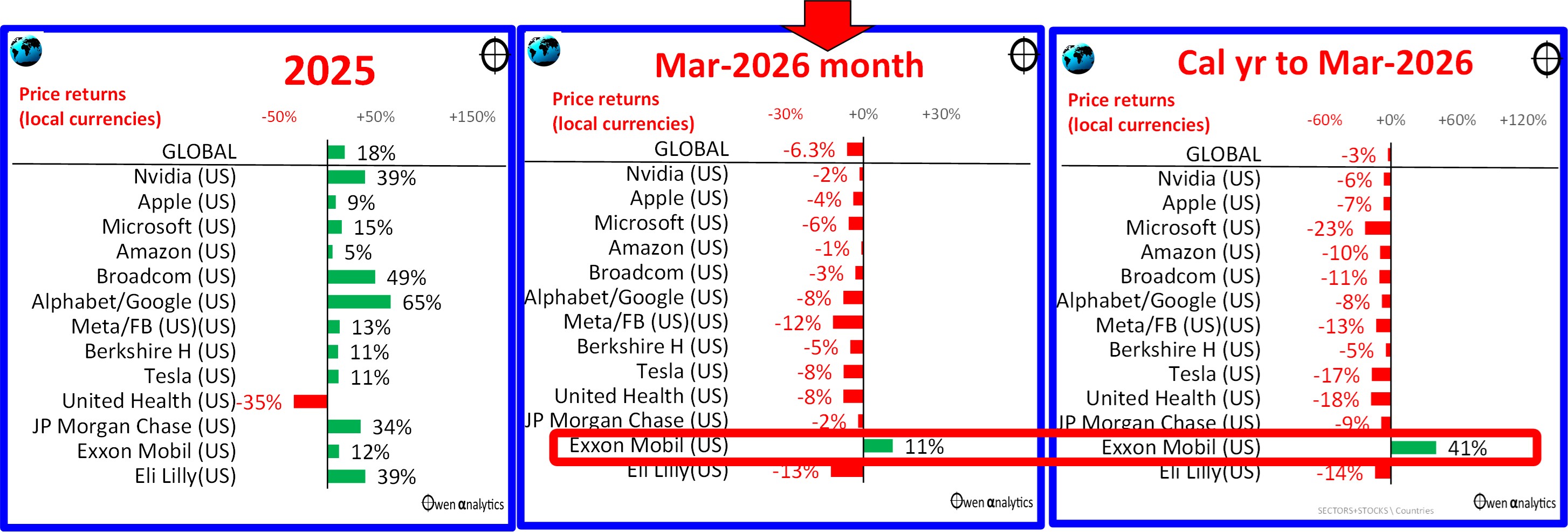
The only mega-cap up is Exxon.
Mag-7 update
For context, next are share price charts for the so-called ‘Magnificent Seven’ stocks over the past decade. I have also added three other punters’ favourites Oracle, Palantir, and Adobe, plus China’s Alibaba and Tencent:
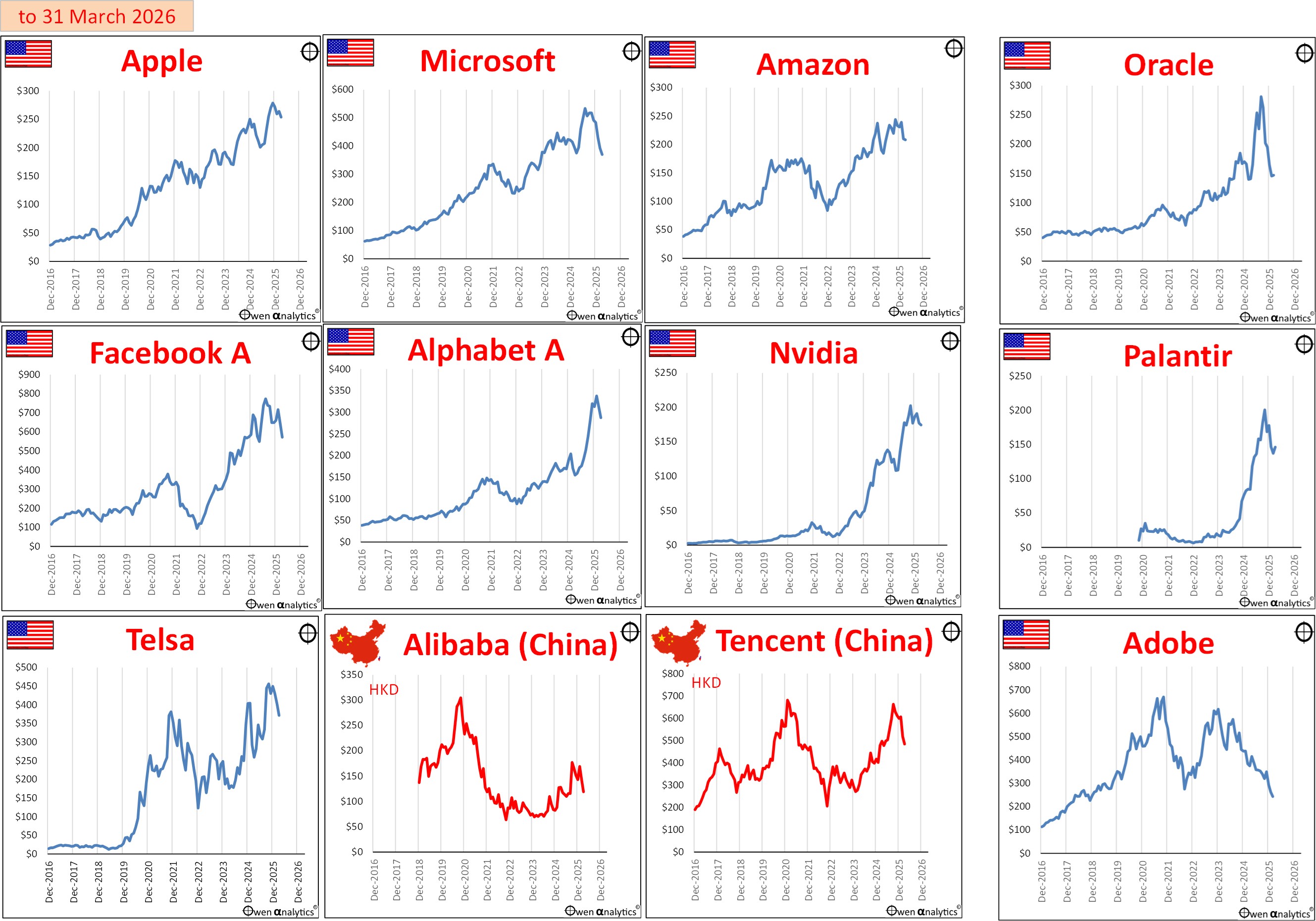
(For the benefit of new readers, I have not used any y-axis scale trickery here – the vertical y-axes all start at zero, and have regular, nominal scales, which highlights the explosive share price growth of the US giants from very low levels in the past decade.)
China’s Alibaba and Tencent are up over the past year, but both are still below their 2021 peaks. By comparison, all of the US majors are well above their previous peaks in the 2021 Covid stimulus boom, even struggling low-margin car-maker Tesla, finally.
Aside from Tesla, Adobe is the odd one out here – seen as being most vulnerable to being eaten by ‘ai’.
The US tech giants are still very expensive on a range of metrics. See my report on how they stack up individually on revenues, profits, dividends, and pricing -
A few months ago I published a six-part series on pricing of global share markets to better understand their implications -
For more on US profits and pricing – see:
Major country share markets
The war in Iran pulled down share markets around the world in March.
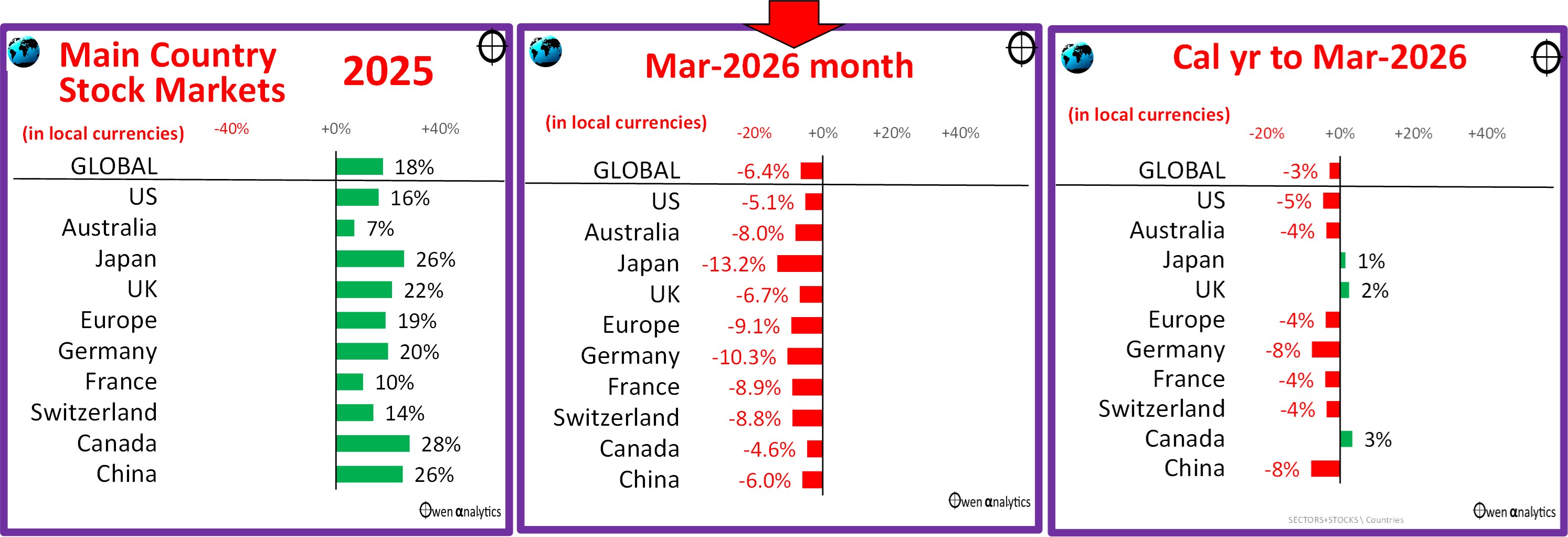
Best of the major markets has been the UK, with oil/giants BP and Shell (up +40% and +30% respectively in March).
Mind you, global share markets have just posted three very strong years averaging +20% per year in 2023, 2024 and 2025, and are running at extremely over-priced levels, so we are well and truly due for a correction.
So far in 2026 global share markets are down just 3%, which is not even a pimple on a hiccup. Shares everywhere (not just US tech stocks) are still vastly over-priced on a variety of measures – including and especially in Australia. Refer to the above reports on share market pricing.
Australian shares
Here are the main ASX stocks for March 2026 (middle chart), calendar year to date (right), compared to 2025 (left chart):
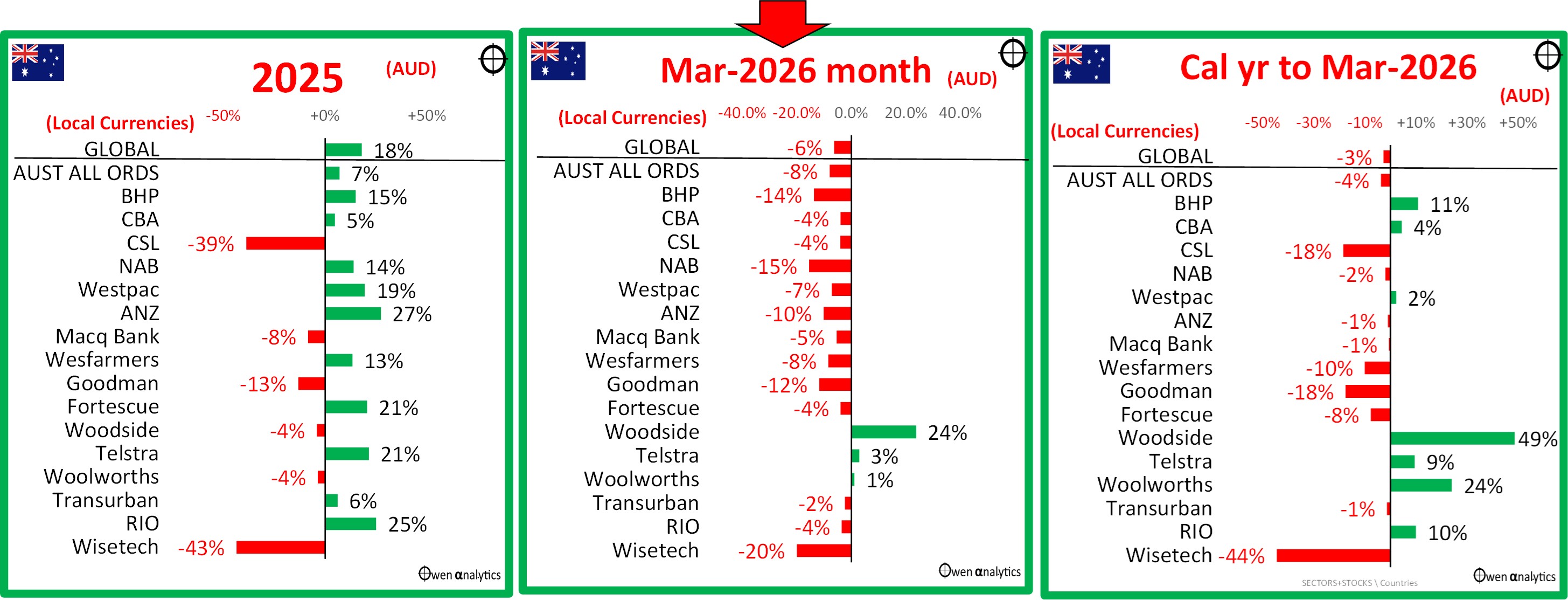
Leading the way in March has been LNG major Woodside, together with other fossil fiends Santos +18%, Ampol +20%, Whitehaven Coal +18%, Origin +2%, APA +8%.
Staple retailers held up (Woollies +1%, Coles +7%) as consumers race to stock up on supplies (dunny rolls again?!), and Telstra was up +3%, strangely regarded by many as a ‘safe haven / defensive’.
Apart from these few stocks, plus a few stock-specific moves (take-overs etc), just about everything else on the ASX was down.
Miners were down across the board as commodities prices fell (see below). All other sectors also fell – the big banks (recession / bad debt fears), building materials, industrials (which is mainly transport), healthcare, (mostly own goals), discretionaries (mainly gambling & travel), REITs, ‘Tech’ stocks (also mostly own-goals there too).
Inflation & interest rates
Even before the latest war on Iran, Australia already had the HIGHEST cash rate amongst its peers:
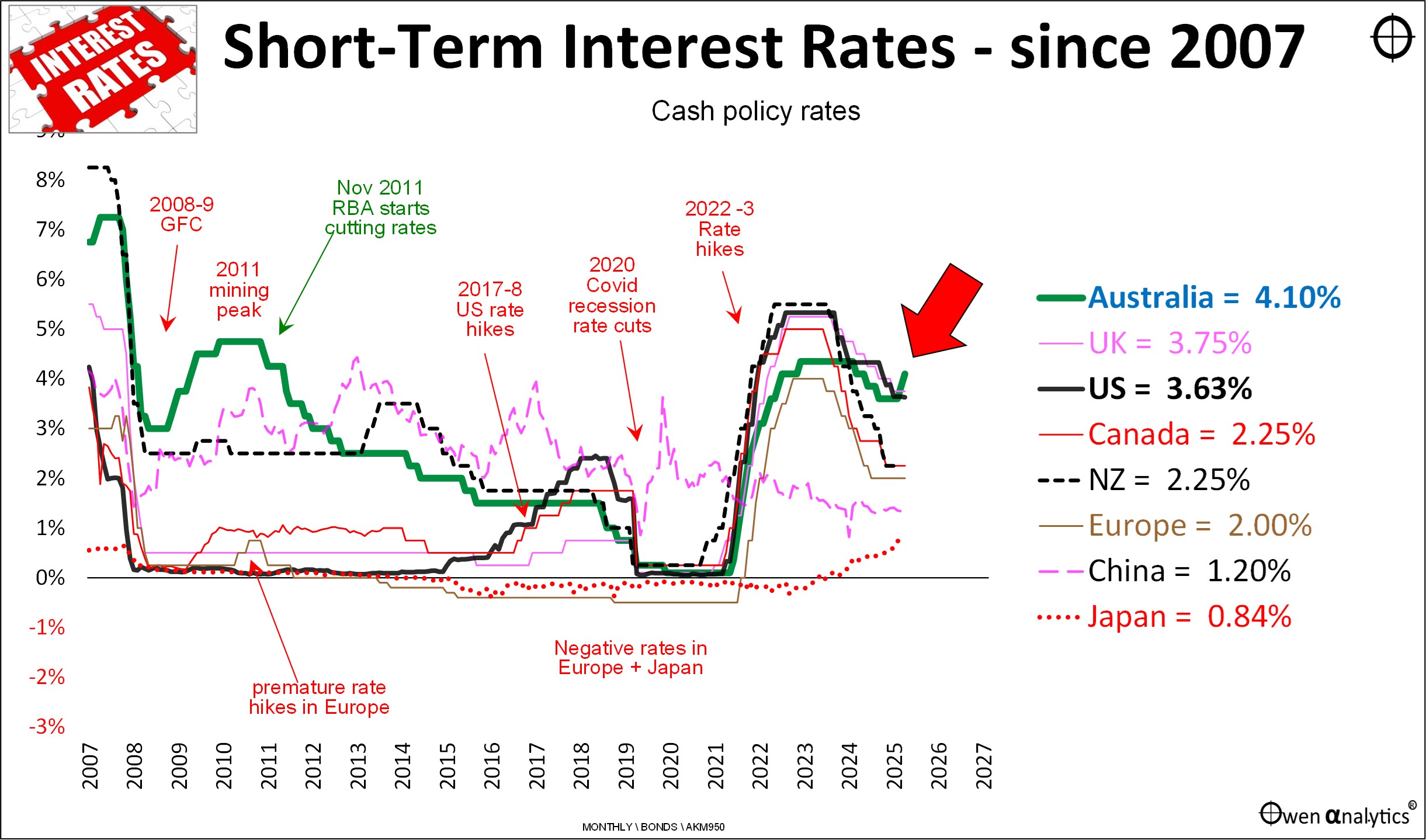
Why? Because we have the HIGHEST inflation:
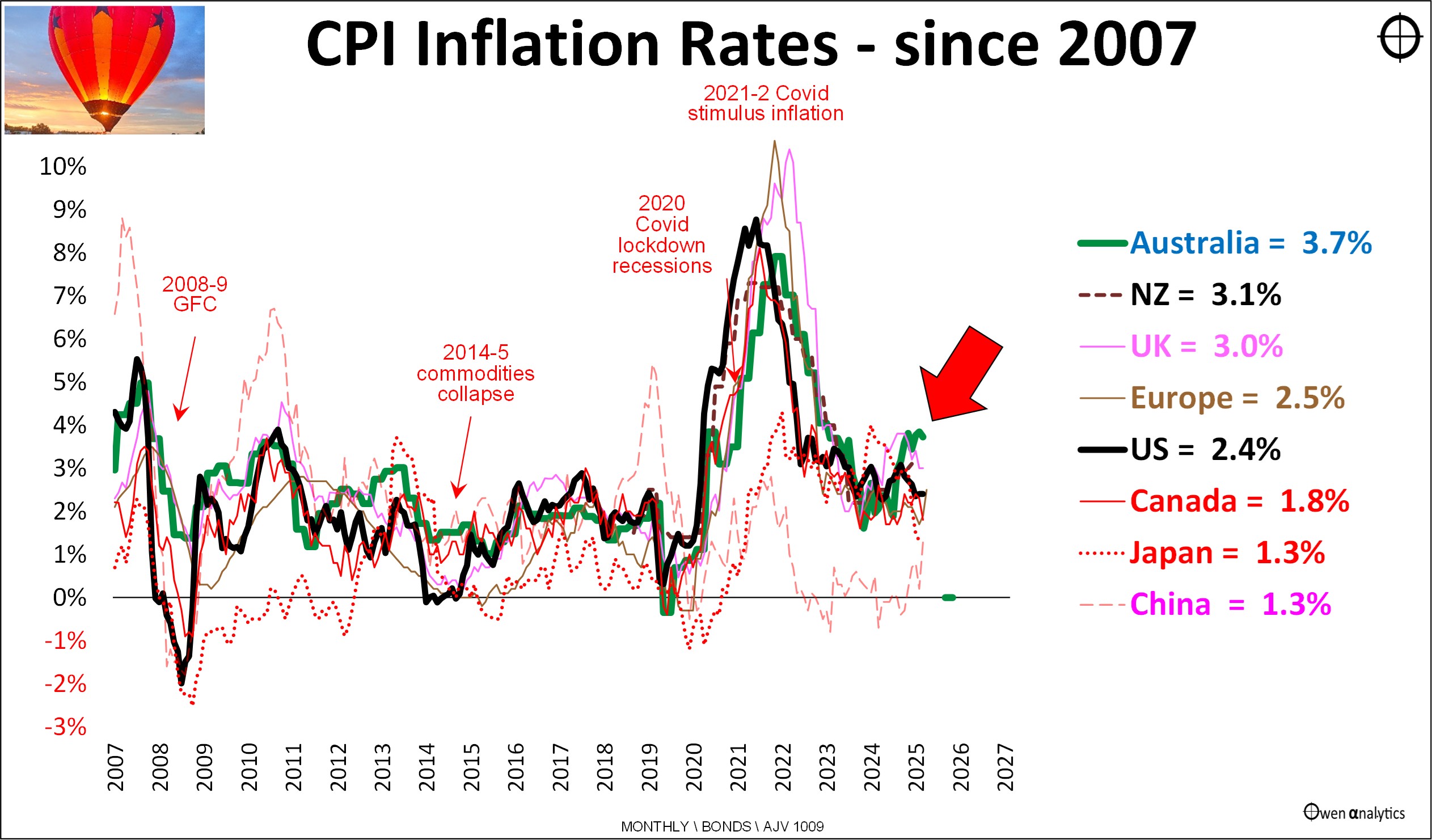
Adding to inflationary pressures, we also have the LOWEST unemployment rate (apart from Japan) – with the bulk of the hiring resulting from Federal and State governments’ open-cheque-book, debt-funded spending sprees.
No surprise that the RBA was the first central bank in the world to start hiking rates again. And now we have the new war, which will put further pressure on inflation and interest rates.
More RBA hikes are on the way.
Bond yields and bond markets
The picture on inflation and interest rates leads us directly to bond markets, in which every local and global institutional retirement/pension fund has huge allocations (but not mine). Bond yields rose across the board in March as fuel prices lifted fears of even higher inflation and cash rates ahead.
The next charts show changes in 10-year treasury yields in March (top chart), in 2026 calendar year to date (middle), and last year(bottom):

(In my charts of changes in bond yields, I show rising yields in red as they mean lower bond prices & returns; and I show falling yields in green as they mean rising bond prices & returns.)
This sea of red (rising yields) is bad for bond market returns.
Bond market returns
Last year (2025) turned out to be the fourth straight year of poor nominal and real returns from bonds, as yields rose virtually across the board with inflation remaining ‘sticky’.
Despite below average returns on bonds in 2025, at least 2025 was a better year for bonds than 2024 when yields rose by significantly more. Not nearly as bad as 2022, which was the worst year for US bonds in more than a century, and the worst year for Australian bonds since the 1931 Commonwealth debt default/restructure.
Now with the war in Iran and major oil/gas disruptions, yields are on the rise even further, meaning more losses (or poor returns at best) for bond markets.
Fortunately I have been out of fixed rate bonds in portfolios (advised and my own) since 2021, due to fears that yields will remain elevated for at least the next few years, due to persistent inflation, with loose fiscal policy (governments running deficits and debts), and also loose monetary policy (central banks under enormous political pressure to keep rates too low).
It is not just the latest war in Iran. We have other inflationary pressures – including rising military spending everywhere, on-shoring of manufacturing, wage pressures from labour shortages resulting from reduced immigration, transitions to renewable energy sources, and increased supplies of bonds from profligate, populist, big spending governments.
For the real story behind oil price spikes and inflation – see:
Maybe I will take a look at fixed rate bonds again in a few years.
Exchange Rates
As the Aussie dollar is a ‘risk currency’, it always sells off in a global crisis, regardless of local conditions. In March it fell against all major currencies, especially the US dollar. This partially cushioned price falls on ‘unhedged’ foreign shares when converted back into Aussie dollars for portfolio reporting.
Conversely, the US is the global ‘safe haven’ currency (and has been since WW1), and so it (almost) always rises in global crises, even if the US is the cause of the panic (for example in the GFC). As global investors (ie primarily US investors) panic sold just about everything in March and retreated home, the US dollar strengthened against all other major currencies.
I have a 40% hedge ratio on international shares in my long-term portfolios, so I have profited from the general rise in the AUD over the past year, but also obtain a decent partial cushion in sell-offs.
There has been a lot of nonsense in the populist media about the impending ‘end’ or ‘death’ or ‘decline’ or ‘demise’ of the US dollar. For the big picture on the strong US dollar and why Trump is understandably trying to talk it down, see:
Commodities
The war (or probably fears of a global recession or slowdown) hit prices of most industrial commodities including battery metals and even gold in March:
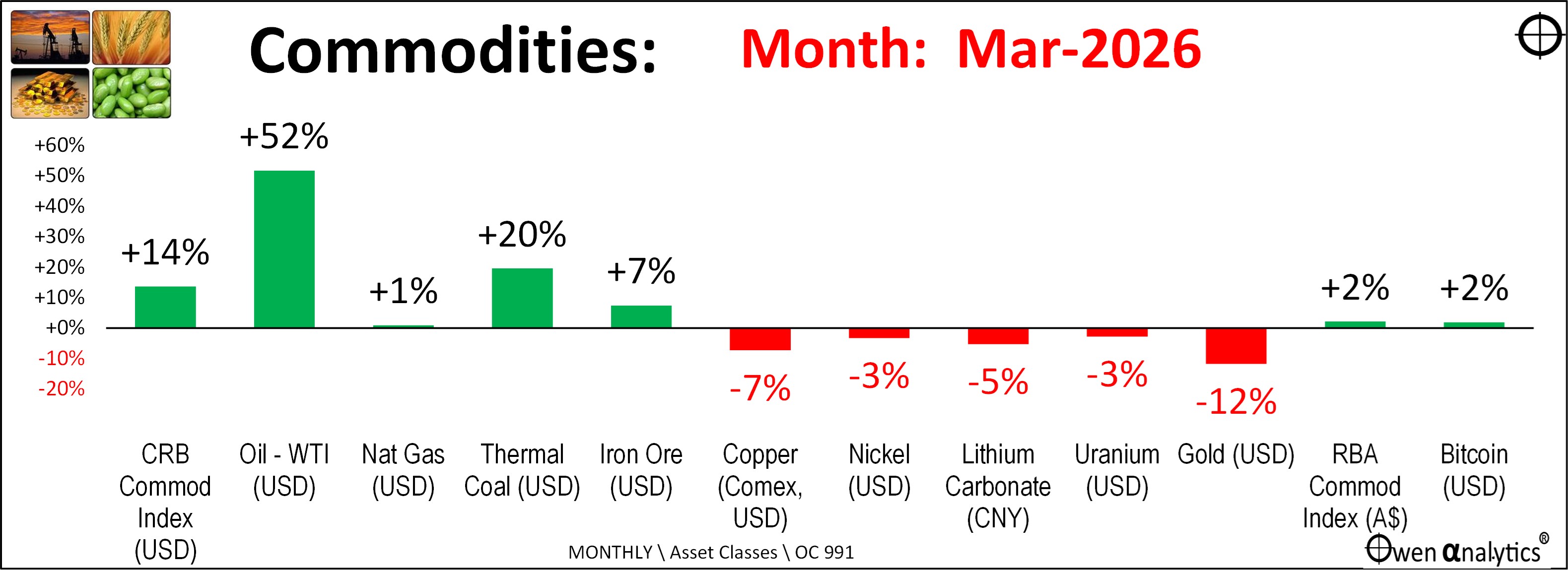
On gold – I hold gold in my portfolios, and it has doubled in the past couple of years, so the minor retreat in March still makes it the best performing holding by far.
Aside from fossil fuels, which were up big-time in March, the only semi-bright spot on the commodities front was iron ore as it climbed back above $100/tonne. However BHP is now primarily a copper play, and all of the Aussie iron ore producers are being hit by rising operating costs (wages, fuel, compliance, red/black/green tape), lower ore grades, and new supply coming out of Simandou, Guinea. The golden age of Australia’s iron ore bonanza is probably past its peak.
Trump’s agenda?
The most important factor for the direction of short-term investment markets prices will be Trump’s twists and turns on the war front (or tariff front, or any of his other hobby horses du jour). Not even Trump knows what he will say or do one minute to the next, so it is pointless trying to guess.
However, I have two fairly sound reasons for being relatively positive for share markets in the coming months.
First - Trump probably has one central practical aim in the short term: to retain MAGA votes in the November mid-term elections. To do that he must (1) get oil prices down, and (2) minimise the number of Americans coming back in body bags.
This points to a relatively quick end to the war. Or at least an end to disruptions in oil/gas supplies, which means opening the Strait of Hormuz to restore normal shipping.
Second – in the event of a sharp economic recession, governments of all flavours in the US, Australia and just about everywhere else no longer have any notion of fiscal discipline. They have shown in the GFC and Covid that they will literally throw ‘free’ money at anything and everything in order to retain populist votes. Politicians no longer have the stomach nor the intellectual framework for ‘tough medicine’, ‘business cases’, trade-offs, or discipline.
The longer-term consequences and downsides will be even higher debts and widening intergenerational inequity, but it supports asset prices in the short-medium term. The current global tech/everything boom is being held up by hopes of endless monetary and fiscal profligacy.
What to do in portfolios?
Let me start by repeating exactly what I wrote in my last monthly report at the end of February before the latest war on Iran:
“I see several themes driving markets in the medium term:
-
-
- Continued shift from rules-based order and win-win multi-lateral trade to power-based order and win-lose trade deals. Trump did not start this. The shift started in the 2010s with US/Europe letting Putin take Crimea in return for cheap gas for Germany/Europe, and US/Japan letting China militarise the South-China Sea. It has certainly accelerated under Trump. Lower cross-border trade & investment, more reliance on government subsidies & distortions, inflationary on-shoring of uneconomic industries.
- Sticky inflation - political pressure on central banks to keep rates low – populist pressure on governments to keep deficit spending. Tariffs + onshoring adding to costs/prices. Bond yields to stay elevated or even drift up further, risk of bond yield spikes, or sudden need for rate hikes, unsettling / breaking share markets.
- Share markets continue to be supported by good profit growth for now. Shares everywhere are expensive but buoyed by loose monetary & fiscal policies, plus a near certainty that governments will throw ‘free’/borrowed money at any problem.
- Commodities rally gathering pace – rising demand soaking up over-supply, ai / data centre boom (industrial metals, energy, water, land), global re-armament – especially Europe, Japan, Canada. This should support ASX market, as long as banks avoid a local recession.
- De-dollarisation fears are probably over-done, but is driving up gold, silver, but not bitcoin. US treasury yields not at risk for now (and even fell in February).
- The current boom will end one day of course. All markets everywhere, including and especially Australia, are over-priced on fundamentals, not just US-big tech. However, each boom is different and the triggers for the inevitable bust are different each time. See my recent 6-part series on share market over-pricing.
-
-
- I have not changed my asset allocation in portfolios (my own and for investment committees) and it has done rather well – beating Big Super by about 2% pa, thanks mainly to two themes - having Gold, and zero interest duration (no fixed rate bonds). A lot has happened in that time, and I have left it alone to do its work. That’s the point of an ‘all-weather’ portfolio – I don’t need to constantly worry and fiddle with it. When I get some time in the coming months, I will certainly take a look and see if I need any adjusting.”
Now, has the new war on Iran changed any of that?
Probably not, except for two things. First, the war adds weight to my pre-existing medium-term inflation fears. Second, the war and oil price spike just may be the trigger for the inevitably unwinding of the speculative tech boom. We knew it would end of course, but we did not yet have a trigger.
Looking beyond the daily noise and gyrations, I am sticking to my portfolio holdings, and I will report on returns when I get some free time (a tad busy with cancer & chemo rounds these days!)
‘Till next time – safe investing and stay healthy!