Tuesday, October 20, 2026

linkedIn

Housing inflation much higher than CPI: Owners hit hard, but Renters have highest inflation. Governments (all 3 layers) the main culprits

20 Jul 2026 3 month(s) ago 2 Comments

Recently I wrote two articles highlighting the fact that the headline Consumer Price Inflation (CPI) rate is just an averaging of spending patterns across all households, and it glosses over huge differences in inflation rates experienced by different households due to their different spending patterns:  

And     

The second article noted that inflation for ‘housing’ costs were higher than overall CPI inflation. Today’s chart shows inflation rates for the main components of housing costs since 2000:
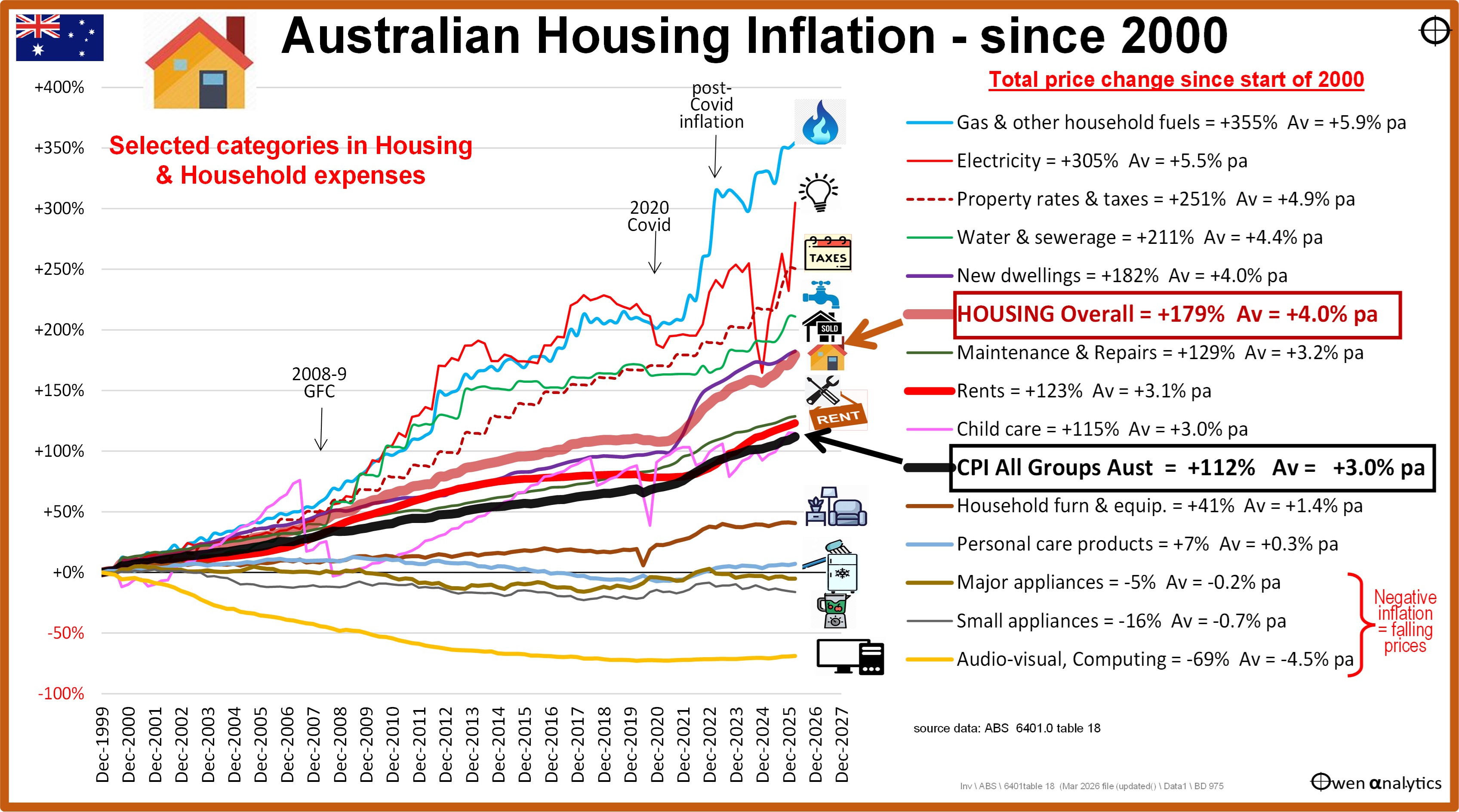
Housing-inflation-20-7-2026.jpg


As in the charts in the first two articles, overall average CPI inflation rate (3.0% pa average since 2000) is the thick black line running through the middle of the charts.

Overall Housing cost inflation is the thick brown line. This has averaged 4.0% pa over the period – ie 1.0% ABOVE CPI inflation, and clearly accelerating since the ultra-loose monetary and fiscal policies that started with the Covid lockdowns.

Real causes of housing inflation

Inflation for new dwelling construction costs is running higher than CPI at 4.0% per year. But that is not the main problem with housing costs. The real problem is rapidly rising costs of UTILITIES.

At the top of the chart - gas and electricity prices have had the highest inflation rates of more than 5% per year.  On average across Australia, gas and electricity prices have more than QUADRUPLED since 2000, whereas the overall CPI spending basket, and also Rents, have merely doubled.

Note that gas and electricity prices already had the HIGHEST inflation rates BEFORE the Russia/Ukraine war and US/Iran war. So government can’t blame foreign wars for their inflation problem, as I pointed out here -

·        Iran war hands politicians another free ticket to blame oil prices for inflation & rate hikes (14-Mar-2026)

Don’t forget that Australia is the largest EXPORTER of energy in the world (apart from the oil states) – with our coal and gas export customers paying LOWER prices for our energy than we pay here at home. Japan actually re-exports surplus cheap gas it buys from Australia, to Taiwan and South Korea at a profit (to Japan!)

Rental inflation relatively modest

The surprising thing is that inflation in Rents (think red line) has been 3.1% pa, just a fraction above overall CPI inflation but well below inflation for utilities costs.

Note that this chart is based on data to March 2026, ie BEFORE the federal government’s recent tax attacks on property investors, which are now starting to push up rents. I will update this chart in a few months to highlight this new surge in rents – which were entirely predictable to everyone except Labor boffins.

But Renters already have highest inflation

While rents have grown by no more than overall CPI inflation, renters tend to be lower income earners and/or welfare recipients, spend more of their income on high inflation items like utilities and food, and have less spare cash to spend on lower inflation items like cars, appliances, furniture and tech/gadgets.

Each State has different laws concerning what utility costs landlords can pass on to tenants, but it is clear that renters suffer the highest overall price inflation – refer to the first article on inflation by household type.

State Tax grab

State property taxes (red dotted line) have risen by 250% or 4.9% per year since 2000 – well above CPI, especially since Covid. This reflects the relentless tax grab by State governments to fund their out-of-control spending sprees.

Government the main problem

The bottom line is that the main problem with housing inflation is GOVERNMENT. The highest inflation items are those directly or indirectly controlled by governments – utilities, property taxes, construction (State taxes, government supply restrictions, centralised wage rises), and rents (tax policies on rental housing investment, government supply constraints).

Some things get cheaper over time

Meanwhile, at the bottom of the chart we can see that physical items like major household appliances, small appliances, furniture, audio-visual gear, computers, phones and other tech gadgets have FALLEN in price (ie negative inflation) over the same period.

The key difference is that these types of goods with low or negative inflation rates are almost all imported from lower wage countries, whereas the items on the upper part of the chart are services provided by Australians, where higher wages feed into higher prices and inflation.

For the importance of understanding your own personal inflation rate based on your spending pattern, and the implications for your long-term investment strategy and retirement planning, refer to the two articles above.

·        What's your Number? Part 1: 'How much do I need to retire?', 'How much can I afford to spend?' (10 May 2024)

·        'What's your Number? Part 2: 17 key factors driving 'How much do I need' & 'How much can I spend?' (14 May 2024)

·        How to not run out of money in retirement - 4 big problems with relying on ‘life expectancy’ tables (6 June 2024)

The power of compounding

Differences in annual inflation rates for different households may appear small and unimportant, but the power of compounding magnifies even very small annual differences into very large differences in wealth and living standards over long periods like 30 years of retirement.

It is now tax season in Australia, an ideal time to get to know your own expense inflation and how it impacts your long-term investment planning and strategies.

Talk to your adviser about your own ‘personal inflation rate’ and whether you have the right long-term retirement portfolio and strategy given your personal inflation rate, and whether it is consistent with your views on the balance between spending it during your lifetime versus preserving it for the next generation.

Disclaimer

I have owned several residential investment properties in Sydney and SE Qld at various times over the past 40 years through different tax environments. Some negatively geared and some bought with cash. Currently own none.

Some further reading on inflation and implications for investors

·        Where are you on the inflation pyramid? Inflation differences by household type (26-Jun-2026)

·        What’s your personal inflation rate? And how it affects your investment strategy & retirement planning (14-Jul-2026)

·          The Low Inflation era of great returns is over. Investing just got a whole lot harder! (16 Apr 2024)

·        Australia’s highest cash rate in the world just got even higher – and the job’s not done yet! (5-May-2026)

·        Inflation BIG Picture: Boomers got rich by lucky timing. Next Gen to get higher inflation & rates (25-May-2026)

·        How the RBA scores on its inflation goal? Somewhere between 3 and 10 out of 10. Overall I give it 8 out of 10. Why so high? (6-Feb-2026)

·        Iran war hands politicians another free ticket to blame oil prices for inflation & rate hikes (14-Mar-2026)


‘Till next time – happy investing and stay healthy!

Visit my web site for hundreds of original articles on a wide range of topics for advisers, portfolio managers, and serious long-term investors.

https://www.owenanalytics.com.au/

·        All completely free of charge. Free of conflicts. Free of ‘ai’.

·        All original research and analysis.

·        No ads, No marketing material, No sponsored material at all.

·        Not ‘monetised’ in any way. No ‘revenue model’.

·        Newsletter cost-free and conflict-free.

·        Guaranteed No ‘hot stocks’, No ‘hot funds’, No ‘hot tips’.

·        Guaranteed No ‘ai’. All human.

Enjoy!

Related Articles

2 Comments

Existing Comments

Hi JMS - thanks for reading + thanks for the comment/question.
Yes of course houses are assets. This story is about CPI inflation, not asset price inflation.
The CPI basket does not include asset prices like house prices. CPI only counts the costs of living in a house - as owner-occupier or renter.
On the relationship between Aussie house prices and inflation see - https://www.owenanalytics.com.au/hi-mod-lo-inflation-returns

Turns out Australian capital city houses have been a pretty good inflation hedge over many decades and economic/inflation cycles.
cheers
ao

ashley owen
July 25, 2026

How’s that inflation? Houses are assets with inherent value and generate income .. why would you expect them to follow CPI like consumables?

We have 200 years of Australian data indicating houses don’t follow inflation.

JMs
July 25, 2026

Leave a Reply

Ashley Owen


Please subscribe to my Newsletter, connect on LinkedIn, or follow me on Twitter X 


Experiences


Director/Principal, Owen Analytics Pty Ltd (current)

Investment Markets Research & Analytics, Portfolio Construction & Management, Corporate Finance, Venture Capital, M&A, and IPOs. Investment Committee membership, consulting to advice firms and financial institutions.

Co-founder & Regular Contributor, Firstlinks (current)

Co-founder of Australia's leading investment and superannuation newsletter and website for industry professionals and investors.

Non-exec Director, Third Link Investment Managers (current)

Leading Australian equities fund-of-funds that donates all management fees to Australian charities. The fund has donated in excess of $21m to a range of Australian chartities since inception in 2008. 

Chief Investment Officer, Stanford Brown (past)

Responsible for managing over $2 billion AUM in multi-asset class portfolios and discretionary accounts at a privately-owned advice practice.

Director & Joint CEO at Philo Capital Advisers Pty Ltd (past)

Specialises in investment portfolio construction & management, multi-asset class asset allocation, and global macro strategies.

Check out my full bio here

▼

‘For many years, Ashley has been my go-to source of information and analysis on what’s going on in financial markets and why.’

“Ashley has an encyclopaedic knowledge of the markets – I call him Mr Google!”

Noel Whittaker, AM – Australia’s best-known personal finance writer, columnist, and media commentator for the past three decades. He has written more than 20 books on personal finance, his regular columns on personal finance are published in almost every major Australian newspaper, and he appears regularly on radio and TV as an expert on finance and investing.

“Ashley is one of the best writers and thinkers on financial markets in Australia. His unique analysis and research is always fact-based and insightful, not the usual uninformed market noise and waffle that infects the mainstream financial media.”

Graham Hand - Editorial Director of Morningstar Australia, including Founder/Managing Editor of FirstLinks, Australia’s leading newsletter and publishing service on wealth management, superannuation, and personal finance.

“Ashley has the rare ability to ground insightful analysis in solid data and to present it in readily understandable ways. His wry, detached style and focus on the long term is rare and willingness to share a lifetime of learning and thinking appreciated by all who come to know him.”

Toby Potter - Chair, Institute of Managed Account Professionals (‘IMAP’), the peak industry body for the discretionary managed accounts industry in Australia, representing investment managers,  advisers, Managed Account providers, and technology companies. It is the primary thought-leader for the industry in Australia, and provides training and industry events and conferences.

“What sets Ashley Owen’s analysis apart from investment banks and the financial press is his deep fact-based understanding of long-term financial data, rather than getting caught up on the daily noise over issues that may generate trades or sell newspapers today, but will be irrelevant and misleading two years from now.” 

Hugh Dive, CFA. Chief Investment Officer, Atlas Funds Management, and frequent expert commentator quoted in the AFR.

“Ashley’s unique fact-based analyses and insights into Australian and global markets are always worth reading. He has an incredibly deep and comprehensive store of financial markets data.”

Chris Cuffe, AO – One of Australia’s best known and most experienced investment managers – former CEO of industry giants Colonial First State, then Challenger Financial; founder and Chair of Australian Philanthropic Services, and Third Link Growth Fund; current/former chair, director and/or investment committee member of numerous funds including UniSuper, Argo Investments, Hearts and Minds Investments, Paul Ramsay Foundation, and many others.

"I read all of Ashley's research on financial and economic issues. His data resources, deep knowledge, and original analysis put him in a class of his own."

Ian Macfarlane AC - Former Governor, Reserve Bank of Australia (Australia's central bank), 1996-2006. Former Director, Woolworths, Leighton Holdings, and ANZ Bank. Also on the International Advisory Boards of Goldman Sachs (2007-2016),  the China Banking Regulatory Commission (2011-2014), and director of the Lowy Institute for International Policy (2004-2017).

“Over the past 20 years, Ashley has been an invaluable assistance to me, as a reliable source of unbelievably strong and interesting data, and many good investment ideas.” 

"The depth and quality of Ashley’s research and analysis of investment markets is the best in the business.”

Dr Don Stammer - Australia’s most respected economic writer, commentator, and speaker for the past 40 years, with a distinguished career including the Reserve Bank of Australia, Chief Economist at Deutsche Bank Australia for 21 years, chair of nine ASX companies, plus numerous non-listed and not-for-profit boards.

Copyright © 2026 Owen Analytics

About Ashley Owen | Terms and Conditions | Privacy Policy | Archive | Disclaimer

The information contained in this document relates to historical, factual events and returns, and contains general commentary and observations about financial markets, asset classes, and asset allocation. This document, or any part thereof, does not, and is not intended to, constitute investment advice, or financial advice, or financial product advice, in any jurisdiction in which it is published, re-published or read. It does not recommend, encourage, or influence readers to buy, hold, sell, or deal in any financial product or security. Where securities of financial products are mentioned, it is purely for the purposes of illustration, context, and/or education, and not intended to influence anyone to buy, hold, sell, or deal in it. The information is current when written. All reasonable measures are taken to ensure its accuracy at the time of publication, but the author accepts no responsibility or liability for any errors or omissions. This document is only provided to, and intended for, holders of Australian Financial Services Licences. It should not be used or relied upon by any person or entity other than a duly licenced AFSL holder, or authorised representative thereof. The author receives no benefit, financial or otherwise, from any product provider, or product issuer, or any other firm involved directly or indirectly in the provision or services in or to financial markets or industries, whether mentioned in the report or not. Any opinions expressed by the author are his alone, and are intended for the purposes of education.