Greetings fellow investors!
Here’s my quick wrap-up on global markets for serious long-term Aussie investors – including share markets, interest rates, inflation, bonds, currencies, commodities, crypto and more, plus portfolio implications.
But first - my essential 1-page snapshot chart - covering Australian and US share markets, short and long-term interest rates, inflation, and the AUD/USD exchange rate. It is my go-to chart that tells me what happened when and why, whenever answering queries from advisers, investors, doing webinars, market updates, etc.
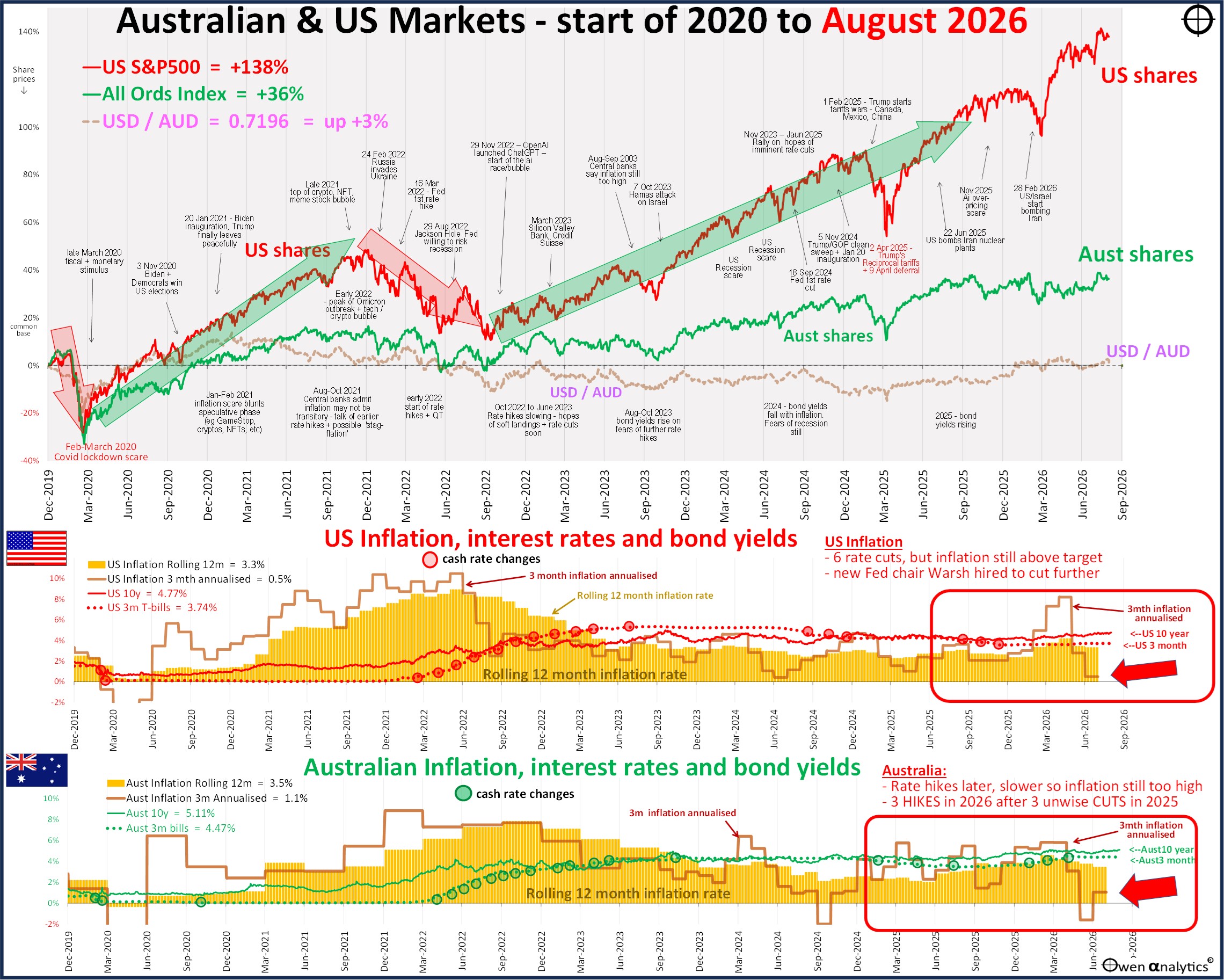
Not only does this chart have all the detail I need to answer investor questions from advisers, but even from the back of the room you can easily see the big picture on where we are for share markets, currency, inflation, long & short interest rates.
I will get into shares in a moment, but from the back of the room you can see that share markets had a minor hiccup in March this year (near top right corner of the chart – red for US, green for ASX), then were quickly back on track with new all-time record highs in the extraordinary tech/ai boom.
Bottom line – if you were rattled by the volatility and (very brief) share market falls in March 2026 or 2022 (rate hikes) or 2020 (Covid), then you ain’t seen nothin’ yet! (or you are too young to remember what a real crash looks and feels like!). There is certainly a proper correction on the way, but we’re making hay while the sun still shines!
Share markets
Global share markets rose pretty much across the board in August after a flat July, continuing rebound since the brief dip at the start of the US/Iran war at the beginning of March. Pessimism over stubborn inflation figures, Fed Chair Kevin Warsh’s hawkish outlook for US inflation, and a late spike in oil prices on Trump’s on-going war on Iran were more or less over-shadowed by good profit reports in the US and Nvidia’s extraordinary revenue and profit numbers in particular.
Global Industry Sectors
Most global industry sectors were up for the month. Here are global sector returns for August 2026 (middle chart), calendar year to date (right), compared to 2025 (left chart):

The stand-out sector up is fossil fuels (‘energy’) – with good gains in the major stocks this year as they profit from the global supply squeeze.
The tech sector is the other star this year, recovering from recent jitters about sustainability of the monumental sums being spend by the ai ‘hyper-scalers’.
Materials sector is also doing well this year – mainly BHP/RIO and gold stocks.
At the other end of the scale - Consumer Discretionary stocks are weak due to declining consumer spending. REITs are suffering from high bond yields plus structural problems in commercial property (‘work from home’, ‘Amazoning’ of retail stores, plus rising interest costs.)
Overall – heading for another above-average year for global share markets if the ai/tech boom can hold up.
Major global stocks
Here are the largest global stocks (almost all of which are US based) for the same three periods:
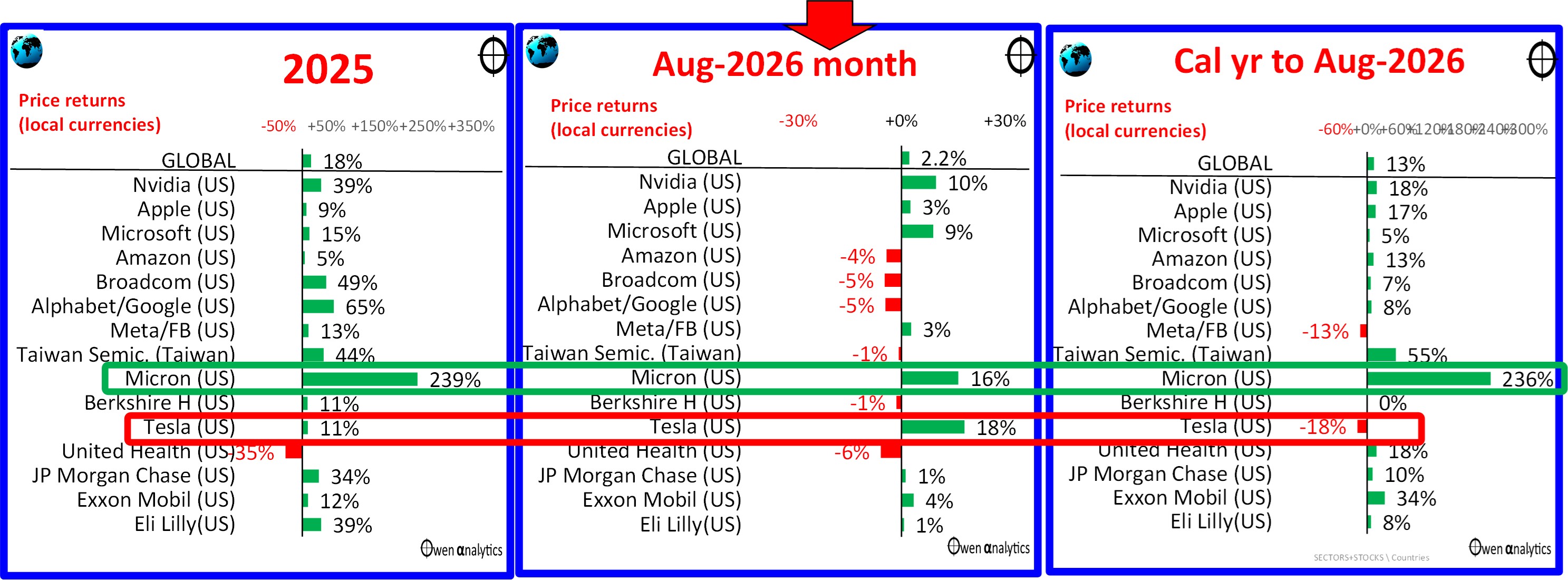
Nvidia’s results dominated the news, not just for its outstanding numbers, but also for the doubts they raised over the profitability of the hundreds of billions of dollars being spent by the ai ‘hyper-scalers’, especially Amazon, Google, Microsoft, Facebook and SpaceX, and the fact that Nvidia is having to vendor finance much of it.
The star this year has been Idaho-based US chip maker Micron Technology (no relation to Idaho potatoes). The laggard this year has been Tesla, the low-margin car maker trying desperately to look like a tech stock.
SpaceX – recovered some ground in August. It is now back above its $135 IPO price but still down -36% below its peak price at the top of the FOMO frenzy. See my summary of SpaceX I wrote at the time of the IPO -
· SpaceX: am I a buyer? How it compares to my only ‘1,000 bagger’ (12-Jun-2026)
My conclusion at the time was – ‘You buy when everyone else is running the other direction. Don’t be lured into a buying frenzy at crazy prices at or near the top of a boom/bubble. Always go against the crowd.”
Major country share markets
Here are the main share markets:
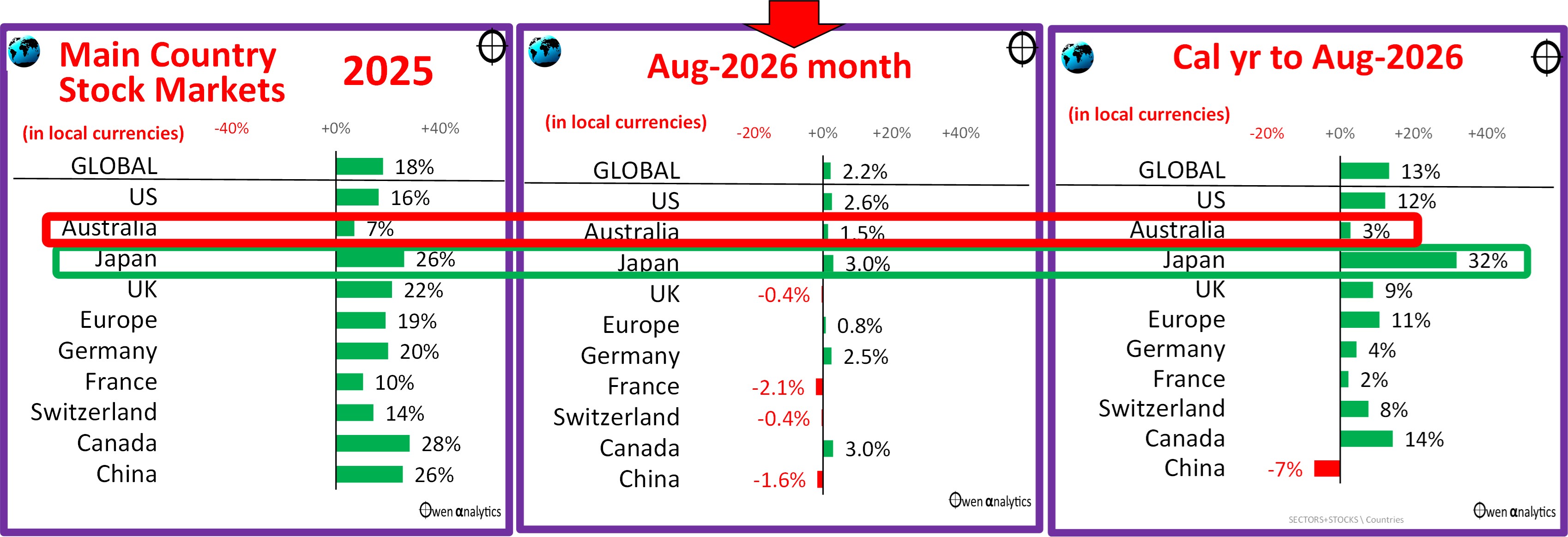
Most global markets were up in August. The main exceptions were France (weak luxury brands in LVMH, Kering, L’Oreal), UK (health care and fossil fuel weaker), Switzerland (health care, BAT, BP down), and China (Meituan, Alibaba, Tencent, Baidu all down).
Despite suborn inflation, likely rate hikes, and slowing consumer confidence and spending, global share markets are ahead by 13% (in local currency terms) in calendar 2026 to date. If they hold up for the rest of the year it will be a fourth good year in a row in the current boom, following three very strong years averaging +20% per year in 2023, 2024 and 2025. Which brings us to . . .
Share market pricing –
Share markets everywhere (not just US tech/ai stocks) are still vastly over-priced on a variety of measures – including and especially in Australia (despite its lower apparent headline pricing) - and we are well and truly due for a global correction. Refer to the above reports on share market pricing.
For a deep dive into share market over-pricing, take a look at my recent six-part series on pricing of global share markets to better understand their implications -
· Part 1: Share market Pricing per country – How does your country rate? (11 Aug 2025)
· Part 2: P/E ratios, Dividend Yields, Price-to-Book value (17 Aug 2025)
· Part 3: Forward P/E ratios and Earnings growth assumptions (20 Aug 2025)
· Part 4: Profit Margins & Returns on Equity – US highest, but it is sustainable? (26 Aug 2025)
· Part 5: Growth rates for Profits & Dividends (28 Aug 2025)
· Part 6: What’s a fair price for growth? – ‘PEG’ ratios & Buffett/Graham’s ‘8.5 rule’ (7 Sep 2025)
For more on US profits and pricing – see:
· US Shares: ambitious multiples on ambitious, accelerating profit forecasts – a double layer of over-confidence. But powering on regardless! (20 May 2025)
Australian shares
The local Australian share market gained +1% in August but continues to lag the rest of the world. For my coverage on why the ASX is lagging world share markets see –
· Australian share market has LAGGED the rest of the world for the past 17 YEARS! Our ‘Home Bias’ is costing investors dearly (11-Aug-2026)
Here are the main ASX stocks for August 2026 (middle chart), calendar year to date (right), compared to 2025 (left chart):
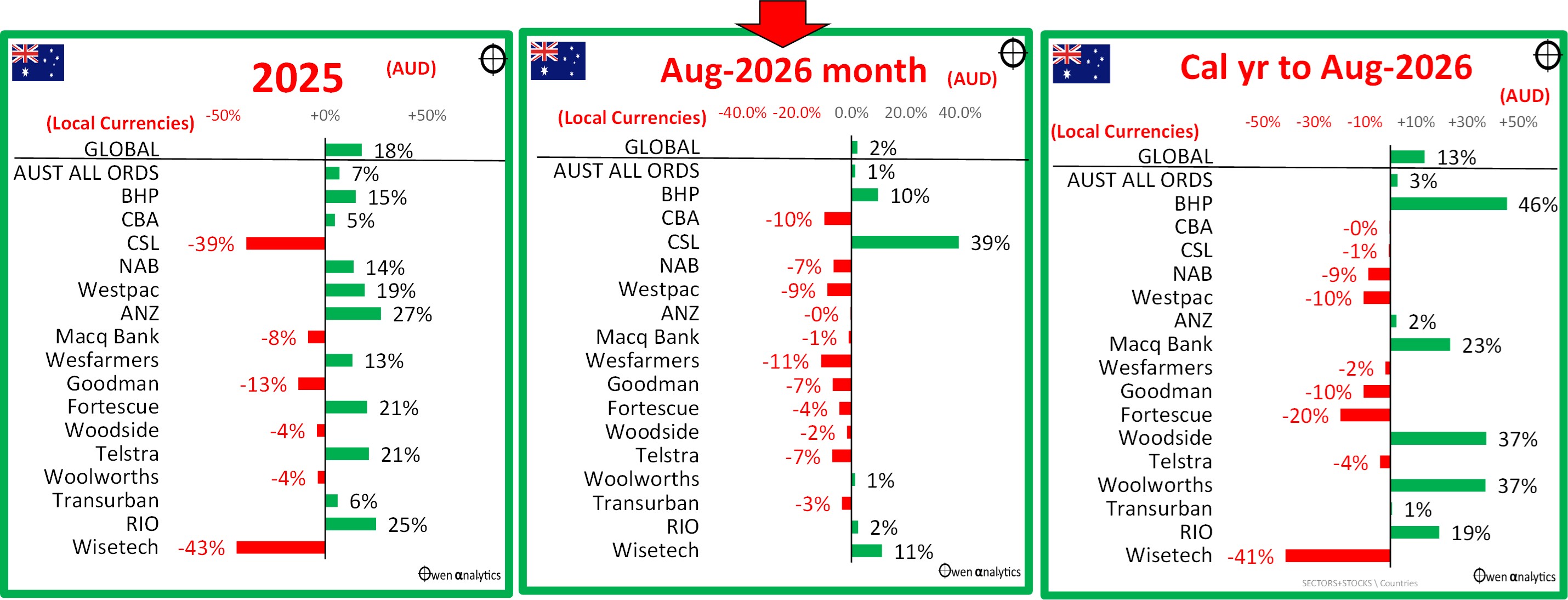
In August the main ASX winners were miners, led by BHP and RIO on higher iron ore and copper prices. Gold miners also surged back with higher gold prices. CSL recovered some ground after writing off more of its troublesome Vifor acquisition, but the share price is still down nearly 50% from its peak $300+ levels during Covid, when it was (briefly) the most valuable company on the ASX.
Weighing heavily on the overall market were the big banks (which are just bloated building societies since abandoning business lending post-Hayne), on further falls in house prices across the board and, property construction collapses.
Rising interest rates and slower consumer spending also hit consumer discretionary stocks including Wesfarmers, JB, Lottery Corp, TAB Corp, Flight Centre, Nine.
So far this year, the main ASX winners have been fossil fuel producers milking the global fuel price spike (led by Woodside +37%, Santos +32%, Ampol/Caltex +35%), and miners on strong-ish commodities prices (BHP +45%, RIO +19%, South32 +45%, Pilbara Min +28%, MinRes +19% Lyna+28%, and gold miners Newmont & Evolution +18% each).
Year to date the big laggers have been: discretionary retail (slower consumer spending), the big banks (housing / construction slowdown), REITs (rising bond yields plus separate sector-specific problems affecting retail, office, tourism sectors); and Healthcare & Tech (major stocks hit by a variety of own-goals).
Inflation & interest rates
The evidence continues to point to above-target inflation for a while yet – with (a) the stalemate in the US/Iran war; (b) continued deficit spending by profligate governments everywhere; and (c) central bankers’ reluctance to tackle inflation properly with rate hikes.
US inflation remains well above target on all key measures. The overall US economy remains rather robust. It is not just a narrow ai capex boom, and US unemployment is continuing to fall back to 4.1%, which is stoking inflation.
In Australia the RBA was the first central bank in the world to switch from rate cuts after the 2021-3 inflation surge, back to rate HIKES. The RBA’s three hikes in February, March and May this year reversed its three unjustified cuts last year as inflation was, and still is, running well above target range. (following the RBA hikes this year, Europe, New Zealand and Japan have now hiked rates once each.)
Governments and central bankers love to blame inflation on war. But even before the US/Iran war started, Australia already had the HIGHEST cash rate amongst its peers – because we have the highest inflation, the highest inflation expectations (treasury yields), the loosest/highest inflation target, and the lowest unemployment rate among our peers.
For the full story see –
· Why are Australian cash rates HIGHEST in the world? Five simple reasons (20-Apr-2026)
Australian Unemployment has remained relatively low at 4.4% (lowest amongst peer countries) which is still too low (inflationary). Adding to the problem is the fact that most of the hiring in recent years has been in low-productivity government and non-market (government driven) sectors. Government hiring is making up for any ai-related job jobs.
Bond yields and bond markets
The picture on inflation and interest rates leads us directly to bond markets, in which every local and global institutional retirement/pension fund is required to hold huge allocations (but not mine fortunately!)
August was yet another bad month for bond investors, with yields continuing to rise across the board. Two main reasons: First is Trump’s war on Iran dragging on. Second is new Fed Chair Warsh appearing to go soft on inflation, despite his hawkish rhetoric at Jackson Hole. US inflation has been well above target for five years but he refuses to raise rates.
US yields blew out most at the long end, with 30 year yields soaring above 5.25%, the highest since the middle of 2006 before the GFC. 30-year yields are far more important in the US than Australia because most US mortgage rates are tied to the 30-year yield, not the cash rate as in Australia.
The next charts show changes in 10-year treasury yields for the month (top chart), in 2026 calendar year to date (middle), and last year for comparison (bottom):
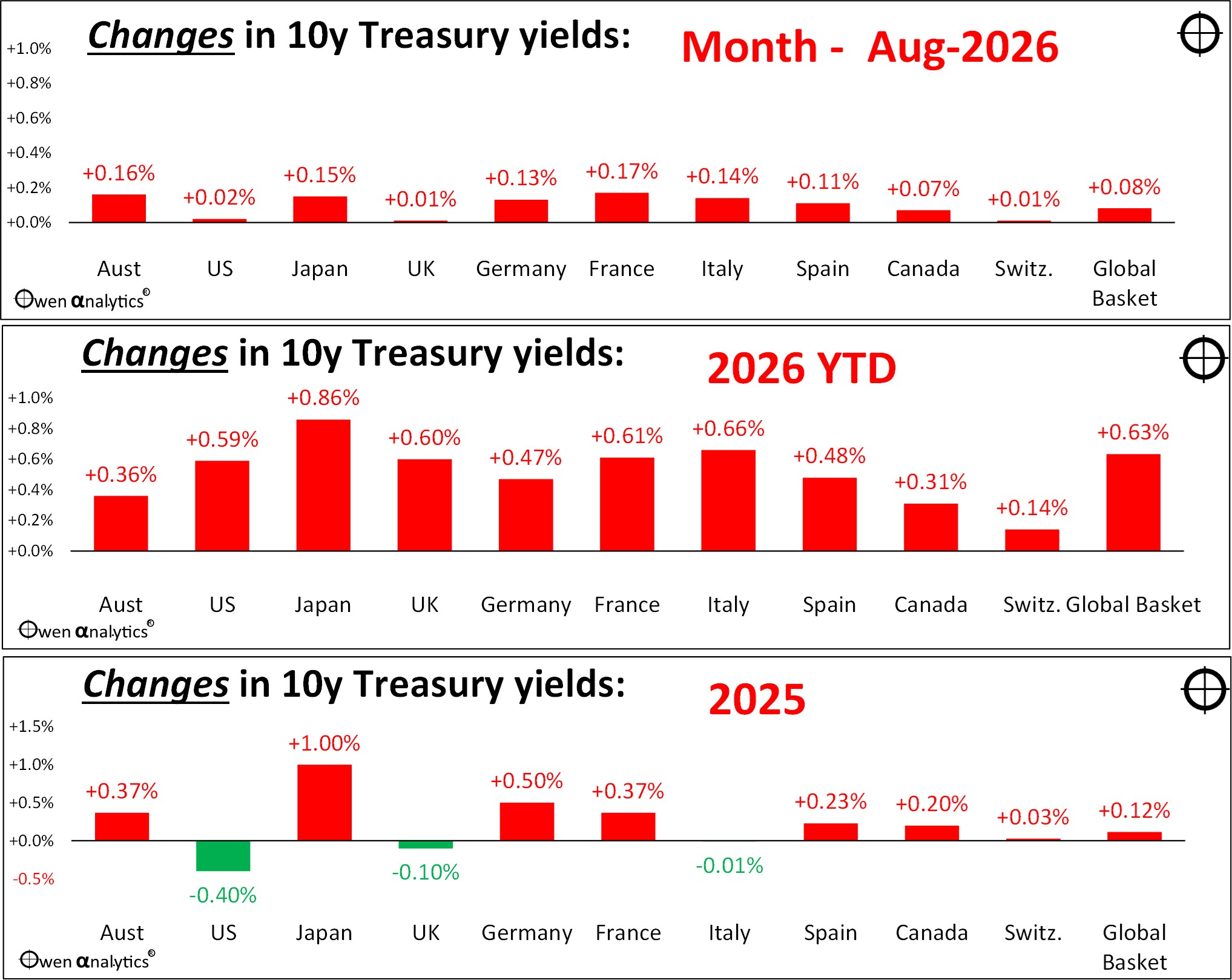
(In my charts of changes in bond yields, I show RISING yields in red as they mean LOWER bond prices & returns; and I show FALLING yields in green as they mean HIGHER bond prices & returns.)
Japan is the worst this year with new-ish PM Sanae Takaichi announcing even more government deficit spending despite rising inflation.
The sea of red (rising yields) this year is bad for bond market returns.
Bond market returns
Last year (2025) turned out to be the fourth straight year of poor nominal and real returns from bonds, as yields rose virtually across the board with inflation remaining ‘sticky’. So far 2026 is looking like being a fifth straight year of poor nominal and negative real returns from bonds. We have not seen that since the 1970s.
Despite below average returns on bonds in 2025, at least 2025 was a better year for bonds than 2024 when yields rose by significantly more. Not nearly as bad as 2022, which was the worst year for US bonds in more than a century, and the worst year for Australian bonds since the 1931 Commonwealth debt default/restructure.
Now with the war in Iran and major oil/gas disruptions, yields are on the rise even further, meaning more losses (or poor returns at best) for bond markets.
Fortunately I have been out of fixed rate bonds in portfolios (advised, and my own) since 2021, due to fears that yields will remain elevated for at least the next few years, due to persistent inflation, with loose fiscal policy (governments running deficits and debts), and also loose monetary policy (central banks under enormous political pressure to keep rates too low).
It is not just the latest war in Iran. We have a host of longer-term inflationary pressures at work – including rising military spending everywhere, on-shoring of manufacturing, wage pressures from labour shortages resulting from reduced immigration, transitions to renewable energy sources, and increased supplies of bonds from profligate, populist, big spending governments here and around the world.
For the real story behind oil price spikes and inflation – see:
· Iran war hands politicians another free ticket to blame oil prices for inflation & rate hikes (14-Mar-2026_
Maybe I will take a look at fixed rate bonds again in a few years or so.
Exchange Rates
The Aussie dollar was stronger against the USD and other major currencies in August, which is the usual pattern in booms, plus also as persistent inflation here raised the changes of RBA rate hikes. 2026 calendar year to date it is also up against all other major currencies, echoing the US global share boom this year:
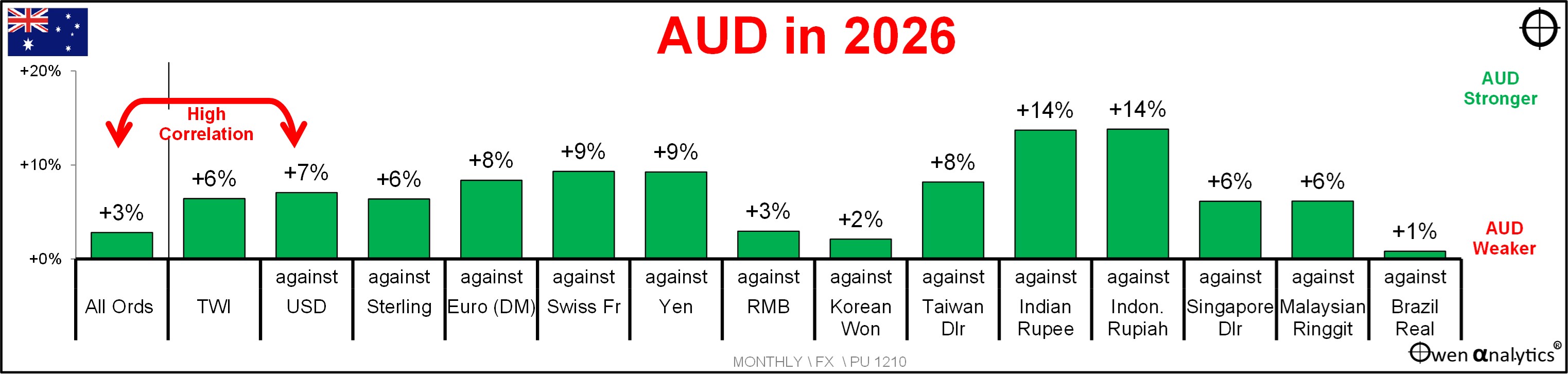
As the Aussie dollar is a ‘risk currency’, it always sells off in a global crisis, regardless of local conditions. In the March share sell-off (start of US-Iran war) the AUD fell against all major currencies, especially the US dollar (ie the usual pattern). This partially cushioned price falls on ‘unhedged’ foreign shares when converted back into Aussie dollars for portfolio reporting.
But since then, the AUD has rebounded along with the share rebound (also the usual pattern). Year to date is up strongly, as is the US/global share market.
Conversely, the US is the global ‘safe haven’ currency (and has been since WW1), so it (almost) always rises in global crises, even if the US is the cause of the panic (for example in the GFC). As global investors (ie primarily US investors) panic sold just about everything in March this year and retreated home, the US dollar strengthened against all other major currencies (the usual pattern).
To illustrate the high correlation between the AUD and the share market (both risk assets), here are the outcomes for 2008 (when the AUD fell heavily with shares in the GFC), and then 2009 (when the AUD rebounded strongly with shares):

I have a 40% hedge ratio on international shares in my long-term portfolios, so I have profited from the general rise in the AUD over the past year (compared to many portfolios that have a policy of zero hedging), but also obtain a decent partial cushion in sell-offs.
Finally, continues to be a lot of nonsense in the populist media about the impending ‘end’ or ‘death’ or ‘decline’ or ‘demise’ of the US dollar. For the big picture on the strong US dollar and why Trump is understandably trying to talk it down, see:
· Is the US dollar in decline? or on its ‘last legs’? – Hardly! The problem is the dollar is too strong. Implications for Aussie investors (21-4-2025)
Commodities
Industrial commodities prices were mostly up again in August (upper chart below), although iron remained weak with China steel production stalled and increased supply from Guinea So far 2026 (middle chart) has been good for miners and fossil fuel producers in particular.
The big gains in August were Gold and Bitcoin (far right of charts) – possibly both rising on renewed US debt fears.

Despite the grand rhetoric about Bitcoin being a hedge against inflation, global turmoil, etc – in reality its price behaves like it is merely a bet on the US tech hype cycle, as I demonstrate here –
· Bitcoin is just a bet on the US tech hype cycle. Will it ever live up to its lofty ideals? (18 May 2026)
Despite the recent partial rebound, Bitcoin has lagged everything else over the past 12 months (lower chart above).
On iron ore - spot prices have been more or less flat for the past year. China has been trying to reduce over-production of steel and is also using its market power (which it should have done years ago) to strong-arm BHP, RIO and FMG on pricing.
The bigger problem is that ore grades in the Pilbara are declining, and new supply is now coming out of Simandou, Guinea (RIO), further putting pressure on Pilbara volumes and prices. On top of all that, the Aussie iron ore producers are being hit by rising operating costs: wages, fuel, compliance, red/black/green tape, and now a return to 1970s-style militant industrial action after Labor’s winding back of three decades of IR reforms.
Iron ore has been the stand-out windfall for Australia since 2003, but the days of peak Pilbara iron ore are behind us.
Meanwhile, seeing this trend, BHP has turned itself into primarily a copper play – with the growth and jobs mainly in Latin America. Likewise RIO in Mongolia.
On gold – I hold gold in my long-term ETF portfolios, and it doubled in the past couple of years, and is still beating Aussie shares in 2026 to date. It the best performing holding by far.
Trump’s agenda?
I have not changed my views since March. At the risk of repeating myself, here is what I said in my end of March 2026 report:
The most important factor for the direction of short-term investment markets prices will be Trump’s twists and turns on the war front (or tariff front, or any of his other hobby horses du jour). Not even Trump knows what he will say or do one minute to the next, so it is pointless trying to guess.
However, I have two fairly sound reasons for being relatively positive for share markets in the coming months.
First - Trump probably has one central aim in the short term: to retain MAGA votes in the November mid-term elections. To do that he must (1) get oil prices down, and (2) minimise the number of Americans coming back in body bags.
This points to a relatively quick end to the war. Or at least an end to disruptions in oil/gas supplies, which means opening the Strait of Hormuz to restore normal shipping.
Second – in the event of a sharp economic recession, governments of all flavours in the US, Australia and just about everywhere else no longer have any notion of fiscal discipline. They have shown in the GFC and Covid that they will literally throw ‘free’ money at anything and everything in order to retain populist votes. Politicians no longer have the stomach nor the intellectual framework for ‘tough medicine’, ‘business cases’, trade-offs, or discipline.
The longer-term consequences and downsides will be even higher debts and widening intergenerational inequity, but it supports asset prices in the short-medium term. The current global tech/everything boom is being held up by hopes of endless monetary and fiscal profligacy.
This remains my Base Case scenario. Trump is desperate to get out but it must be with him ‘winning’. The problem is finding something to call a ‘win’. He is now reduced to a rather tiresome tirade of threats, then backdowns, then mysterious alleged ‘negotiations’ with nameless parties about so-called ‘deals’, then more threats, and more back-downs.
The most likely outcome is probably yet another humiliating US withdrawal dressed up as a ‘win’, but leaving a festering mess behind, like in Iraq, Afghanistan, Vietnam, Cuba, and numerous other foreign military misadventures.
What to do in portfolios?
Here I have also not changed my views all year. Here is what I wrote in my end of February 2026 monthly report, which was BEFORE the US started bombing Iran in the latest war:
“I see several themes driving markets in the medium term:
· Continued shift from rules-based order and win-win multi-lateral trade to power-based order and win-lose trade deals. Trump did not start this. The shift started in the 2010s with US/Europe letting Putin take Crimea in return for cheap gas for Germany/Europe, and US/Japan letting China militarise the South-China Sea. It has certainly accelerated under Trump. Lower cross-border trade & investment, more reliance on government subsidies & distortions, inflationary on-shoring of uneconomic industries.
· Sticky inflation - political pressure on central banks to keep rates low – populist pressure on governments to keep deficit spending. Tariffs + onshoring adding to costs/prices. Bond yields to stay elevated or even drift up further, risk of bond yield spikes, or sudden need for rate hikes, unsettling / breaking share markets.
· Share markets continue to be supported by good profit growth for now. Shares everywhere are expensive but buoyed by loose monetary & fiscal policies, plus a near certainty that governments will throw ‘free’/borrowed money at any problem.
· Commodities rally gathering pace – rising demand soaking up over-supply, ai / data centre boom (industrial metals, energy, water, land), global re-armament – especially Europe, Japan, Canada. This should support ASX market, as long as banks avoid a local recession.
· De-dollarisation fears are probably over-done, but is driving up gold, silver, but not bitcoin. US treasury yields not at risk for now (and even fell in February).
· The current boom will end one day of course. All markets everywhere, including and especially Australia, are over-priced on fundamentals, not just US-big tech. However, each boom is different and the triggers for the inevitable bust are different each time. See my recent 6-part series on share market over-pricing.
· I have not changed my asset allocation in portfolios (my own and for investment committees) and it has done rather well – beating Big Super by about 2% pa, thanks mainly to two themes - having Gold, and zero interest duration (no fixed rate bonds). A lot has happened in that time, and I have left it alone to do its work. That’s the point of an ‘all-weather’ portfolio – I don’t need to constantly worry and fiddle with it. When I get some time in the coming months, I will certainly take a look and see if I need any adjusting.”
Now, the question I posed in my end of March 2026 report – ‘Has the new war on Iran changed any of that?’
Probably not, except for two things. First, the war adds weight to my pre-existing medium-term inflation fears.
Second, the war, together with the oil price spike and rate hikes to attack inflation just may be the triggers for the inevitably unwinding of the speculative tech boom. We know the boom will end of course, but we did not yet have a sufficient trigger.
The background for the big correction may be US/global slow-down caused in part by higher fuel prices / inflation / interest rates. The trigger may be a sudden realisation in the emptiness of the extraordinary hype over tech / ai profitability, probably accompanied by contagion withing the private credit / private equity funds that are holding mountains of unsustainable debt extended to tech / ai / data centre operators, perhaps leaking into / across the US banking sector – especially regional US banks and money centre banks lending to hedge funds and private credit.
It will be a big correction in the order of 40-60% crashes in share markets everywhere and trillions of dollars of debt written off as worthless. What we don’t know is when.
Meanwhile, life goes on. Looking beyond the daily noise and gyrations, I am sticking to my portfolio holdings, which is beating the vast majority of institutional super/pension funds without all of their fiddling & fudging –
· My ‘10-4 all-weather ETF portfolio’ doing well after two busy/lazy years, beating Big Super funds again by big margins (8-Jul-2026)
Falling Australian house prices plus Private Credit troubles
The media headlines in Australia are dominated by falling house prices, property contruction collapses, and resultant troubles for several Private Credit funds.
I do not cover these issues in this report because direct property and private credit funds are not ordinarly held in managed discretionary account portfolios, which is the primary focus of this series of monthly reports aimed at portfolio managers and advisors running client portfolios.
However direct property certainly is a major (arguably THE major) component of investment asset holdings for most Australians.
Because of the unusually large size of the property construction industry in Australia, falling house prices have major direct and indirect flow-on effects for Australian share markets, not just via the banks, but several other sectors as well.
Many investors have also been lured into the rapidly growing Private Credit fund trend/fad in recent years (most of which are stacked full of high-risk, low-ranking loans to highly-geared property developers and builders) and they are only now finding out about many of the problems they were never warned about. I have stayed out of this market for good reason.
I will cover these topics in separate articles.
‘Till next time – safe investing and stay healthy!
Ps - I am happy to report that I have recovered pretty well after completing my 12th and hopefully FINAL round of chemotherapy at the start of August, completing six months of chemo after the big cancer surgery in Januaury. I am having the next round of scans and tests this week which will hopefully give me the all-clear (well hopefully for a while yet anyway.)
Ashley Owen
No ai. All Human. All original research & analysis.